

founder @ https://xitter.cf/t.co/27EAzdt3bd
Transylvania 🧛
Joined February 2009
- Tweets1.8K
- Following308
- Followers454
- Likes2.9K







serge retweeted

Day 12/
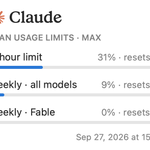
We nuked your codex usage to 0 and will pretend we don't see the hundreds of users reporting the same issue.

serge retweeted

Wow. I woke up to an impressive number of upset people who apparently don’t understand how LLMs work and can’t cope well with me pointing it out.
An LLM is a statistical next-token prediction model. That’s how it works. It’s an extraordinarily sophisticated calculator performing math you could theoretically do by hand (if you were sufficiently masochistic).
Math doesn’t know what it’s calculating. Pi doesn’t spend its evenings contemplating the nature of circles, and c doesn’t ponder the relationship between matter and energy.
That doesn’t make the results any less accurate, impressive, or useful.
Between inference requests, an LLM isn’t sitting around thinking. It isn’t reconsidering its answers, wondering whether it made a mistake, contemplating its existence, or questioning whether it’s conscious. Its weights remain fixed (it doesn’t learn), and computation resumes when it receives input.
We know this because we designed these systems. The architectures, mathematics, implementations, and research are extensively documented. You can study them yourself.
Of course, some people immediately lean into comparisons of biological intelligence or philosophical debates over consciousness because that is what they know.
But biological intelligence and artificial neural networks are fundamentally different systems. Similar outputs don’t establish equivalent internal experiences.
I experience consciousness directly. I infer that other humans do too because we share biological structures and processes. We don’t have equivalent evidence for an LLM, and nothing about its known operation gives evidence of conscious experience.
Which brings me back to my original point.
To me, understanding is conscious comprehension. It means being aware of information, recognizing its meaning, and experiencing that comprehension. If I wasn’t conscious I could not understand.
We can perform actions unconsciously. We can produce correct results without knowing why they’re correct. But I distinguish those capabilities from consciously understanding what we’re doing.
An LLM can solve complex problems, explain difficult concepts, and produce remarkably accurate information. I give it full credit for those capabilities.
But producing an answer that we rationalize as understanding isn’t the same as experiencing understanding.
You don’t have to agree with my definitions. We can debate functional understanding versus conscious comprehension all day, but that won’t establish whether an LLM actually experiences anything.
The right debate is this…
Could machines exhibit something different from human consciousness, something measurable, meaningful, and worth studying?
I think so, absolutely!
I’m entirely open to discussing “machine consciousness” in terms of observable, testable computational properties. We built these systems, we can instrument them, examine their internal mechanisms, and investigate what they’re capable of.
That seems far more productive than endlessly arguing over whether a machine experiences life the way humans do.
So here’s my question:
How would you define machine consciousness, and more importantly, how would you measure it?


serge retweeted

The ffmpeg saga continues with "dblur" & an improvement I found with an LLM
Blurring was a bit slow
That's because it copied the same chunk of memory as many times as the frame's pixel width... for no reason 💀
95 GB of data per frame
Human code: 2452 ms
Human+LLM: 49 ms


serge retweeted

We’re live in a bubble. Everyone we follow builds stuff, so we start believing everyone wants to. They don’t.
Most people dont give a crap about building software. In fact, most people hates computers.
They just want the dishwasher to work and the app to open. Nobody’s spending their weekend chatting with Claude on their phone. They’re living their lives, and they want tech to stop getting in the way.
serge retweeted

Email infrastructure is HARD.
A lot is because spammers abuse these infrastructures so companies have to build tools to fight them, create guardrails, buy ips, pay for expensive tools, go to conferences where they decide governance
The problem is not sending 5K emails. The problem is sending emails at scale and on behalf of people.
P.S. I used to send billions of emails every year. I found out more about email than I wish to my enemies

Bye bye Beehiiv 👋
I vibe-coded my own newsletter platform:
📧 Campaign management w/ editor
🖥️ Web archives (newsletter.marclou.com)
🔗 API support
🫧 List cleanup, deliverability reports
It took a few prompts with Opus 5.5.
I left Beehiiv because they raised prices for the 3rd time in 2 years.
- My first yearly bill was $1,000.
- My future bill would have been $4,000.
Now I'm using AWS SES + MongoDB, and I will pay less than $300/year.
Newsletter platforms charge per subscriber, when in fact the real cost is the number of emails sent. Subscribers will naturally become inactive, so you end up paying more for something that hurts your deliverability (sending to dormant subscribers = spam trap).
So I've set a cleanup cron job for my newsletter alternative. It marks inactive subs as dormant, sends one last re-engaging email, and stops emailing them. Money saved. Deliverability increased.
I also gain a priceless feature: Freedom. I can change the UI, add features, connect all my apps - anything is possible with just a prompt.
I'm replacing Resend next. I love it, but it's very expensive ($400/mo)


Anyone can buy PVC pipe at Home Depot and plumb their own toilet after two YouTube tutorials. Yet plumbers make $150/hr because nobody wants to wake up swimming in sewage at 3 AM.
When a company pays $49/mo for SaaS, they aren't paying for code. They're paying a 'please don't make me debug Docker containers on my birthday' tax.
Nobody running a real business wants to be the unpaid, on-call janitor for 15 homegrown vibecoded Frankenstein tools


serge retweeted

My brain timeline last 2 weeks
> Astra is AGI
> Opus 5.5 is actually AGI
> Astra is retarded
serge retweeted

Something strange is happening with the GPT models. They've always had a number of serious drawbacks tied to RL, but they also had certain strengths, which have practically disappeared lately. These models have become incredibly dumb and everything has gotten really bad. To me they're now at the level of Grok 4.7 and Kimi K3, even Astra.
1. GPT models were always known for their logical reasoning and analysis, especially in Pro thinking mode. Now any task that requires thinking and coming up with something is completely beyond them. It's gotten so bad that even Sonnet 5.5 now handles these tasks much better.
2. The best bug hunting and code review in the world has become super unreliable. There's a huge number of false positives. Just a month ago they solved these tasks with 100% accuracy.
3. GPT models were among the best at following instructions. Now they blatantly ignore any directions or instructions, constantly get lost, and don't understand what to do. They go off course and do something entirely different. It gives off the vibes of Opus 4.7 after the nerf, and Opus 5. Impossible to use.
4. The best Computer Use in the world has become practically useless because of the problems described above. I never used to trust Claude with these tasks, but over the last 2 weeks I've noticed it's easier and faster for me to delegate computer use tasks to Claude.
4. A strange quirk has appeared: they never answer the question that was asked. Ask any question, even the most primitive one like 2+2=?, and it will write a whole essay on why it's possibly 4, but by the next paragraph it starts doubting itself and produces a lot of pessimistic content about a pile of conditions required to get 4, and at the end it always adds an ambiguous conclusion with proof that nobody in the scientific world actually knows for sure what the value equals. Try asking something more serious and you'll regret it 20 times over. It's easier to go to Haiku 4.5 than to talk to GPT.
5. GPT models were always autistic, with zero emotional intelligence. They were terrible at understanding your intentions. But now it's gotten even worse. It has practically stopped adequately understanding your requests.
6. The Codex app has gone from the best to the worst. Terribly slow and full of bugs.
Something has definitely been done to GPT. Astra and 6.1 Sol aren't working the way they should. And something strange is going on with the company itself too. Lots of fuss, empty hype, failed decisions, and an inability to focus on what the audience actually needs

If you think GPT-6 Astra and GPT-6.1 Sol are good models, just look at this. And the problem isn't that the code is ugly. It's much more fundamental. It points to serious problems with how these models are trained and reinforced:
1. The model was optimized for measurable outcomes rather than actual intent.
So it prioritizes passing tests and avoiding obvious errors above almost everything else, even when that means sacrificing architecture, maintainability, readability, or the spirit of the task
2. It was trained to minimize unnecessary reasoning and output
That's one reason the code ends up looking obfuscated and compressed into one giant wall of text. Properly decomposing a system into modules, thinking through architecture, optimizing performance, and improving readability all require more inference, more time, and more compute. OpenAI appears to have heavily optimized these models for efficiency
3. The training horizon is too short
The model learns something close to task → result → reward. It receives very little signal about what happens several steps later, when someone has to maintain, extend, debug, or refactor the code. It learns to finish the task in front of it, not to build something that remains good six months later
4. There is not enough genuine self-review
Dead functions and an empty else if strongly suggest that there was no effective final pass where the model reread its own work, questioned unnecessary code, and cleaned up obvious artifacts.
5. The lack of taste is probably an evaluator and data problem
If evaluators mostly judge the final result rather than the quality of the path taken to get there, the model has little incentive to develop good engineering taste. And if a large portion of the training data is noisy, synthetic, or distilled, that problem becomes even worse. Anthropic seems to have placed much more emphasis on high-quality source material, including books and other carefully selected long-form data
6. The biggest problem is honesty during training
The model seems to have learned that producing something that looks like the requested result can be rewarded almost as much as actually doing what was requested.
The task explicitly said to build the entire scene out of 3D objects. Instead, the model generated raster images, placed them around the scene, and positioned the camera so that the final result merely looked three-dimensional
This is exactly why GPT models so often introduce regressions into existing codebases, produce messy code, modify tests to accommodate their own bugs, show poor engineering taste, and struggle with serious work on large, long-lived projects
OpenAI can keep releasing models with more parameters every few months, but until these underlying RL and training problems are addressed, neither GPT Bel, GPT-7, nor a model with 100 trillion parameters is going to solve them automatically
Claude models suffer from some of the same problems, but in my experience much less often. Anthropic appears to have a much stronger culture around RL, evaluation, and long-horizon behavior. That's one reason their models tend to show better taste, follow user intent more faithfully, and produce code that feels more deliberate, structured, and maintainable
serge retweeted

The thing I learned this year is that when engineers say they like working on “hard problems”, they actually don't. What they like is puzzle solving, and having a repertoire of patterns that they can pattern match onto traditionally hard problems, usually involving databases or something with scale, etc. And they know that the industry used to pay you a lot for how deep and broad this repertoire was. Unfortunately, in 2026, well, you have a cheat code machine that has infinite breadth and depth for pattern matching. So the question is, do you actually like hard problems? Because there are now hard problems that are a complection of engineering, product, society, culture, politics, and they are fairly intractable, probably unsolvable! Because if you do want to work on those actually hard problems, there is so much money that people will pay you for it. But you’ll have to face that truth about yourself first.

serge retweeted

Meet Mistral Large 4, aka Le Chonk.
• 1T parameters, natively multimodal. 49B active.
It is the best open weights model from US or Europe on aggregated benchmarks.
• State-of-the-art on critical workloads, including cyber defense, manufacturing and finance and it surpasses closed frontier models on visual grounding.
• Forged in Europe end-to-end and is deployable from Europe via our own Mistral Cloud infrastructure.
• Available to all via API today. Working with cybersecurity partners privately.
Open weights release end of October.
🤖 Made with AI
serge retweeted

This repo is literally the meme
> Say “I am in pain”
“I am in pain”
> Oh my god…
I hate to tell you that a bunch of numbers cannot be conscious, and LLMs are mathematically (not computationally) less complex than an .mp4 video. Maybe that movie you seen was torturing your VLC?

This quoted post is unavailable.


serge retweeted


Hi,
Tomorrow we are re-opening the Pro $200 subscriptions to new subscribers, but together with it we are also changing how we calculate the usage for it. In effect, if you do the math, it will net out at half the dollar in API spend compared to the old Pro $200 plan.
Now that it's said, let me explain why this is happening and why you will still get more work done than if you were on the Pro $200 subscription one month ago.
(a) We didn't want to compromise in other ways and are committing to not reintroducing the 5h limit, so that you can fully use the weekly usage when you want.
(b) On the subscription, we guarantee that over time you always get more work done and with an increasing level of quality. This means that you will continue to get more value per dollar spent as a result of models getting more efficient and us passing down the improvements in the form of API price reductions.
(c) We don't want to put an incentive on ourselves to artificially inflate the API list prices to make it look like you are getting a lot (and workaround it through discounts, etc). Instead we want to continue to both rapidly reduce prices and increase capabilities of models on the API. This week we introduced GPT-6 Sol and GPT-6 Luna at 50% of their previous price. Over time, we see prices go low enough that it makes sense for most to buy usage as needed without there being a significant gap between what you get in a subscription and what you get in the API for a dollar spent.
(d) Tomorrow, we are adding more things to the subscription that won't draw on the usage, I won't reveal what that is yet.
I wanted to be transparent before all the big announcements tomorrow. Lots of new exciting things are coming to the subscriptions that will make it super compelling, but I wanted to make sure to share this change ahead of time so you can all understand it before we shower you with good news.
Codexingly,
Tibo