Investor. Curious about business models, behavioural economics, social psychology.
UK
Joined May 2019
- Tweets3.7K
- Following308
- Followers596
- Likes7.1K






Sequent retweeted
There was limited/no welfare 1790-1840, so displaced labour had to accept wage bargaining as it was and productivity accrued to capital. These days we have too much welfare, so the feedback loop includes government outlays which will focus minds. This is why AI losers (incl. Youkay) are wanting to pace/regulate AI, you can’t easily tax US companies. A country who has determined to stop manufacturing anything, has no natural resources, is structurally uncompetitive in the physical world, has spent the last 4 decades pivoting to a white collar service led economy, ripe for deflation in the value of that GDP. What’s more, those services needn’t happen in the UK, accounting, law, marketing, consulting, advisory - can all be cross border, so you can’t artificially hold wages up, UK GDP will accrue elsewhere, robbed from under its own nose. Those at the top will behave rationally - you can already see it (Deloitte this week), so I do subscribe to the view that in a world where labour is displaced by AI, very clearly the share accruing to capital will be larger than labour. Welfare will dampen this dynamic, but unlike in 1840, capital is mobile, and as I said above, services don’t have to happen onshore. The UK will be faced with a choice, how structurally uncompetitive it wants to make itself vs how much inequality in can tolerate.

Sequent retweeted
'I have never yet heard of an economy being taxed into prosperity. I have never heard of a poor person spending himself into wealth.'
Economist Arthur Laffer explains why he believes Britain has a 'totally dysfunctional' tax system.
Watch in full | spectator.com/article/livest… | @realartlaffer | @Simmons__


Sequent retweeted
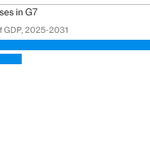
The shocking thing here is that this is the average to 2019. Now do 2021-26 when we know disability benefit claimants lifted off post COVID…


Sequent retweeted

Most depressing chart ever

Part of the issue is a lack of growth. A recent study showed cohorts who experience more GDP growth in their lifetimes are more likely to trust the government and have positive perceptions of their living standards. academic.oup.com/qje/advance… In Britain, such voters are dying out

Sequent retweeted

Milton Friedman: “Keep your eye on one thing and one thing only: how much government is spending, because that’s the true tax.”
“If you’re not paying for it in the form of explicit taxes, you’re paying for it indirectly in the form of inflation or borrowing.”


Sequent retweeted

Let us never forget this fundamental truth: The state has no source of money other than the money people earn themselves. If the state wishes to spend more, it can do so only by borrowing your savings or by taxing you more. And it is no good thinking that someone else will pay—that "someone else" is you.
There is no such thing as public money, there is only taxpayers' money.
Prosperity won't come by inventing more and more lavish public expenditure programs. You don't grow richer by ordering another chequebook from the bank.
No nation ever grew more prosperous by taxing its citizens beyond their capacity to pay.
We have a duty to make sure that every penny piece we raise in taxation is spent wisely and well.
Sequent retweeted

There's a line in a democracy that, once crossed, changes everything: when elections cease to be an obligation and become a variable. That line has now been crossed in Britain, and it's the state's own elections watchdog saying so.
The Electoral Commission has been explicit: Labour's justification for delaying local elections is not legitimate. Not unwise. Not clumsy. Illegitimate. Extending mandates damages public confidence, undermines local legitimacy, and creates a clear conflict of interest by letting councils decide how long they can avoid voters. In any functioning democracy, that would end the matter. Here, the government presses on regardless.
That's the scandal. This is no longer a party political dispute or a row between Reform and Labour. The referee has intervened and said the game is being rigged, and the players have decided to ignore the whistle. When a government continues with election delays after being told by the independent authority charged with protecting electoral integrity that its reasoning does not hold, the issue stops being reform and becomes power protecting itself.
The language Labour uses is revealing. Elections are framed as an inconvenience. Voters are framed as an administrative burden. Democracy is reduced to a cost-saving exercise, something to be postponed if the spreadsheets look untidy or the reorganisation plans are mid-flow. Ministers speak of "capacity constraints" as if the right to vote is a luxury item that must wait until the filing cabinets are rearranged. In a democracy, administration exists to serve elections. Elections do not exist to suit administration.
The conflict of interest identified by the Electoral Commission should alarm anyone who still believes in democratic norms. Councils are being asked whether they would like to delay the moment they must answer to voters. That's not consultation. It's self-dealing. No serious system allows those in power to decide how long they may remain there without consent. Yet this is now presented as a "locally led approach," as though outsourcing democratic suspension makes it virtuous.
Worse still is the uncertainty. Candidates have been selected. Campaigns have begun. Money has been spent. And with months to go before polling day, the government is still dangling the possibility of cancellation. The watchdog describes this uncertainty as unprecedented. That word matters. Democracies rely on predictability. Once elections become provisional, subject to last-minute ministerial approval, the entire process is degraded.
When challenged, ministers retreat into condescension. Chris Bryant waves away concerns as conspiracy and insists that "ordinary people" would think elections are "a bit daft." This is a familiar trick: speak for the public while denying them a voice. Redefine democratic rights as common-sense nuisances that sensible adults should stop fussing over. It's the rhetoric of managed democracy, where participation is tolerated only when it produces the correct outcome.
None of this is happening in isolation. Mayoral elections have already been postponed. Now council elections are being pushed back again. The pattern is clear. When the polls turn hostile, the timetable moves. When voters become unpredictable, the vote is delayed. Governments confident in their mandate do not need to buy time. They face the electorate and take their chances. Labour is not doing that because it knows what the numbers say.
The danger is not just that millions of people may be denied a vote next year. It's the precedent now being set. Once a government learns it can delay elections after the watchdog objects, after campaigns have begun and candidates are in place, the principle is broken. Elections become conditional. Democracy becomes something you are granted when those in power feel safe enough to allow it.
"Chris Bryant waves away concerns as conspiracy and insists that "ordinary people" would think elections are "a bit daft.""

Sequent retweeted
All I want for Christmas is our esteemed leaders to listen to Milton @ZackPolanski @Keir_Starmer @RachelReevesMP


Sequent retweeted

This is a banger of a chart. And they wonder why people to the right of it are moving to Dubai. 🤷


Sequent retweeted

It’s absolutely true that median earners (and below) pay less tax in the UK than most of the rest of the world. Lots of data here: taxpolicy.org.uk/2025/06/27/…