

Always a 0% pool. Cybersecurity professionals with passion for crypto operate high secure Cardano Stake Pools (SECUR)
Amsterdam Area, Netherlands
Joined August 2020
- Tweets2.1K
- Following373
- Followers532
- Likes6.6K



René (SECUR) SecureStaking.io retweeted

In Fund13, the Cardano Foundation had a decisive and massive voting power of 200 million ADA. The good news is that in Fund14, with just 5,000 ADA you can achieve an equivalent level of voting power 👀
The cube root of 200 million ADA is 585. Since the minimum participation amount in Fund14 is 25 ADA, you can prepare 200 wallets with a 25 ADA balance each.
25^(1/3) * 200 = 585, which equals the voting power of a single wallet holding 200 million ADA.



René (SECUR) SecureStaking.io retweeted

⚠️Largest NPM supply chain attack ever!
Crypto developers, if you published some software during the last few hours, check it has not be compromised.
Crypto users, if you don't use an hardware wallet, maybe wait a few hours before transacting.

🚨 There’s a large-scale supply chain attack in progress: the NPM account of a reputable developer has been compromised. The affected packages have already been downloaded over 1 billion times, meaning the entire JavaScript ecosystem may be at risk.
The malicious payload works by silently swapping crypto addresses on the fly to steal funds.
If you use a hardware wallet, pay attention to every transaction before signing and you're safe.
If you don’t use a hardware wallet, refrain from making any on-chain transactions for now.
It’s still unclear whether the attacker is also stealing seeds from software wallets directly at this stage.
Excellent report here: jdstaerk.substack.com/p/we-j…
René (SECUR) SecureStaking.io retweeted

#Cardano fam, wasn’t planning on sharing my opinion about the cost of @CardanoSummit tickets but as a DRep that represents the regular retail segment of our community I believe it’s important, especially as 6 Million $ADA was approved to fund the event from our ecosystem treasury.
Living in the US I researched flights, and other costs and calculated what I would need to spend on the conservative side to attend.
This is what I found:
$500 - Hotel, 3 nights
$1200 - Flight, economy class
$350 - Summit Ticket
$500 - Food/other expenses
$150 - Ground transportation
Total: $2700
IMHO, this is a prohibitive cost for most regular community members. Even the most passionate.
So who then is the Summit for??
Only folks that live in Europe, Large Entity employees, founders of well capitalized projects and our wealthy members?
That doesn’t seem like what the intent and spirit of what the Summit is meant to be.
I am deeply troubled by this.
There are many, many great people at @Cardano_CF. I hope they reconsider.
@CryptoIRELAND1 @IOHK_Charles
René (SECUR) SecureStaking.io retweeted
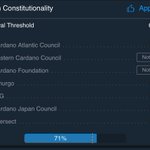
Our Cardano Product Vision & Strategy drafts are published! These documents are a direct output from the workshops we've been running this year with the community. Your feedback is crucial as we shape the future, so dive in and share your thoughts: product.cardano.intersectmbo…


René (SECUR) SecureStaking.io retweeted
#Cardano fam,
Delegate to a DRep like myself who is outside of the top 30, unaffiliated and whose only priority is the long term
Success of our ecosystem, builders and regular $ADA holders. Fiscal responsibility….
My dRep ID:
$drep.chris.o
drep14pjm8ytt682wkp4jcegdj2yerkcy9a20xevvp7udlcd0ggjxdud
@cardano_whale @CryptoIRELAND1 @rickmccracken
René (SECUR) SecureStaking.io retweeted

Let's run a little thought experiment:
Imagine someone managed to compromise the USDC admin key and mint, say, ~$3B.
That USDC would be immediately sold for uncensorable assets (BTC, ETH, DAI, etc). Circle would, as soon as they can, pause() USDC while they decide their next step.
As far as I see it, they would have two options:
-take the hit, scramble to raise $3B
-propose a hard fork
Being USDC, and having $60B on EVM chains, they have special leverage in this situation.
If they choose to hard fork, whatever chain they back as canonical is the one that will be able to redeem the $60B in collateral.
This means that almost all protocols that rely on USDC maintaining its USD price—which are almost all—will, in turn, have two options:
-support the hard fork
-take the hit
For example:
-Maker would have at least $3.7B in bad debt
-Arbitrum would have $3.8B in worthless USDC
-Hyperliquid would wipe all of its $2.5B in deposits
-AAVE would have ~$1.05B in bad debt
In this scenario, it's incredibly hard to imagine all the users and DeFi projects choosing to essentially nuke their products and funds in order to maintain “Ethereum neutrality,” and they would instead fight tooth and nail for this hard fork to reach consensus, and of course choose themselves the Circle-chain as the canonical Ethereum.
Now, replace the “USDC admin compromise” with “US government mandate over Circle and Tether,” and tell me how Ethereum is credibly neutral.
There’s precedent for centralized stablecoin issuers effectively choosing “valid” consensus.
Circle publicly declared support for Proof-of-Stake during the 2022 Merge, stating that “USDC as an Ethereum asset can only exist as a single valid version.”
One has to wonder: would the Merge have happened on the same timeline if neither Circle nor Tether had agreed to migrate their stablecoin backing to the PoS chain?
To be fair, a similar type of attack is possible through Ethereum’s staking and governance infrastructure, but it is much more complex to orchestrate.
In contrast, Circle and Tether are always within the regulator’s reach, making their reach on Ethereum consensus far more direct and immediate.

Ethereum is de facto controlled by Tether and Circle, and by extension by the US gov.
By only allowing redemptions on their consensus of choice, they control it. Ethereum has been allowed to choose its own consensus thus far only because it didn't displeased the US gov, Tether or Circle.
Do you really think the "credibly neutral" version will do well? the one where all of "DeFi" goes to $0 and ETH is no longer accepted on exchanges?
Ameen has been on about it for years, and while it sounded like a conspiracy theory then, the sheer size and integration of these fiat-coins have made it a reality.


René (SECUR) SecureStaking.io retweeted

The US should've never glorified AI without caution.
What set American workers apart was their ability to deliver quality over quantity.
Now, by automating creativity and precision, AI is dulling that very edge.
We’ve sacrificed our competitive advantage for short-term gains.
René (SECUR) SecureStaking.io retweeted

If I'm a great hacker, does that make it moral to exploit a vulnerable system?
If I'm CF, is it moral to vote with 180M $ADA, disrupting decentralized voting due to low participation?
Power demands responsibility.
(unless the argument is: the protocol allows it)
René (SECUR) SecureStaking.io retweeted

CF Whistleblower
I'll just post it so everyone in Cardano can read the email:
Hi Pey,
I'm writing to you as I know you've been unafraid to challenge people and organizations in Cardano for a long time. After the recent issues with the CF on Catalyst and the Constitution, I can't keep quiet anymore, especially after reading posts like this which so is far from the truth. I want to constructively whistleblow, but due to my personal and professional connections I, unlike you, am too afraid put my head above the parapet. I've sent the below to a couple of other no-BS community heads too, incase you feel compromised or uncomfortable. I respect too, if you disagree with some or all of my report below, but it's my truth and want to share it now before it's too late.
I admire your ability to question and confront, and if, at the very least, someone else hears it that will be enough.
Yours, D
--
This is an anonymous memo to the community to shine a light on internal politics and provide an insider’s perspective on the Cardano ecosystem. I’ve been here since the ITN days and initially ran a stake pool (though I’m now retired). Over the years, I’ve worked directly and indirectly with each of the three founding entities on various projects. More importantly, I spent a considerable amount of time inside the Cardano Foundation (CF) itself, where I gained personal connections with senior figures and recently developed ties with some at Intersect. I’ve been around Intersect’s working groups and committees since the end of last year, carefully observing. Across these interactions, I’ve seen how foundational organizations operate from within—how certain “key players” flex their egos, engage in internal tug-of-war, and lose sight of what truly matters. While serious issues persist among multiple entities, none are as alarming as those I’ve witnessed inside the CF’s corridors.
Today, I step forward—anonymously—as a whistleblower, offering suggestions for a different path forward. The perspective below comes from firsthand observations within the CF, direct conversations with its leadership and staff, and reports from those present in critical decision-making sessions. With on-chain governance on the horizon, it’s time to confront the CF’s role and poor management head-on, however slim the chance that doing so might spark change. My allegiance is to Cardano itself, as both a long-time community member and ADA holder. I know first-hand how a strong Foundation could truly benefit the ecosystem—if only it chose to.
From my vantage point within the Foundation, it’s painfully clear that the CF’s recent burst of activity is part of a larger strategic play—an attempt to undermine Charles, IOG, Intersect, and the broader governance roadmap. Don’t mistake their carefully crafted “we care” narrative—or the honest efforts of their “in-the-trenches” staff (many of whom are genuinely good people, stuck in a flawed structure)—for anything other than a bid by the top brass to force their own relevance and control. The CF leadership is failing. Deflated egos at the senior level are poisoning the strategy, and if their plan succeeds, it will steer Cardano into a slow decline.
It isn’t breaking news that there’s no love lost between the CF and IOG. I recall how, back in September, IOG severed internal communications with the CF after the Foundation tried to poach key engineers and undercut IOG’s capabilities. I also know that IOG refused to sponsor the Cardano Summit partly because CF insisted on Dubai for a second consecutive year (ignoring Argentina) and partly because the CF demanded large sums from IOG, despite sitting on hundreds of millions of ADA. From what I’ve seen firsthand, the real issue lies in the CF’s overall incompetence and their sense of entitlement—believing that they, not IOG, should set Cardano’s course, despite offering no real vision or ambition. Frankly, I’ve never seen them display the competence or work ethic needed to lead this ecosystem.
Before I detail more of the CF’s failings, I must acknowledge IOG’s, Emurgo’s, and Intersect’s shortcomings. In my view, while these issues are real, they remain relatively manageable and do not actively undermine Cardano’s long-term interests in the way the CF’s machinations do.
IOG
IOG, Charles, and much of that team are largely responsible for Cardano’s technology and growth. Without their initial push, Cardano wouldn’t have reached this point. They’ve moved the needle, while Emurgo and the CF often felt like late-game substitutes who fail to influence the outcome.
This was partly expected: the genesis ADA allocation (2.4 billion ADA) mandated IOG’s obligations. They’ve broadly met these obligations with intent and rigor, though slowly and at great cost. Charles frequently states he funded Cardano, noting the genesis allocation is gone/used at low-dollar values in the early days. Now, it’s time for transparency: where are the IOG wallets, and how was the allocation truly spent? Emphasis on show, not tell.
Charles can be a difficult CEO. He’s a strong communicator but struggles with people management and has made questionable investment decisions. Still, these are common leadership flaws. Despite them, his vision and ambition push IOG and Cardano forward, not backward.
Emurgo
Emurgo, meanwhile, has historically neglected its duties. They poured resources into ventures that yielded net-negative returns or clashed with Cardano’s interests. Some insiders described hearing Emurgo team members refer to Cardano as just “one of the chains we look at,” conveniently forgetting the 2.1 billion ADA they received at genesis and their ongoing responsibilities.
That said, in the last two years, Emurgo has improved, co-funding Intersect and supporting events. They remain present, though slow, and sometimes appear dismissive of the community—likely due to poor communication rather than outright disdain. A solid hire this year helped, but now that person is leaving, and I fear Emurgo may slip back into old habits.
Despite some governance involvement, Emurgo is largely absent from on-chain decision-making. Their position on the ICC is token at best. They must either invest resources or step aside. Emurgo owes everything to Cardano, and it’s time they remember that.
Intersect
Intersect is starting to resemble the very institutions many of us dislike. Bureaucracy is creeping in, and self-proclaimed experts or opportunists—familiar faces who emerge whenever they smell opportunity—are sitting on committees and working groups. As a member-based organization, Intersect must listen and act on its members’ wishes more diligently. Still, many honest community members there are doing substantial, positive work, and the organization overall has delivered real value—certainly more than I ever saw the CF deliver from the inside.
To be fair, Intersect has only existed for a year and has accomplished more in that time than the CF has in five. So I’ll restrain my criticism for now. I’ve spoken with several individuals at Intersect who clearly aren’t afraid of hard work, and a few core team members genuinely mean well. As it’s early days, I believe Intersect can fix its issues quickly. The budget is one area needing immediate attention. After watching budget committee calls and hearing community input, I suggest Intersect use smart contracts wherever possible, have DReps approve funding by category instead of one lump sum, and request smaller funding amounts.
If we’re honest, Intersect wouldn’t be necessary if we had a stronger, more effective Foundation leading the charge. The fact that Intersect stepped in to fill gaps speaks volumes about what the CF has failed to do.
Now, the CF
Compared to the CF’s dysfunction, IOG’s, Emurgo’s, and Intersect’s flaws seem minor. The CF claims its mission is to scale the diversity, quality, and quantity of on-chain activities, yet I saw little tangible evidence of this when I was inside. Their recent impact report doesn’t cut it—it claims credit for others’ work and shows they’re hoarding genesis ADA for a perpetual payroll, not for Cardano’s growth.
Below, I focus on governance involvement (or the lack of it), because that’s where the CF’s personal vendetta is most glaring. The Foundation was dragged into the governance roadmap only because its absence was more deafening than its half-hearted involvement.
CIP-1694
CIP-1694, published in November 2022, was primarily authored by IOG contributors. Matthias Benkort from the CF is listed, but I know firsthand that Matthias’ role was mostly commentary after the real work was done. This became crystal clear when Matthias tweeted on August 11th—months after CIP-1694’s publication—displaying limited understanding. Had the CF truly embraced CIP-1694, this wouldn’t have happened.
To be fair, Matthias is a good actor who has done significant work for Cardano infrastructure and on Aiken. The CF, however, barely cared until governance momentum made ignoring it untenable. From inside the CF, I saw minimal interest in truly shaping governance—only in not being left behind.
MBO
After CIP-1694’s publication, the concept of a member-based organization (MBO) emerged, later becoming Intersect. Emurgo and IOG supported its creation; the CF hesitated. I remember the Foundation’s indecision and lack of expertise. They frequently deferred and deflected, uncertain how decentralized governance would affect their control.
IOG and Emurgo seed-funded Intersect; the CF refused. Inside the Foundation, I’ve overheard leadership blaming everything from regulations to Intersect’s US entity status. Yet, their Board Chair is a US citizen, and eventually, they joined Intersect as an Enterprise member once they realized they had no alternative. The problem wasn’t the MBO itself; it was that IOG and Charles spearheaded it, making the CF reluctant to support it for fear of losing influence.
The Constitution
The governance roadmap highlighted the CF’s tepid involvement. They allowed employees to participate only in a personal capacity, never officially backing their contributions. Within the Foundation, there’s a palpable fear of endorsing anything not firmly under their control.
The turning point came on November 21st, 2024, when the CF released its “updated proposal for the Cardano Constitution” a day after Intersect unveiled its latest version. The CF’s proposal cribbed from the publicly available July 29th Intersect draft, timing their release for maximum disruption rather than genuine input. They had four months to engage and chose only a last-minute intervention for optics.
As someone who saw this dynamic play out internally, it was no surprise. Nicolas Cerny (CF Governance Lead) had been part of the Intersect drafting team for months. Instead of building on his work from within, the CF undermined him at the finish line. Nicolas even signed the approved delegate constitution in Buenos Aires, yet the CF never publicized that fact.
On November 29th, a CF blog confirmed their move aimed to challenge, not improve, the community version—another shot at IOG, Intersect, and even their own dedicated staff. While Intersect’s process wasn’t perfect, it achieved far more in a short time than the CF’s leadership ever did from within.
The CF contributed zero funding to the constitution drafting or the Convention, hosting only one meager workshop. IOG, via Intersect, funded everything. It was classic CF: waiting until the train moved, then trying to claim partial credit or more likely derail it.
Registering as a DRep and Catalyst
Similarly, on November 20th (just before their constitution proposal), the CF registered as a DRep. They announced on December 4th that they would “initially abstain” from delegating ADA. This language signaled future intent. Shortly afterward, the CF wielded 180 million ADA to dominate Fund13 Catalyst outcomes. Given past voting trends, 180 million ADA effectively decides the winners in each category, confirming that the CF is willing to exert control. Don't believe the "it's on us" and that's "it's the community who are at fault" narrative.
From inside the CF, I know their intention is clear:
Establishing a precedent to use huge ADA blocks against governance outcomes that go against their self-interest, like the constitution or budgets. “Initially abstain” is a hollow promise.
Stirring community discontent and forcing changes within Catalyst, which IOG largely supports.
Don’t let their excuses fool you. The CF leadership knows exactly what it’s doing—playing power games under the guise of community welfare. It's my belief that a genuinely community-aligned Foundation might have used a fraction of that ADA to support deserving projects without skewing the entire vote - using their platform as the primary driver for influence. They might have facilitated region-specific, multi-sig DReps so that underrepresented areas could have a meaningful say. Instead, they chose dominance and centralization.
Conclusion for Now
The leadership at the CF needs a complete overhaul. From what I saw, they use the community’s ADA to serve their own egos. They long to see IOG and Charles diminished so they can “lead” Cardano—despite lacking any real capacity to do so.
A successful Foundation would invest in business development talent, deliver meaningful enterprise growth (rather than token partnerships like the Georgian wine integration), and engage in on-chain governance with integrity. Instead, they promote infighting and spin narratives that mislead at least some in the community.
I challenge the CF leadership directly:
Will you delegate the 180m ADA used in Fund13 (or any of your genesis ADA) to your DRep in the next 6 months?
Are you voting yes, no, or abstain on the constitution approved in Buenos Aires? Just tell us the truth.
To the CF employees lower down who genuinely care and work hard: your efforts deserve better leadership. You don’t have to tolerate this. I call for change and for the Foundation to remember who they truly serve. Cardano can achieve far more with an effective CF—let’s make that happen.
Some of it seems fair, what do you think Cardano?

René (SECUR) SecureStaking.io retweeted

While it's great that the Treasury lost the case against their sanctioning of the Tornado Cash smart contract, the Devs are still in jail.
Alexey Pertsev is serving a 5 year sentence and Roman Storm is standing trial - all for writing code.
Let's not forget that.
René (SECUR) SecureStaking.io retweeted

Who appointed Intersect as the administrator of anything related to the treasury? Who created, appointed and manages the CDF? What is there corporate governance set up of either of these entities? Who is the “community” and what is “betterment”? Definitions plz

René (SECUR) SecureStaking.io retweeted

there, I said it
stay tuned for the November Sessions - a truly open community forum to discuss the most important document to future of our ecosystem

René (SECUR) SecureStaking.io retweeted

Cardano Community needs to pay attention. We urge all Dreps to vote NO for this budget. Spending 300-500m ADA in 2025 is irresponsible, at this rate Treasury will run out in 2030!
If DReps vote yes for this, they will pretty much have nothing to vote on until 2016 budget!
tempo.vote/treasury


1/ 📒 2025 Budget Overview
🔹 Estimated budget: 300m - 500m $ADA
🔹 Each committee has a dedicated budget, overseen by the Budget Committee for efficient and impactful fund use.
René (SECUR) SecureStaking.io retweeted
absolutely not
Intersect does not get to use community taxed Ada to gain Instant leverage over the ecosystem
4/ 🔗 Leveraging Funds in Voting
🔹 $ADA from budget may be used in voting processes
🔹Decisions ultimately rest with Intersect members, keeping power in the hands of the community