




seantoh retweeted

Enovix to Double Korea Drone Battery Capacity
Read the press release 👉🏼 ow.ly/y2mc50ZC3nM
seantoh retweeted

The battery inside your next AI smartphone may end up being just as important as the AI chip itself.
The company is $ENVX.
Enovix isn’t trying to build another lithium-ion battery. It’s attempting to solve one of the biggest physical constraints facing edge AI: how do you fit significantly more energy into the same device without making it thicker, heavier, or unsafe? If the company succeeds, it won’t just participate in the mobile AI cycle—it could become one of the critical enabling technologies behind it.
The Silicon Bottleneck:
The next generation of AI smartphones and smart glasses will consume far more power than today’s devices. Running LLMs locally, powering always-on AI assistants, and supporting increasingly complex on-device inference all require dramatically higher energy density, yet consumers still expect devices to become thinner rather than thicker.
Traditional graphite anodes are approaching their practical limits.
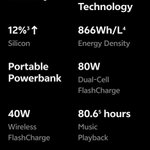
Enovix replaces graphite with a high-silicon anode built around its proprietary 3D cell architecture and BrakeFlow safety system, allowing substantially higher energy density while addressing the expansion problems that have historically prevented silicon from being commercialised at scale.
The moat isn’t simply the silicon chemistry. Numerous companies have experimented with silicon anodes for years. The difficult part has always been controlling silicon expansion over hundreds of charge cycles while manufacturing the cells consistently at commercial scale. That is where Enovix believes its 3D constraint architecture, patent portfolio, and manufacturing process create the real competitive advantage.
If mobile AI requires batteries that are 20-45% more energy-dense while remaining thin enough to accommodate increasingly powerful AI chips and cooling systems, then the bottleneck shifts away from battery assembly and toward the enabling cell architecture itself. That’s the layer Enovix is trying to own.
The 0.7C Story:
The market largely interpreted the removal of the 0.7C qualification test as a delay.
I think it represented something much more important.
Honor and a second Tier-1 OEM abandoned the 0.7C requirement and moved Enovix into the standard 0.2C qualification framework used for commercial smartphone batteries. That wasn’t simply a procedural change—it removed what had become the largest qualification barrier preventing Enovix from entering the smartphone market.
Major OEMs do not rewrite qualification pathways for technologies they believe have no future. If anything, it suggests the discussion has shifted from proving whether the battery works to validating it for volume production.
That distinction is easy to miss, but it fundamentally changes where Enovix sits in the commercialisation process.
From Technology To Manufacturing:
For years, investors questioned whether Enovix could manufacture these batteries economically at scale.
That question is becoming increasingly difficult to argue.
Fab2 in Malaysia has already been built, yields have exceeded 90% across most production zones, commercial production for AI smart eyewear has begun, and the company has already shipped EX-2M samples into the smartphone ecosystem. The debate is becoming less about whether the technology works and more about how quickly production ramps.
Conclusion:
What makes Enovix interesting is not simply that it has developed a better battery.
The larger thesis is that edge AI may require a step-change in battery technology just as much as it requires better processors. AI models will continue becoming more capable, but unless battery technology improves alongside them, much of that capability cannot be delivered inside thin, consumer devices.
If that proves true, companies enabling the next generation of battery architecture become infrastructure providers for the mobile AI ecosystem rather than just component suppliers.
Enovix is attempting to build exactly that position.
NFA. Do your own DD

Predictions
Spurs in 7, why?
To me, Spurs is actually the underdog. However, I think they believe so strongly that team basketball, oh I must stress, the Spurs team basketball.
So, Spurs in 7.
$gospursgo


Wemby and the San Antonio Spurs really believe they will win the title this year.
To come out in GAME 1, taking punches and delivering them, they won.
They still don't have an answer for CHAOS (Mr. Carusso) today.
SPURS in 6.
#NBAFinals


seantoh retweeted

This 2-hour Stanford lecture breaks down how models like ChatGPT and Claude are actually built, clearer than what many people in top AI roles ever get exposed to.
Save this and set aside two hours today. It might end up being the most valuable thing you learn all week.
Most important piece of clue for what is to come for battery manufacturers worldwide.
if you are not in silicon you are gone (or sunset)
$enovix
group14.technology/resources…

Advisor in the Material Qualification and Adoption Committee.
Another strategic move. #execution

$ENVX Nice to hear from James Wilcox again. He has secured a position as strategic advisor 'Material Qualification & Adoption' at Volta Foundation.
(Volta Foundation is the world's largest network of battery professionals. As a global not-for-profit association of more than 50,000+ battery professionals and 160+ member companies, Volta produces publications, networking opportunities, and industry resources to foster collaboration, innovation and advocacy within the battery industry.)


$envx
Sure hope @EnovixBatteries is already listed as a battery supplier or potential supplier for this tech.
Perhaps working within the military supply chain ecosystem.
Dr. TJ Rodgers was sharing about how Enovix AI-1 batteries can lift up cars. so why not power this #militarytech

seantoh retweeted
Great conversations last week around the future of advanced technology at the 2026 Cantor Global Tech & Industrial Growth Conference in NYC.
Proud of our CFO Ryan Benton for representing the team and sharing how our 100% active silicon batteries will power next-gen devices.


seantoh retweeted
$ENVX 🇮🇳 Enovix India expands its presence at Kapil Kavuri Hub, Financial District, Hyderabad


seantoh retweeted

$envx /1
RT’s notable, condensed comments in Q&A session:
[William Blair: in your engagements with Honor, how receptive were they when you suggested the change? Given that cycle life and energy density are always paired trade-offs, would Honor take a formulation that hits that 0.7 rate cycle life spec with a slightly lower energy density?] ..most of the use cases in smartphones are under 0.2 C discharge, which basically means we have a battery that we believe under 0.2 C goes over 1,000 cycles. We essentially feel we have a battery that meets the requirements of the smartphone market
if you run at 0.2 C it takes a long time. So customers typically use higher rate of discharge, like 0.7 C, to cut the amount of time it takes to test. When you change technology from graphite to silicon, silicon anode batteries behave differently when you discharge them very fast in this 0.7 C
Honor and our other smartphone customers, we’ve talked to them, they understand that. They realize that this test is a proxy and an accelerated test and not a true test. We are in discussions with them
3 pathways forward:
1 is we are able to convince them that this is not a real-life test, and the real-life test is really 0.2 C and we can get away with a less cycle life for 0.7 C, for example
2 is we have to find, together with them, another accelerated test that is more representative for silicon anodes. We have some ideas on what that is and we are discussing with them on that
3 is we’ll have to modify our electrochemistry just to pass this test at 0.7 C
we are working on all 3 of those. Ultimately, there is a lot of interest from our customers in wanting to use our batteries because of the higher energy density we provide, and the roadmap to even higher energy densities because of 100% silicon anode, and those conversations are going well
Ultimately we need to solve this passing of this test to where they and us both are comfortable that in the real-life use case, when the battery is put in the phone, it’s gonna do really well and everyone’s happy with the performance
[William Blair: You did mention an initial production demand in your, in the release statement, should we think about that as a purchase order or is that a next step? Can you frame what the revenue opportunity might be for 2026, or is this a 2027 story?] Yes, you absolutely should think of the question you asked as a purchase order, and we are manufacturing them now to our lead customer. We are very excited by that. The whole team, I was in Penang last week, is focused on executing that and building those products and sending it out. Initial volumes will be lower just because they’re just starting. But 2027, 2028, we expect the market to really grow and be meaningful for us
[Canaccord: you pointed to a little bit of an issue with the electrode dicing in the manufacturing process, getting yields up there. How much have you been talking with your customers around fixing that issue maybe together, in anticipation of ramping production towards the end of this year?] ..yields on almost all steps are above 80%. On the dicing side they’re close to 80% but not quite there in 4Q. This quarter to date we’re at 80%. We feel confident that, as we make progress, it’ll sort itself out
We’re now focused on 2 batteries, one on Agility, one on HV line. We’ll continue to work to get it better
our customers have visited our factories. They have seen it, we’ve got through multiple customer audits. we have enough supply to meet all the requirements for 2026. We’re looking at various options to increase the throughput and get even more cost-effective than laser dicing methods to actually get the volumes up. A lot of focus on that. We are working with our customers on that
This is super good news.
1. 2026 is our Pivotal Year
2. 3 super experience individuals with track record of manufacturing batteries at scale. (You realize that for a phone company to issue a PO, they must already be asking if you guys are ready for mass production?), now we have 3 experience guys that have done this for decades.
3. Am I the only one hearing this, manufacturing at scale guys, PO is around the corner no doubt.
4. Buying opportunity again ❤️
$envx

Enovix Announces Leadership Transition to Support Manufacturing Scale-Up
Read the press release 👉🏼 ow.ly/pJL050Y0bjK


