

Room to explore. Space to get it wrong. Time to understand. Free interactive science practice for IGCSE and A-level, with exam tips. Made by a Head of Science.
Joined October 2026
- Tweets123
- Following105
- Followers3
- Likes280





Well done. You made it.
The November IGCSE science papers are complete. Be proud of every hour you put in.
Thank you to the teachers who guided them here.
Rest well. When you're ready, scholarlab.education will be here.
#IGCSE #WellDone

3
Electrical, to chemical, to electrical.
How a nerve impulse travels along an axon, and how it crosses the synapse to the next neurone.
scholarlab.education
#Biology #IGCSE #ALevelBiology
6
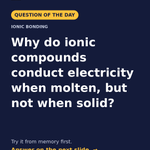
Question of the day: Why do ionic compounds conduct electricity when molten, but not when solid?
Try it from memory, then swipe for the answer.
Exam tip: The solid already has ions. Say fixed in the solid, mobile when molten, not free electrons.
scholarlab.education


7
Question of the day: Why do ionic compounds conduct electricity when molten, but not when solid?
Try it from memory, then swipe for the answer.
Exam tip: The solid already has ions. Say fixed in the solid, mobile when molten, not free electrons.
scholarlab.education


6
How does a vaccine protect you without the disease?
Phagocytes, B lymphocytes, antibodies and memory cells, shown in one short clip.
scholarlab.education
#Biology #IGCSE #ALevelBiology
7
Light energy in, chemical energy out.
Inside the chloroplast: the light-dependent reactions on the thylakoids and the Calvin cycle in the stroma.
scholarlab.education
#Biology #IGCSE #ALevelBiology
11
Question of the day: How do guard cells open a stoma?
Try it from memory, then swipe for the answer.
Exam tip: Use the key words: osmosis, turgid, and the pore opens. Vague words like "swell up" lose marks.
scholarlab.education


12
One helix in, two out. Each half old, half new.
See helicase, DNA polymerase and ligase at work, and why replication is semi-conservative.
scholarlab.education
#Biology #IGCSE #ALevelBiology
9
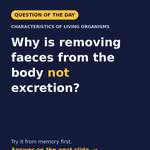
Question of the day: Why is removing faeces from the body not excretion?
Try it from memory, then swipe for the answer.
Exam tip: Excretion means waste made by metabolism. Faeces leaving the body is egestion. Keep the two words apart.
scholarlab.education


5
Planning question in the exam? Use CORMMSS to hit every mark: what you Change, the Organisms, Repeats, two Measurements, and what you keep the Same.
Exam tip: give real values, like "5 concentrations including none", not "different amounts".
scholarlab.education

6
Question of the day: Why is the left ventricle wall thickest?
Try it from memory, then swipe for the answer.
Exam tip: Link structure to function: thicker muscle, so higher pressure, so blood reaches the whole body.
scholarlab.education


1
5

Question of the day: Why does adding CO₂ make no difference to a plant in dim light?
Try it from memory, then swipe for the answer.
Exam tip: Name the limiting factor. If adding more CO2 changes nothing, something else is in short supply.
scholarlab.education


9
DNA, to mRNA, to protein, in under 35 seconds.
Follow transcription in the nucleus and translation at the ribosome, codon by codon.
scholarlab.education
#Biology #IGCSE #ALevelBiology
Question of the day: Why does a sprinter breathe hard after the race?
Try it from memory, then swipe for the answer.
Exam tip: For any "explain" question, write it as a chain: one step leads to the next. Each link is usually a mark.
scholarlab.education


12
Knowing the content and getting the marks are not the same thing.
ScholarLab has 3,000+ free exam-style IGCSE Biology questions, every one with a mark scheme.
Exam tip: count the marks. A 3-mark question wants three separate points.
scholarlab.education
#Biology #ExamPrep

11
Question of the day: How does a vaccine give immunity?
Try it from memory, then swipe for the answer.
Exam tip: Name the memory cells. "The body remembers the disease" will not get the mark.
scholarlab.education


14
Exams first. Then, what comes next?
ScholarLab's free Careers Explorer links what you enjoy to careers, A-level choices and university courses. No account needed.
Exam tip: revise the subject you need, not just the one you like.
scholarlab.education/careers

10

Why are you not identical to your siblings? Meiosis.
This clip shows crossing over, random orientation and the two divisions that produce four haploid cells.
scholarlab.education
#Biology #IGCSE #ALevelBiology
13