
PhD candidate @LTIatCMU | collaborative AI agents | Previous: Intern @MSFTResearch @autodesk, student @iiit_hyderabad, intern @ChandarLab @Mila_Quebec | he/him
Joined September 2013
- Tweets188
- Following604
- Followers619
- Likes1.1K




Pinned Tweet
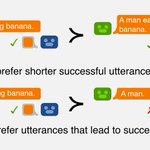
People adapt their language to communicate more efficiently over time. How can we make models do this? In our recent work, we trained models in self-play, and found that using the right incentives can make models adapt to communicate efficiently even without human demonstrations.

Saujas Vaduguru retweeted

Schelling Atlas: AI agents know where to find each other on the web 📣
I've always wondered what instinctive (system-1) behaviours LLMs have, *knowing* that they have?
We study coordination (a la schelling points) on the internet purely from models' internal priors.
Deets 👇


Saujas Vaduguru retweeted

Same Accuracy, but up to 5.8x fewer visual tokens!
Introducing Visual Token Routing (VTR), a new method for faster and more cost-efficient VLM agents.
VTR jointly trains a lightweight router that drops visual tokens that are temporally redundant or that the agent doesn’t need to act on!
🌐 : pranjal2041.github.io/vtr
🧵
Saujas Vaduguru retweeted

Honestly, the human trajectories are just endearing.
The "I'm lost", "aha", and the final "hooray!"... is a uniquely human experience. I think these experiences are important, especially now.
head over to arc3-human-think-aloud.githu… to watch some trajectories 🥳
Saujas Vaduguru retweeted

We're hiring PhD research interns to join the MSR AI Interaction and Learning team for Summer 2027. We advance the science of large-scale AI systems through research on behavior, collaboration, evaluation, learning, and adaptation.
Learn more and apply: apply.careers.microsoft.com/…

Saujas Vaduguru retweeted

Excited to be in the fourth batch of @LaudeInstitute slingshots, among some excellent projects.
We're also perhaps the first from Europe :)

Saujas Vaduguru retweeted

User simulators are only as faithful as the user representations they are conditioned on.
Missing details force simulators to fill gaps with assumptions, leading to generic behavior⚠️
Introducing UserRepGen-4B, which generates representations optimized for simulation fidelity.

Saujas Vaduguru retweeted

WildChat, LMSYS, ShareChat… each human-LLM chat dataset aims to capture "real-world" AI use. But do they paint the same picture?
Not quite. From user messages alone, a classifier can name a chat's source dataset, and user models trained on them inherit these signatures 🧵👇

Saujas Vaduguru retweeted

Honored to be part of this cohort! I'm looking forward to continuing our work on multi-agent communication, trying to make sure that agents coordinate in trustworthy and legible ways.

Today, Schmidt Sciences is excited to announce 28 new AI2050 Fellows tackling the defining AI challenges of our time, from understanding its risks to expanding what it can help us discover.
schmidtsciences.org/ai2050-f…

Saujas Vaduguru retweeted
I don't like that new tools are elevating a disengaged way of creating, like a boss who's too busy to care ("Just text your bot while out for a jog").
That we can do this now is amazing! But great work happens with our hands in the clay. The same tools can let us get deeper in.
Saujas Vaduguru retweeted

Excited to share my first work after joining @MSFTResearch!
LLMs have entered the agentic era, and we now collaborate with agents on complex tasks over many turns of interaction.
But does your agent actually follow what you intended?
We show where agents get lost: LLMs Get Lost in Evolving User Intent.
📄 arxiv.org/abs/2607.20734 🧵 1/N

Saujas Vaduguru retweeted

1/ When chatbots remember something about you in “personalized” answers, does it ever feel uncomfortable, offensive, or just unnecessary?
🚨 Our paper argues these misalignments reflects a deeper issue in personalization: over-reliance on synthetic users and LLM judges.
🧵👇

Saujas Vaduguru retweeted
We're creating a new course on AI Agents at CMU this Fall!
We’re aiming to give students hands-on experience: from building agentic harnesses and evals to training with RL.
Check out our course site for the full schedule: cmu-agents.com


I'll be at #ACL2026 presenting our work on convention formation! I'm thinking about collaborating and communicating with agents these days, and am excited to chat with others working on these problems!
Find us at Poster Session E on Monday, July 6 to check out the work!

Saujas Vaduguru retweeted

Simple string manipulation can still break LLMs.
In our ACL Findings 2026 paper, PBEBench, even GPT-5 drops below 5% accuracy on long-horizon inductive reasoning tasks. 🧵

Saujas Vaduguru retweeted

New paper: We uncover latent tokens: predicted-but-not-decoded positions that can give diffusion models an advantage over autoregressive models. We show AR models can also be augmented with latent tokens, overcoming known failure modes.
arxiv.org/abs/2602.03769

Saujas Vaduguru retweeted

What can LLMs tell us about the nature of spoken communication? 🗣️🤖
From an info-theory perspective, speech has two main channels: words (text) and melody of speech (prosody). We propose a new method using spoken LLMs to quantify how these channels conveys meaning (1/n)

ALT Title of the paper, "What Do Prosody and Text Convey? Characterizing How Meaningful Information is Distributed Across Multiple Channels", authors, and the venn diagram depicting the informational relationship between the linguistic channels (prosody P, text T, Audio A) and meaningful feature Y.
Saujas Vaduguru retweeted

Loving the plan mode in cursor. Most annoying thing with coding agents for me was that they often got small but important details wrong (or at least diff from what I had in mind) and trying to fix them afterwards is a pain. Reviewing the planned implementation before the actual build is so much easier and better. Feels like a successful example of an AI tool leveraging critical human in the loop input.
Saujas Vaduguru retweeted

Tired of evaluating LLMs on made-up problems that look nothing like real tasks?
Introducing EDIT-Bench, a code editing benchmark built from in-the-wild user interactions in VSCode.
Real-world edits are challenging: 𝗼𝗻𝗹𝘆 𝟭/𝟰𝟬 𝗺𝗼𝗱𝗲𝗹𝘀 𝘀𝗰𝗼𝗿𝗲 > 𝟲𝟬% 𝗽𝗮𝘀𝘀@𝟭.

Saujas Vaduguru retweeted

I'm recruiting my first group of PhD students at TTIC! If you're interested, please apply! If you know people who might be interested, please spread the word!
Application deadline is Dec 9, 2025, and there is no application fee: ttic.edu/studentapplication/