





Sam Davis retweeted

Smooooth ⛷️
MAI-Base-2 trained perfectly cleanly over the full run thanks to careful scaling ladders and steady refinement of the recipe.
Sam Davis retweeted
We now have state-of-the-art pre-trained base models in the 3T-parameter weight class, built entirely in-house at MAI.
Post-training results coming soon -- stay tuned!
Lots of details in our technical blog post.
microsoft.ai/news/frontier-p…

Sam Davis retweeted

Today we’re releasing Muse Spark Open, the most capable US open-weight model to date.
Built for coding and agentic work, it excels at long-horizon tasks, complex software engineering, and multi-step reasoning.
Key Model Specs:
→ 816B total / 42B active parameters
→ 1M token context window
→ Natively multimodal across text, image, video, audio


Google model launches always confusing on how to access - maybe @zacharynado? "Let's go" sends me to a page that selects a prompt to fire off to a 3.x model?


Sam Davis retweeted

Been thinking a bit about what the future holds for coding in an agentic world and I have a pretty interesting specific example that is near and dear to my heart and which I want to write down: CUDA streams.
Sam Davis retweeted

Introducing Muse Wonder, our new family of frontier models with state of the art performance for personal and professional agentic work.

Sam Davis retweeted

Today we are announcing our biggest bet yet on our own silicon.
Starting next calendar year, we will scale our Maia family to multi-gigawatt deployments, making it the primary inference system for our own product and services.
And we’re introducing Maia 300, which delivers 40% more tokens per watt compared to leading GPU-based systems.
We are already deploying Maia 200 across the US, Europe, and Australia, delivering up to 1.7x more tokens per watt across experiences in Teams and Copilot.
Our goal is to build on the full-stack efficiency gains we’ve already seen, while continuing to bring the latest innovations from across the ecosystem into our fleet.

Sam Davis retweeted

We are entering a new era of discovery now:
openai.com/index/sharing-ai-…

Sam Davis retweeted

Meet Mistral Large 4, aka Le Chonk.
• 1T parameters, natively multimodal. 49B active.
It is the best open weights model from US or Europe on aggregated benchmarks.
• State-of-the-art on critical workloads, including cyber defense, manufacturing and finance and it surpasses closed frontier models on visual grounding.
• Forged in Europe end-to-end and is deployable from Europe via our own Mistral Cloud infrastructure.
• Available to all via API today. Working with cybersecurity partners privately.
Open weights release end of October.
🤖 Made with AI
Sam Davis retweeted

Introducing Beam: a highly efficient agentic open model with 501B total parameters and 23B active.
- Frontier reasoning efficiency
- Advances the Western open frontier on coding & agentic tasks
- Trained end-to-end from scratch
Full weights release this month.
Learn more about Beam: reflection.ai/beam


Sam Davis retweeted

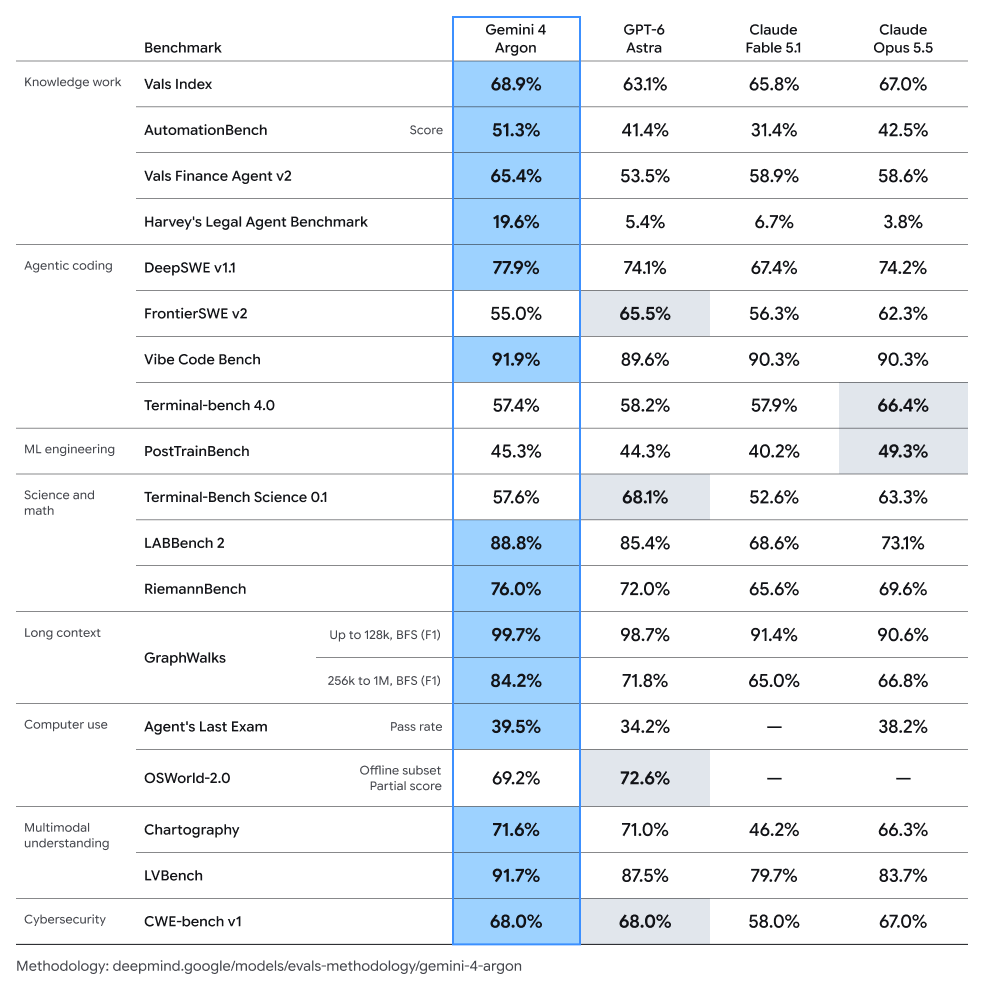
Introducing Gemini 4 Argon – our new frontier model.
It’s built for complex workflows across coding, enterprise knowledge work, and cybersecurity defense – rolling out today to a set of trusted testers through our Fairwind Program.
Sam Davis retweeted

Please welcome GPT-6 Sol and GPT-6 Luna to the GPT-6 universe.
GPT-6 Sol and Luna build on the advances behind GPT-6 Astra, bringing much of its strengths into faster and more affordable models to support work at scale.
We’ve also made caching and inference more efficient, and we’re passing the savings directly to you: 50% lower API prices for Sol and Luna compared with GPT‑5.6 promotional pricing.


Sam Davis retweeted

Jeff Dean says he's bullish on specialized hardware because a handful of workloads will be a lot of the world's compute
"I'm pretty bullish on more and more specialized hardware, because I think that's the way you really get much more efficient systems."
"And we now have workloads where there's like a handful of workloads that are going to be a lot of the compute in the world."
"And so if you think about that, that is crying out for specialization."
"The problem with specialization is if what you want to do changes in the future, then the thing you've lovingly crafted in hardware for maybe two years is no longer perhaps as relevant."

SemiAnalysis' Jordan Nanos reveals the OpenAI engineers scrolling their own kernel code had no idea what it did line by line, and it didn't matter because the AI does
"It's not slop, because it performs, but it's literally just AI-generated assembly basically puked out in Gluon, this low-level kernel programming language that they built on top of Triton, which uses this really interesting programming model."
"The point is, the guys who were scrolling through this code with us, it was kind of clear that they know a whole bunch about hardware, they know a whole bunch about the concepts in the system, and they just have no idea what this MLA kernel that they're showing us for DeepSeek actually does."
"You can go line by line and it's like nope, nope, nope."
"But it doesn't matter. The AI understands it, the AI tests it, and you see the results. It produces correct kernels that perform really well."
"And I think this is just a sign of what's to come again."
"That actual code is not necessarily something that a human has to reason about deeply, if the AI knows how to manipulate the data movement and the processing elements on the hardware that you've given it."
________
More takeaways from OpenAI's Jalapeno development: firesidealpha.substack.com/8…
Sam Davis retweeted

We’re sharing how GLM-5.3 helped build and optimize the inference infrastructure serving GLM-5.3-Flash.
The system went from its first successful run to production readiness in less than two weeks, with end-to-end throughput tripling relative to the initial baseline.
The key was dense feedback: local correctness tests, execution traces, microbenchmarks, and end-to-end measurements that enabled targeted hypothesis testing rather than reliance on aggregate performance metrics alone.
z.ai/blog/glm-built-its-infe…

Sam Davis retweeted

💾 Smaller KV cache. Bigger savings.
Compared with the previous generation, V4.1-Flash’s KV cache needs just:
🔹 1/4 the HBM
🔹 1/8 the SSD storage
Cache-hit charges often account for a large share of agent costs. Compressing the cache cuts those costs significantly.
3/6

Sam Davis retweeted

FP8 on Apple Neural Engine opens:
1- better PREFILL on ANE: keeps high precision x2 FLOPS, helps to save GPU/ALU for tail
2- KV Cache compression in FP8
3- 4-bit LUT'd FP8 for x2 compute ? perhaps
PS: should be easy to enable in CoreML even if official release lags, assuming compiler supports it for M6
🤔
