

Was looking at the Muse Spark Open config: qk_scale_factor = 5.473006486, which seemed like a pretty random number.
Well, comparing against Muse Glimmer (qk_scale_factor = 3.87), it's actually just 3.87√2.
Since Glimmer uses head dim 128 while Spark uses 64, with QK-Norm where q̂ᵀk̂/√d = √d cos(q,k), halving head dim would increase the attention temperature by √2. The adjusted qk_scale_factor, applied only to q̂, preserves it.
So a neat way to simulate muP's 1/d scaling while still being in a regular 1/√d attention setting. Worth keeping in mind when ablating head dim!

Ryan Chin retweeted

New paper with Google PI: We derive a new learning paradigm coming from the sgd/linear-attention duality, where instead of updating linear layers with gd at every step during training, we maintain a growing “kv cache” of gradient signals we attend over (NN grows during training)

There is a beautiful dual view of gradient descent on dense linear weight layers: A linear layer trained by GD computes exactly the same function as its initial weights plus linear attention over its own training history. Each test input attends to every input the layer received during training ("keys") and recombines the backpropagated errors stored assoc. with them ("values"). This intriguing connection has been discovered and revisited before but is unfortunately still not really well-known!
If you want a new perspective on one of the most fundamental things we do when training modern neural networks, I highly recommend studying this dual view, and thoroughly thinking about its implications.
Taking this perspective seriously, we replaced the linear attention with more powerful kernels, such - obviously ;) - softmax attention. This (not trivial at all!) led to a new paradigm for neural network learning that we call Retrieval-Centric Deep Learning (RCDL): neural networks whose basic building blocks aren't classic linear weight matrices but growing, nonparametric databases of inputs and backpropagated errors, read out by nonlinear attention variants.
Via the RCDL approach, we were furthermore able to find cool, insightful derivations for known ml tools such as the FOOF optimizer!
In our new paper, we describe this RCDL in detail and study its behavior on simple learning tasks - it performs surprisingly well! And of course, we also address the obvious current limitation: Linear growth in memory as the number of training points increases. To circumvent this, we propose some early ideas using a hybrid parametric/nonparametric approach. We are particularly excited to see what tricks can be found to adapt these growing layers to today's hardware constraints. But after all - this work was originally motivated by a simple idea: Compute is getting cheaper and cheaper, hence are there methods that seem wildly expensive today, but may be affordable and extremely powerful in the future? We think this RCDL paradigm offers a promising path :)
There is a ton of possible follow-up work that can be done now and we are very excited to see what people will try and do with this new retrieval centric learning approach!


link to @osieberling's full thread for paper: xitter.cf/osieberling/status/210…

Ryan Chin retweeted

Efficient way to grow the state size w.r.t params 🔥
Ryan Chin retweeted
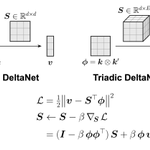
Linear attention is arguably the most naive RNN, but still massively outperforms traditional RNNs by maintaining a matrix state. So... what if we use a (triadic) outer product of three vectors and maintain a three-dimensional state?
Introducing: Triadic Linear Attention 🧵

Ryan Chin retweeted

Today, we’re excited to launch Recursive (@recursive_si): an exceptional team across London and San Francisco, building AI systems that can safely improve their own capabilities over time.


Ryan Chin retweeted

We introduce Variance Controlled Policy Optimization (VCPO), a method for explicit variance-targeted controls for policy-gradient objectives in off-policy RL — enabling stable, scalable Async RL training.
✨ Seamlessly integrates into common policy-gradient methods like REINFORCE/RLOO/GRPO 🚀 2.5x faster Async RL training while matching Synchronous RL performance 🧠 Robust training stability under high off-policy settings (at least 128 steps off-policy)
📄Paper: arxiv.org/abs/2602.17616
🔗Code: github.com/mit-han-lab/vcpo
🧵👇

Ryan Chin retweeted
Multi-agent systems (MAS) ≠ “just add more agents.”
Today’s MAS orchestration is mostly sequential, local, and hard-coded, and we still lack a principled answer to when MAS actually helps.
MAS-Orchestra reframes MAS design as a holistic RL problem: an orchestrator generates the entire system via function-calling, with an explicit Degree of MAS (DoM) controlling coordination complexity.
With MASBench, we quantify when MAS beats single agents—achieving strong multi-step reasoning with ~10× efficiency.
🧠 Project Page:vincent950129.github.io/mas-…
📘 Paper: arxiv.org/pdf/2601.14652
💻 Code: github.com/SalesforceAIResea…
📚 Dataset: huggingface.co/datasets/Sale…

Ryan Chin retweeted
Meet SFR-DeepResearch (SFR-DR) 🤖: our RL-trained autonomous agents that can reason, search, and code their way through deep research tasks.
🚀SFR-DR-20B achieves 28.7% on Humanity's Last Exam (text-only) using only web search 🔍, browsing 🌐, and Python interpreter 🐍, surpassing DeepResearch with OpenAI o3 and Kimi Researcher.
🤖SFR-DR agents are trained to operate independently, without pre-defined multi-agent workflows. They autonomously plan, reason, and propose and take actions as defined by their tools.
🔄SFR-DR agents are trained with end-to-end RL. Starting from reasoning optimized models, our RL pipeline carefully preserves reasoning abilities while training models to become more capable research agents.
📝SFR-DR agents are also trained to manage their own memory by summarizing previous results when context becomes limited. This enables a virtually unlimited context window, enabling long-horizon tasks
Paper: arxiv.org/abs/2509.06283
#AIAgents #ReinforcementLearning #DeepResearch

Ryan Chin retweeted

Excited to unveil Boltz-2, our new model capable not only of predicting structures but also binding affinities! Boltz-2 is the first AI model to approach the performance of FEP simulations while being more than 1000x faster! All open-sourced under MIT license! A thread… 🤗🚀
Ryan Chin retweeted

We’re super excited to announce that HackMIT 2025 is happening Sept 13-14 and applications are now open! Priority decisions are due July 4th and Regular due July 25th. Info about mentor/judge applications coming soon! Find all the details on our website hackmit.org.
