

-Mobile 📱and Web Developer 🕸️- -Full Stack Developer 💻~ https://xitter.cf/t.co/FHzyzb6Hft
Wilayah Persekutuan Kuala Lump
Joined July 2017
- Tweets5.2K
- Following237
- Followers636
- Likes829





Matdan The Great retweeted

no clients? 6 months building, still $0 revenue.
i gave explee my website link. it found companies that need my product, wrote each of them a personal email, and helped me book calls.
$30 free 👇
explee.com/auto-gtm/x/tw-ag1…


Matdan The Great retweeted

It's been 7 years from GPT-2 to GPT-6, and a lot has changed.
The diagram below shows each generation and its key highlights, based on the public information we know.
GPT-2 (2019): More like a prototype to validate the potential of the decoder-only transformer. This was a 1.5B-parameter model that only went through pre-training with next-token prediction. The trained model was only capable of continuing text, not answering questions.
GPT-3 (2020): The same recipe as GPT-2, just much bigger and trained on more data to test how far scale alone could go. GPT-3 had 175B parameters, more than 100 times the size of GPT-2, and still only went through pre-training. The scale allowed it to show in-context learning capabilities. When shown some examples, the model could follow them.
GPT-4 (2023): On top of pre-training, OpenAI fine-tuned it with RLHF (reinforcement learning from human feedback), so it was not just a completion model but could actually answer questions. It was also multimodal, meaning that it could process input images as well as text, and it handled up to 32K tokens of context.
GPT-5 (2025): The first GPT generation with built-in reasoning. Given a prompt, tools, and an effort level, the trained model could generate reasoning tokens before the answer. Its context window grew to 400K tokens, with a router in ChatGPT to decide when a prompt needed thinking mode.
GPT-6 (2026): This new model has a bigger context window (1.05M), supports async tool calling, and is generally safer. An interesting feature, called mid-turn steering, is that it can take a new instruction while it's thinking.

Matdan The Great retweeted

Introducing Muse Wonder, our new family of frontier models with state of the art performance for personal and professional agentic work.

Matdan The Great retweeted

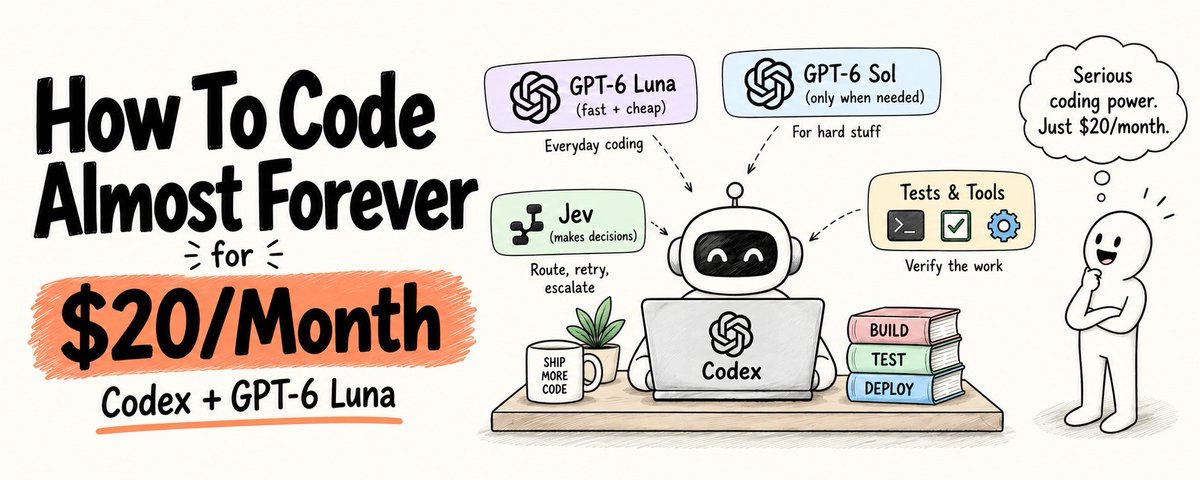
Send this config to your Codex
It sets up Luna + Jev → classifies every task → finds where you waste compute and money → upgrades your coding setup beyond 95% of developers...
Copy this now. Thank me later:



Matdan The Great retweeted

if people still ask you to share screen asking coding question pls end the interview. We shouldn't even tell the interviewer we can actually cheat and show how dumb your assessment method is. Let them live in their bubble

Matdan The Great retweeted

SYSTEM DESIGN FUNDAMENTALS
System design is simply about how you plan, structure, and connect different parts of a system so it works efficiently at scale. Think of it like designing a city → roads, buildings, traffic flow, utilities → everything must work together smoothly.
When you build small apps, design doesn’t matter much. But once users grow, things break unless the system is well designed.
WHAT IS SYSTEM DESIGN
System design is the process of defining architecture, components, data flow, and interactions of a system.
You are answering: → How will users interact with the system
→ How will data move
→ How will the system scale
→ How will it stay fast and reliable
HIGH-LEVEL VS LOW-LEVEL DESIGN
HIGH-LEVEL DESIGN (HLD) → Focuses on the big picture
→ Defines system architecture
→ Shows major components and how they connect
Example: → Client → API → Database → Cache
LOW-LEVEL DESIGN (LLD) → Focuses on details inside components
→ Classes, functions, database schema
Example: → How a “User Service” is implemented internally
CORE COMPONENTS OF A SYSTEM
CLIENT → The user interface (web, mobile, etc.)
→ Sends requests to the server
SERVER → Processes requests
→ Contains business logic
DATABASE → Stores data permanently
CACHE → Stores frequently accessed data for speed
LOAD BALANCER → Distributes traffic across servers
HOW A REQUEST FLOWS
User clicks a button
→ Request goes to server
→ Server checks cache
→ If not found → queries database
→ Processes logic
→ Sends response back
This flow must be fast and reliable.
SCALABILITY
Scalability means handling more users without breaking.
VERTICAL SCALING → Add more power to one machine (CPU, RAM)
HORIZONTAL SCALING → Add more machines (servers)
Best practice: → Use horizontal scaling for large systems
LOAD BALANCING
A load balancer spreads traffic across servers.
User requests
→ Load balancer
→ Server 1 / Server 2 / Server 3
This prevents overload and improves availability.
DATABASE BASICS
SQL DATABASES → Structured data
→ Strong consistency
→ Example: MySQL
NOSQL DATABASES → Flexible data
→ High scalability
→ Example: MongoDB
Choice depends on system needs.
CACHING
Caching improves speed by storing frequently used data.
Without cache
→ Every request hits database (slow)
With cache
→ Data served instantly
Tools: → Redis
→ Memcached
CONSISTENCY VS AVAILABILITY (CAP IDEA)
You can’t have everything perfectly.
CONSISTENCY → All users see the same data
AVAILABILITY → System always responds
PARTITION TOLERANCE → System works even with network failures
Trade-offs: → Choose based on your system goals
MICROSERVICES VS MONOLITH
MONOLITH → Everything in one codebase
→ Simple to start
→ Hard to scale
MICROSERVICES → Split into small services
→ Easier to scale independently
→ More complex to manage
RELIABILITY AND FAULT TOLERANCE
Systems fail. Good design expects that.
Use: → Redundancy (multiple servers)
→ Failover systems
→ Monitoring and alerts
Goal: → System should keep running even when parts fail
LATENCY AND PERFORMANCE
Latency = time taken to respond
Improve performance by: → Using caching
→ Reducing database queries
→ Using CDNs
→ Optimizing code
REAL-WORLD THINKING
When designing systems, always ask:
→ What happens when traffic spikes
→ What happens if a server crashes
→ How fast is the response
→ How secure is the system
System design is about thinking ahead.
HOW TO START PRACTICING
Pick simple systems and design them:
→ URL Shortener (like bit.ly)
→ Chat System (like WhatsApp)
→ File Storage (like Google Drive)
→ News Feed (like Twitter)
Break them down step by step.
FINAL MINDSET
System design is not memorizing answers.
It is: → Understanding trade-offs
→ Making smart decisions
→ Thinking at scale
→ Designing for failure
Grab the System Design Handbook here:
codewithdhanian.gumroad.com/…


Matdan The Great retweeted

MALAYSIA PERKENALKAN DIESEL DARI KELAPA SAWIT
FELDA memperkenalkan minyak alternatif bernama B100 susulan krisis bekalan minyak ketika ini
Minyak itu sepenuhnya daripada kelapa sawit dan merupakan minyak biodiesel pertama di dunia tidak menggunakan elemen minyak fosil
Harga minyak B100 ini dianggarkan RM 4.40 seliter dan lebih murah dari harga diesel ketika ini sekitar RM 6.02 seliter. Pengeluaran Kelapa Sawit sebanyak 20 Juta Tan setahun membolehkan bekalan B100 diberikan cukup untuk keperluan Diesel rakyat Malaysia dari segi teorinya
Namun cabaran utama minyak ini ialah kapasiti pengeluaran yang tidak sebanyak minyak diesel dan permintaan yang rendah
FELDA mencadangkan agar Kerajaan mula memperkenalkan minyak ini di semua stesen minyak dan FELDA sendiri akan mula mengoperasikan minyak ini di semua kilangnya dan elemen logistiknya selepas selesai ujian selama 15 bulan dan 15,000 km perjalanan


Matdan The Great retweeted

🚨JUST IN: PETRONAS reported an 18% decrease in net profit, which fell to RM45.4 billion in 2025.
Revenue also declined 17% to RM266.1 billion, mainly due to lower average realised prices, reduced sales volume, forex impacts, and the divestment of the Engen Group.
The board approved a dividend of RM200,000 per ordinary share, amounting to a total of RM20 billion for 2026.
🧵1


Matdan The Great retweeted

How to build AI agents:
A great cheat sheet (bookmark for later).
Here's how to use it:


Matdan The Great retweeted

RAG isn’t just embeddings + vector DB
Production-ready RAG requires:
• Smart chunking
• Efficient embeddings
• Scalable vector storage
• Hybrid retrieval + re-ranking
• Proper document versioning & access control
RAG is not a feature
It’s infrastructure

Matdan The Great retweeted

🚨 This GitHub repo just changed how I use Claude Code forever.
It's called claude-code-best-practice and it gives you production-ready Agents, Commands, Memory, Hooks, and Skills all in one place.
No guessing. No scattered docs. No trial and error.
Here's what's inside:
→ Agents — orchestrate complex multi-step tasks autonomously
→ Commands — custom slash commands you can reuse instantly
→ Memory — Claude remembers context across every session
→ Hooks — shell commands that fire on tool call events
→ Skills — installable capabilities that level up Claude Code
Most devs are still using Claude Code like a basic chat assistant.
This repo turns it into a full autonomous coding system.
100% Opensource.
