

Love land, water, nature, food. Mad guitarist. Views expressed are my own.
South West, England
Joined December 2017
- Tweets2.3K
- Following355
- Followers1.1K
- Likes2K







Pinned Tweet
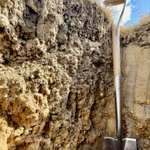
To celebrate World Soils Day tomorrow, here are typical soils on the diverse geology in SW England.
Clay-with-Flints
Cretaceous Greensand
Triassic Mudstone
Chalk
Permian Sandstone
Permian Breccia
Granite
Peat
Devonian Slate
Carboniferous Shale
Alluvium
Pebble Bed

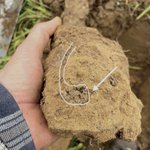
Some unusual features found today in the clay with-with-flint geology:
- sand grains in a chamber that look like an earthworm pellets, but more likely to be dissolution of the former Greensand
- folded iron pans from soil movement during the Ice Age.
@Subsolum


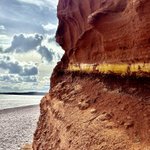
A recent revisit to this fossil soil or “paleosol”.
The paleosol is the dark brown colour…a preserved soil.
The bright yellow colour above the paleosol is so unusual. I’ve not seen this elsewhere. I wonder if the sulphate-rich sea spray is part of the chemistry?

“Rotted soil”….. A local expression that is very descriptive.
The soil is so dry that the clay has shrunk and fissured at the micro scale.
Sounds like gravel.
Classic Batcombe soil series over clay-with-flint.
Wonderful soil structure through out the profile.
To think this soil was full with water bubbling to the surface 6 months ago.

Beautiful examples of shallow Lithomorphic soils.
Rocks are characteristic of weathered Ice Age materials.
The B horizon is absent. Rocks are a weathered C horizon with minimal soil formation. @Subsolum
Acid Devonian rock vs Calcareous chalkland.
Similar but different!


Compacted soil that needs subsoiling…or leave?
Fine grained sandy loam soils over Bridport Sands.
An interesting field with wild bird seed mix. Abundant earthworms creating casts and burrows in the subsoil after 4 years. #soilrecovery. A pleasure to see @olblackburn


Interesting shallow line of bleached stones in this podzol in a road cutting at Studland Heath. I’m assuming that these are Pleistocene gravels laid down during the ice age? @Subsolum.
An ancient soil profile?


This soil profile looks almost natural!
A wonderful archaeological dig at the site of a former abbey, Cerne Abbas.


Great day out with Plymouth Uni designing runoff experiments.
Examples of soil structure in a field of wheat showing differences 20m apart.
Compacted soil under perched water
Slumped seedbed between rows without cover
Seedbed under crop cover
Ancient hedge bank.
@PlymUni

Modern art! Experimental image looking at what thermal imagery can tell us about the soil.
Blue colour is maize harvest wheelings (and shaded areas behind trees). Field headland is deep ripped. Middle is stubble, and right is shallow tilled with wheelings grinning through.

…and OSR field. Can see drill wheel marks and tramlines. Top half of the field is much warmer. Green colour is colder soil.
