

Postdoctoral Scientist @UCLA & Affiliate Fellow @broadinstitute of @MIT and @Harvard. Alumni @TuftsUniversity. GWAS of complex traits. Unraveling GxE effects.
Massachusetts, USA
Joined May 2012
- Tweets127
- Following1.6K
- Followers290
- Likes487






Robel Alemu retweeted

Article: This study examines the effects of early-life iodine deficiency on health and educational outcomes following the war-induced disruption of Ethiopia’s salt iodization programme in the late 1990s.
nature.com/articles/s43016-0…

Robel Alemu retweeted

A @StanfordMed large-scale study of gene activity in immune cells could help researchers identify potential targets for treating autoimmune diseases.
news.stanford.edu/stories/20…

Alex is a brilliant statistical geneticist and one of the most thoughtful scientists I’ve had the privilege of working with. Please consider supporting his fundraiser to help him access a personalized cancer vaccine. Wishing him strength as he continues this fight.

In March 2024, at the age of 35, I was diagnosed with stage IV rectal cancer with a metastasis in my liver. This was a shock: I had no family history, and none of the doctors suspected it. After two years of chemotherapy, radiation, and multiple surgeries, I'm still not cured. Now I'm asking for help to get a personalized cancer vaccine.
This is my story so far.
Following diagnosis, I was treated with total neoadjuvant therapy at UCLA. I had 6 weeks of radiation and chemotherapy (Xeloda). This was followed by 6 rounds of oxaliplatin infusions and Xeloda. I tolerated this unusually well. During this period, I managed to hike up to over 11,000ft multiple times in the Sierras, and I wrote the main text of a 72 author meta-analysis paper and submitted it to Nature where it is still in review.
I showed a good clinical response, and at the end of October I had surgery: I was under for 9 hours, and they cut out a bit of my rectum, 1/3rd of my liver, and gave me a temporary ileostomy. Waking up from this was probably the strangest experience of my life: I felt more machine than man, and I had wild hallucinations form such a large dose of anesthesia.
It took a while to feel OK after that surgery. However, I still had the ostomy. I had that reversed at the end of January in another surgery, which took a greater toll on me than I expected.
I only just started to feel OK again and I got bad news: I got a positive circulating tumor DNA test (ctDNA), the signatera test from natera. Unfortunately, the ctDNA carried on rising, and in July 2025 a new lesion appeared in a lymph node near my liver (periportal).
I was treated with irinotecan and panitumumab infusions, which showed a good response, followed by live MRI guided SBRT radiation treatment to the lesion. However, after finishing this treatment, the ctDNA remained positive and began rising again. I restarted irinotecan and panitumumab infusions, which brought ctDNA back to negative (signatera), although it remained positive on the more sensitive Personalis assay.
During this period I had begun to develop stomach pain and digestive symptoms. Then I collapsed vomiting blood while out in Santa Monica and was rushed to the ER. They found out I had a duodenal ulcer that had bled. I had some blood transfused, and I was sent home to complete an intensive course of antibiotics for H. Pylori infection.
However, after about a week, I started to get very weak. I collapsed again and went back to the ER in an ambulance. They found my hemoglobin was 5g/dL, a dangerously low level (normal is over 13.5). Multiple blood transfusions didn't bring it up and I collapsed again in the night after passing a large amount of blood. They took me to intensive care and performed an emergency endoscopy where they clipped and sprayed the ulcer. Thankfully this worked and I was discharged after another 3 nights in hospital.
Unsurprisingly, nearly bleeding to death wasn't good for me, and my ctDNA began to spike rapidly. I had a PET-CT and it revealed 3 new disease sites in abdominal lymph nodes. I restarted irinotecan and panitumumab infusions after barely recovering from the ulcer incident. This showed an excellent response, with the sites resolving on imaging, although ctDNA remained positive.
I've now started bot/bal immunotherapy, a not yet approved immunotherapy treatment that is the first of its kind to show strong results in my kind of cancer, micro-satellite stable colorectal cancer. This was possible thanks to a donation from an anonymous benefactor and supporter of free and open inquiry in science.
Hopefully this treatment will be effective, but it is unlikely to be enough on its own to prevent future disease recurrence.
I am asking for help to get a personalized neoantigen cancer vaccine, which could substantially increase my chances of surviving this deadly disease that is likely incurable under standard care.
While cancer vaccines have shown promising results, they are not yet approved, meaning one has to pay for the design, manufacture, and administration of the vaccine. The total cost of which is $104,133, beyond my means or those of my family.
Any help would be greatly appreciated! I've started a GoFundMe here: gofundme.com/f/cancer-vaccin…. Please donate and share with anyone who might be interested in helping.
I've carried on working throughout this period and I'm still running a research group in statistical genetics at UCLA. I'm hoping to continue making contributions to science for as long as I can, hopefully longer with your help.

Robel Alemu retweeted

In March 2024, at the age of 35, I was diagnosed with stage IV rectal cancer with a metastasis in my liver. This was a shock: I had no family history, and none of the doctors suspected it. After two years of chemotherapy, radiation, and multiple surgeries, I'm still not cured. Now I'm asking for help to get a personalized cancer vaccine.
This is my story so far.
Following diagnosis, I was treated with total neoadjuvant therapy at UCLA. I had 6 weeks of radiation and chemotherapy (Xeloda). This was followed by 6 rounds of oxaliplatin infusions and Xeloda. I tolerated this unusually well. During this period, I managed to hike up to over 11,000ft multiple times in the Sierras, and I wrote the main text of a 72 author meta-analysis paper and submitted it to Nature where it is still in review.
I showed a good clinical response, and at the end of October I had surgery: I was under for 9 hours, and they cut out a bit of my rectum, 1/3rd of my liver, and gave me a temporary ileostomy. Waking up from this was probably the strangest experience of my life: I felt more machine than man, and I had wild hallucinations form such a large dose of anesthesia.
It took a while to feel OK after that surgery. However, I still had the ostomy. I had that reversed at the end of January in another surgery, which took a greater toll on me than I expected.
I only just started to feel OK again and I got bad news: I got a positive circulating tumor DNA test (ctDNA), the signatera test from natera. Unfortunately, the ctDNA carried on rising, and in July 2025 a new lesion appeared in a lymph node near my liver (periportal).
I was treated with irinotecan and panitumumab infusions, which showed a good response, followed by live MRI guided SBRT radiation treatment to the lesion. However, after finishing this treatment, the ctDNA remained positive and began rising again. I restarted irinotecan and panitumumab infusions, which brought ctDNA back to negative (signatera), although it remained positive on the more sensitive Personalis assay.
During this period I had begun to develop stomach pain and digestive symptoms. Then I collapsed vomiting blood while out in Santa Monica and was rushed to the ER. They found out I had a duodenal ulcer that had bled. I had some blood transfused, and I was sent home to complete an intensive course of antibiotics for H. Pylori infection.
However, after about a week, I started to get very weak. I collapsed again and went back to the ER in an ambulance. They found my hemoglobin was 5g/dL, a dangerously low level (normal is over 13.5). Multiple blood transfusions didn't bring it up and I collapsed again in the night after passing a large amount of blood. They took me to intensive care and performed an emergency endoscopy where they clipped and sprayed the ulcer. Thankfully this worked and I was discharged after another 3 nights in hospital.
Unsurprisingly, nearly bleeding to death wasn't good for me, and my ctDNA began to spike rapidly. I had a PET-CT and it revealed 3 new disease sites in abdominal lymph nodes. I restarted irinotecan and panitumumab infusions after barely recovering from the ulcer incident. This showed an excellent response, with the sites resolving on imaging, although ctDNA remained positive.
I've now started bot/bal immunotherapy, a not yet approved immunotherapy treatment that is the first of its kind to show strong results in my kind of cancer, micro-satellite stable colorectal cancer. This was possible thanks to a donation from an anonymous benefactor and supporter of free and open inquiry in science.
Hopefully this treatment will be effective, but it is unlikely to be enough on its own to prevent future disease recurrence.
I am asking for help to get a personalized neoantigen cancer vaccine, which could substantially increase my chances of surviving this deadly disease that is likely incurable under standard care.
While cancer vaccines have shown promising results, they are not yet approved, meaning one has to pay for the design, manufacture, and administration of the vaccine. The total cost of which is $104,133, beyond my means or those of my family.
Any help would be greatly appreciated! I've started a GoFundMe here: gofundme.com/f/cancer-vaccin…. Please donate and share with anyone who might be interested in helping.
I've carried on working throughout this period and I'm still running a research group in statistical genetics at UCLA. I'm hoping to continue making contributions to science for as long as I can, hopefully longer with your help.
Robel Alemu retweeted

Very excited for this work led by @tigerstatdoc along with @SashaGusevPosts @g_parmigiani now in @Nature!
Wonderful collaboration across @MGBResearchNews @DanaFarber @broadinstitute @harvardmed @HarvardBiostats

One of my first consults as a cardiology fellow: a 34-year-old, textbook MI. A day earlier, no risk model would have flagged him for prevention. That paradox has driven my work ever since — our models miss how disease actually evolves, dynamically, on top of a genetic background. @Nature nature.com/articles/s41586-0…

Robel Alemu retweeted

Very excited about this preprint that we just posted! It introduces the Genomic-Relatedness Matched Association (GRMA) study. It’s an extension to family-based GWAS that uses extended relatives beyond only siblings in diverse-ancestry data with very little bias.

Robel Alemu retweeted

Excited to share one of my favorite genetic discoveries made at the Regeneron Genetics Center.
We went looking for genetic clues about why some people smoke more than others and found something in an unexpected place: the genomes of Indigenous Mexicans. 1/

Robel Alemu retweeted

We are pleased to announce that our new study explaining the missing heritability of many phenotypes using WGS data from ~347,000 UK Biobank participants has just been published in @Nature. Please check out our manuscript here: nature.com/articles/s41586-0….
Excited to share our preprint on PGI portability across ancestries—now on bioRxiv. With co-authors @AysuOkbay, @patrickaturley, @AlexTISYoung, @Dan_J_Benjamin. Preprint: doi.org/10.1101/2025.09.11.6… Thread below for details.
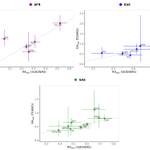
Recomputing LoA(LD+MAF) with fGWAS PGIs gives interesting picture: downward shift for most phenotypes in AFR, mixed in SAS, & upward for EAS. fGWAS-based PGIs can alter the contribution of LD & MAF to prediction loss, with direction & magnitude varying by phenotype and ancestry.

Robel Alemu retweeted
Our lab is looking for pre-doctoral RAs for next year! We do our best to do good work and foster a supportive environment for lab members! Feel free to reach out to me if you have questions about the position. Application instructions are in the link below. Please RT

The SSGAC is seeking research assistants for social-science genomics research at @UCLA beginning in summer 2025.
Please send the application materials specified in the below link directly to [email protected].
danieljbenjamin.com/_files/u…
@econ_ra @predoc_org
Google DeepMind and Isomorphic Labs introduce AlphaFold 3 AI model blog.google/technology/ai/go…