





Roma Cryp retweeted

Introducing taker tier rebate program - poly.market/taker-tier
Get rebated up to 50% of all trading fees on polymarket, earn $ level up bonuses, and be eligible for large future rewards.
Will be live starting next week 🙂


Roma Cryp retweeted

90% of traders on Polymarket avoid weather markets
Those who stay trade against people reading headlines instead of data
Here's a universal system for analyzing any weather market and finding where the crowd is wrong
Step 1: Find the resolution source
Open the market conditions. Polymarket resolves weather markets through Weather Underground
This means one thing: your forecast needs to match not what CNN or AccuWeather shows - but what the specific station on Weather Underground records on expiration day
Always check which exact station is listed in the market conditions. Different stations in the same city can give different readings
Step 2: Three forecast sources
Most people look at one forecast. The professional approach - three sources with different strengths
ECMWF - the gold standard for global forecasting. Covers all cities worldwide, updates twice a day (6 UTC and 18 UTC). The most accurate model for horizons from 3 to 7 days
HRRR / GFS - for US cities within a 48-hour horizon, more accurate than ECMWF. Runs at higher resolution and incorporates real-time observations. Updates every hour
Simple rule: US city + horizon under 2 days → HRRR. Everything else → ECMWF
METAR - real-time observations from airport stations right now. If it's 2pm and the station already recorded 68°F while ECMWF forecast 63°F - the forecast undershot. An additional signal for markets expiring today
Step 3: Historical data as a filter
NOAA Climate Data Online - over 100 years of observations by specific location
Example: market "Snow in Atlanta in November" is trading at 15%
You open historical data - snow in Atlanta in November was recorded twice in the last 50 years. Real probability around 4%
Market is overpriced by 4x. You buy NO at 85%, hold until expiration
Step 4: Speed beats accuracy
Weather models update twice a day. Most market participants don't track this in real time
Your edge isn't knowing more - it's seeing fresh data before it gets priced in
ECMWF drops at 6 UTC and shifts the forecast 5°F higher - you have a window before the market catches up
Step 5: Account for forecast instability by region
Weather markets are harder than other repeating markets on Polymarket because a forecast isn't a single point - it's a range of uncertainty that varies heavily by region and season
Miami in January - temperature is predictable within 2°F a week out. Chicago in March - models can diverge by 15°F over 5 days
Most participants only look at the forecast itself. You look at how much that forecast can actually be trusted
If you know that for a specific city in a specific season forecasts are historically unstable - you understand that current prices reflect false confidence.
And the opposite: when the forecast is stable and all three models agree - that's your signal to enter with high conviction
Trading logic
Weather markets run on a simple cycle: a threat appears → inexperienced participants panic and push prices up → the threat doesn't materialize → prices collapse back
This repeats over and over because most people react to headlines instead of data
You're not predicting the weather - you're finding where a gap opened between real data and market price. And trading that gap


Roma Cryp retweeted

The most profitable Polymarket niche i've found this year isn't crypto or politics
27,924 in a couple of months on Polymarket - and the only tool used is completely free
the weather trading strategy is dead simple:
pull ECMWF and NOAA forecasts every few hours → find where the model says 70%
but Polymarket says 10% → buy at 8¢–12¢ → wait for resolution
instead of guessing one exact temperature, buy every adjacent range at once
Toronto March 26 example:
8°C → $0.02
9°C → $0.04
10°C → $0.08
11°C → $0.03
12°C → $0.02
total risk: $0.19. if any single one hits → payout $1.00
but he's not buying them equally - he weights toward the 2-3 ranges ECMWF and NOAA already favor, and uses the outer ranges as $0.01–$0.02 insurance
the results:
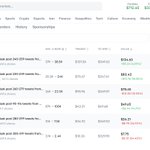
Toronto 10°C → bought at 9.8¢ → resolved at 80¢ → +718%
Chicago 66–67°F → bought at 12.3¢ → resolved at 99.5¢ → +708%
Sao Paulo 30°C → bought at 8¢ → resolved at 78.5¢ → +881%
he's not predicting the weather better than everyone else
he's just reading forecasts that Polymarket hasn't priced in yet
