

💼 Econoom en coördinator onderzoek @UNIZOvzw | ⚽🎾🚴♂️ | Gentenaar | Travel, food, music and festivals 😎
Joined June 2011
- Tweets471
- Following107
- Followers144
- Likes1.7K






Robin Deman retweeted

To illustrate just how nonsensically these tariffs were calculated, take the example of Lesotho, one of the poorest countries in Africa with just $2.4 billion in annual GDP, which is being struck with a 50% tariff rate under the Trump plan, the highest rate among all countries on the list.
Why? Does Lesotho apply extortionate tariffs on U.S. products and the U.S. is merely being "reciprocal" here? Not at all, despite what Trump is saying, it's NOT the way these tariffs are defined.
As a matter of fact Lesotho, as a member of the Southern African Customs Union (SACU), applies the common external tariff structure established by this regional trade bloc.
Which means it applies the same tariffs on U.S. products as South Africa does, as well as the 3 other members of the bloc: Namibia, Eswatini and Botswana.
So since the tariffs charged by these 5 countries on U.S. products are exactly the same, they must all be struck with a 50% tariff rate by the U.S., right? Not at all: South Africa is getting 30%, Namibia 21%, Botswana 37% and Eswatini just 10%, the lowest rate possible among all countries.
So what gives? Again, the way these tariffs are calculated has absolutely zero relationship with actual tariffs imposed by these countries on U.S. products. Instead, they appear to be simply derived from trade deficit calculations.
Looking at Lesotho specifically, every year the U.S. imports approximately $236 million in goods from Lesotho (primarily diamonds, textiles and apparel) while exporting only about $7 million worth of goods to Lesotho (wits.worldbank.org/CountryPr…).
Why do they export so little? Again this is an extremely poor country where 56.2% of the population lives with less than $3.65 a day (databankfiles.worldbank.org/…), i.e. $1,300 a year. They simply can't afford U.S. products, no-one is going to buy an iPhone or a Tesla on that sort of income...
The way the tariffs are ACTUALLY calculated appears to be based on a simplistic and economically senseless formula: you take the trade deficit the U.S. has with a country, divide it by that country's exports to the U.S and declare this - falsely - "the tariff they charge on the U.S."
And then as Trump did in his speech last night, you magnanimously declare that you'll only "reciprocate" by charging half that "tariff" on them.
As such, for Lesotho, the calculation goes like this: ($236M - $7M)/$235M = 97%. That's the "tariff" Lesotho is deemed to charge this U.S. and half of that, i.e. roughly 50% is what the U.S. "reciprocates" with.
It's extremely easy to see why this makes no sense at all.
First of all, there's nothing Lesotho can do about it: they can't change tariffs they allegedly charge the U.S. to reduce the tariff rate the U.S. "reciprocates" with because, again, it's NOT based on any tariff that they charge.
Similarly they can't do much about reducing the trade deficit they have with the U.S. because, again, they simply don't have enough money to buy U.S. products.
Also the main rational Trump gave for the tariffs is to get production back to the U.S., to "bring manufacturing back". 47.3% of Lesotho's exports are diamonds: how do you bring the "manufacturing" of that "back to the U.S."? Anyone can see it makes just about zero sense.
The Lesotho example exposes the fundamental economic incoherence of these tariffs. Rather than addressing actual trade barriers, they punish countries based on trade deficits that arise from structural economic realities. All the more countries like Lesotho which pose zero competitive threat to American industry.
Worse yet, these tariffs will likely make these structural realities even worse: the U.S. is Lesotho's second most important export destination so it's a fair bet that applying 50% tariffs on their products will make people in Lesotho even poorer, and therefore even LESS able to afford U.S. products.
But perhaps the most unfair and detrimental aspect of all this is that these tariffs represent a complete reversal of longstanding U.S. development policy, and therefore a betrayal of countries - like Lesotho - who chose to follow U.S. advice in the past.
For decades the U.S. has used preferential trade access to encourage economic development in the world's poorest nations, recognizing that trade, not just aid, could get them out of poverty and ultimately put them in a position where they too could afford iPhones or Tesla.
They're now effectively penalizing countries for following previous U.S. policy, a lesson which I bet they won't forget anytime soon.
So all in all the irony is painful: in the name of fighting unfair trade, America has just demonstrated what truly unfair trade looks like.
This isn't something designed to address genuine trade issues, but simply a mechanism based on arbitrary math to punish countries for the affront of selling more to the United States than they buy.

Just figured out where these fake tariff rates come from. They didn't actually calculate tariff rates + non-tariff barriers, as they say they did. Instead, for every country, they just took our trade deficit with that country and divided it by the country's exports to us.
So we have a $17.9 billion trade deficit with Indonesia. Its exports to us are $28 billion. $17.9/$28 = 64%, which Trump claims is the tariff rate Indonesia charges us. What extraordinary nonsense this is.
Robin Deman retweeted

Arizona verdient lof voor haar socio-economische hervormingen.
Maar verkoop ze niet als staatshervorming.
Het blijft factuurfederalisme: de mogelijkheid voor overheden om de factuur van hun beslissingen naar een ander beleidsniveau door te schuiven 👇
tijd.be/opinie/column/rechts…

Boeiende presentatie van de bekende economieprofessor De Loecker op het @VARIO_VL colloquium over het belang van ondernemerschap en het tegengaan van marktmacht voor meer productiviteitsgroei. Cruciale determinant van onze welvaart.

1
2
110
VDAB-cijfers tonen wel nog een hoog aantal vacatures voor uitzendopdrachten. Hoe zie je de link met de daling in activiteit (= gewerkte uren?)?
1
44
Robin Deman retweeted

Er komen nog plotse prijsstijgingen fossiele brandstoffen aan…België extra kwetsbaar voor zo’n externe schokken door automatische loonindexering, met negatieve gevolgen voor concurrentiekracht en werkgelegenheid. Nieuwe regering moet dit aanpakken door indexkorf aan te passen.

🔴 De olieprijs schiet omhoog na het nieuws over de dood van Hamasleider Ismail Haniyeh. Wat betekent dit voor de wereldwijde oliemarkt en de spanningen in het Midden-Oosten? Lees meer 👇🌍🛢️
#Olie #Hamas #MiddenOosten #OPEC #Israel
trends.knack.be/nieuws/oliep…

Robin Deman retweeted
Ten years ago, I had a chance to meet veterans of D-Day in Normandy. On this 80th anniversary, let’s remember the brave service members who stormed those beaches despite long odds, and whose example continues to show us the way.


Robin Deman retweeted

Productiviteitsgroei zou dé prioriteit moeten zijn voor de volgende regeringen van ons land, zeggen 64 economen in De @tijd, waaronder onze eigen adviseur @robindeman.
Lees waarom dit zo belangrijk is en hoe we dit kunnen realiseren➡️ ow.ly/OkhO50Rn2Pn
#Productiviteit

Robin Deman retweeted

Aleksey Navalny's courage will never be forgotten.
This tragedy – further proof of Putin's brutality – reminds us of the stakes of this moment.
Failure to support Ukraine against his vicious onslaught will never be forgotten.
Robin Deman retweeted
Hetzelfde geldt voor België. Lage inflatiecijfer is een fabeltje. Zo wordt alle energiesteun van vorig jaar gedurende 12 maanden als een “prijsdaling” in index doorgerekend. Niemand krijgt vandaag echter nog die korting op energiefactuur. Geen enkele media heeft dat vermeld


Robin Deman retweeted

"Begrotingsbeleid: vergeten instrument in strijd tegen inflatie". De nieuwe KBC Economische Opinie van collega Lieven Noppe @KBC_Economics:
kbc.com/nl/economics/publica… via @KBC_BE

Robin Deman retweeted
📚 Nieuw artikel alert: Is de energiecrisis voorbij? 💡Onze herleefde blog "Economische Inzichten" onderzoekt de economische impact van de energiecrisis!
Lees het volledige artikel hier 👉 bit.ly/43LrNZp.
#energiecrisis #blog

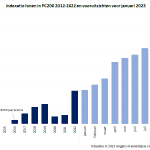
10,84% verwachte loonindexatie voor 500.000 werknemers in januari 2023. Evenveel als de vorige acht indexaties opgeteld (2015-2022). Stelselmatig opgelopen dit jaar (in januari '22 werd 3,65% voorspeld). Werkgevers zijn spilfiguur in het op peil houden van koopkracht.


Robin Deman retweeted

Burn-out en mentale problemen zijn de grootste reden voor langdurige afwezigheid op het werk. Er is niet één oorzaak of één oplossing. In @tijd licht ik er één oorzaak uit die we kunnen aanpakken: een chronisch gebrek aan erkenning. tijd.be/opinie/column/geef-m…

Met een stevig luik over de belastingschalen en -tarieven in de personenbelasting. Daar zit het grootste potentieel om werk meer te laten (netto)lonen.


En hoe beïnvloedt dit de recente prognoses van de Studiecommissie Vergrijzing? Pensioenuitgaven zouden tussen 2022 en 2027 stijgen met 1 procentpunt bbp, of in euro's van vandaag €5,4 miljard (over vijf jaar dus...).
1
Benieuwd naar chiffrage #pensioenhervorming door @FPB_BE. In het kader van doorrekening verkiezingsprogramma's, werd in 2019 de budgettaire kost van €1.500 netto minimumpensioen 'en cas de carrière complète' geraamd op jaarlijks €3,2 miljard. (1/2) dc2019.be/measures/measures_…
1
Robin Deman retweeted

Very concerned about implications of @USSupremeCourt decision on #RoeVWade and the signal it sends to the world.
Banning abortion never leads to fewer abortions, only to more unsafe abortions.
Belgium will continue to work with other countries to advance #SRHR everywhere.