
Building AI for the real world. token maxxing. prev: https://xitter.cf/t.co/qB3Y1eZhnG, martech, enterprise consulting, @Techstars
Columbus, OH
Joined January 2009
- Tweets2K
- Following988
- Followers318
- Likes1.9K




Winkle retweeted

well that was fast! last week's workshop from @aiDotEngineer nyc is now on yt
youtu.be/7T-gldvgfpo?si=KFfT…

Winkle retweeted

For a while now, @kirancodes has been excitedly telling everyone at @BasisOrg who would listen about a crazy idea she's been pursuing. Not everyone thought it was possible, but it's starting to work. See basis.ai/blog/ship-your-inte…
TL;DR: The bottleneck in verifying the world's software is shifting from theorem proving to specifications and semantics. We now have a way to verify semantics that can scale across all programming languages.
The basic idea:
To verify that a program is correct, you need the program, a specification you want to prove, and a semantics that defines what programs and specs mean.
Most programming languages (Python, Ruby, Lua…) have no formal semantics, because semantics are painful to write for complex languages.
You can ask an LLM to write a semantics for you, but it'll probably have mistakes.
But (i) programming languages do have interpreters/compilers, which ultimately are compiled down to machine code, and (ii) some instruction sets do have formal semantics. RISC-V has an official formal model.
So, crazy idea:
Step 1: Compile your interpreter (e.g. Python's) down to RISC-V. Now its behaviour is formally defined. It's exact, but unreadable: thousands of machine instructions.
Step 2: Ask your LLM to write a semantics for your language.
Step 3: Ask the LLM to prove, in @leanprover, that its semantics agrees with the compiled interpreter on every possible program. If the semantics is wrong, the proof gets stuck, and the LLM goes back to fix it.
Step 4: If the proof goes through, you have a semantics you don't need to trust, and you can verify programs in a language that never had one, with guarantees that reach the binary that actually runs.
Kiran has now done this end to end for a simple WHILE language, and we're scaling it up to Lua and OCaml, with Python as the north star.

Winkle retweeted

For your weekend reading: Build with Pi Durable on Cloudflare, a walkthrough of how to create a multiplayer chat agent, including subagents, on Durable Objects.
earendil.com/posts/pi-durabl…

Winkle retweeted

i went from "let me replace hermes and grok bot just for myself" to not only replacing them.. but replacing our family chat too and creating probably the best personal productivity agent
rm -rf hermes grok-bot
meet Pip :)

Winkle retweeted

interpretability might be the most important scientific problem in the world right now, as I don't think we can solve alignment if we don't know what we're building. I think I have good news about it. I co-authored early work in mechanistic interpretability at OpenAI and came away pessimistic, because neural networks appeared to fold into arbitrary tangled knots. years later, I started openai's first large-scale automated interpretability project, finding about 2% of neurons legible with the primitive tools we had
with modern agentic tools and a much closer look, the picture looks totally different. the vast majority in models up to trillions of parameters are legible, and their circuits beautiful. many famous examples of tangled neurons turned out to be misunderstood. The roadblocks I expected mostly aren't there. I now think ambitious interpretability will be solved by the time we need it most, and possibly quite soon, as automated scientists keep improving. it may be a bitter lesson for interpretability: the simple thing, at absurd scale, works
already-clean.goodfire.com/

Winkle retweeted

My dear friends, I’d like to show you my latest toy project
Introducing Handwired: turn your regular JavaScript code into a neural net!
- no training
- exact outputs vs the JS program
- fully differentiable
All runnable in a browser, without GPU
Winkle retweeted

New on our Engineering blog: Creating in-house source control.
In May, we merged around 2,500 code changes per day. In September, we merged more than 30,000 per day. As a result, we became bottlenecked by developer infrastructure built for human (rather than agent) scale.
Here, we share how we built a new version control system—and fully migrated our monorepo from git—in five months: anthropic.com/engineering/re…

Winkle retweeted

I’ve had a few people write to ask me to follow up on a (reply!) tweet I wrote that’s gotten a lot of retweets. I considered deleting it just to avoid the headache, but I think that would make people more paranoid. So let me share my thoughts.

Remember when the web used http everywhere and none of the connections were secure?
And then letsencrypt.org came along and the web was safer and more secure.
Looks like we are back in the http days if we can't rely on the encryption.
EP 53: 2,000 AI Pull Requests: What’s Left of the Code Moat? xitter.cf/i/broadcasts/1mxPaZYqe…




Winkle retweeted

Pleased to announce my first @AntithesisHQ project: a property testing webinar!
In property testing, instead of checking "this input to the function has this output", we check "given a million random inputs, all the outputs have this property". PBT has been around for a quarter century now and is fairly well known in functional programming and distributed system circles.
Which is why we're gonna do something very experimental and target a community that almost never uses PBT: web developers.
See, there's a thousand PBT tutorials out there, and they all use examples like "reversing a list twice returns the original list" and "add(x, y) should return the same result as add(y, x)". These are stateless properties on the code's functions, where we randomize inputs to a fixed test sequence. People have a hard time finding useful stateless properties in their systems.
I've come to believe that most intuitive and useful business properties are instead stateful properties on what must always hold about the system's states. For example, "our total spend is always below our budget cap", or "two talks must never be scheduled for the same room and time", or "free users can't access premium features". We can property test these by randomizing the test sequence itself, to simulate a user doing whatever the heck they want, and testing that no matter what they do, our properties still hold.
So, if you've ever had your data model get corrupted because you forgot to validate one update method, or seen a 500 when the user clicks `send` three times in a row, or gotten mad at SQL for not enforcing cross-table constraints, this webinar is for you.
We'll be live on October 29. Sign up here: pages.antithesis.com/webinar…
Winkle retweeted

to know where you are going, you have to know where you have been:
pldb.kirancodes.me
Titles and abstracts of 22,324 programming languages papers, from the first POPL in 1973 to this year's proceedings.

ALT Webpage of pldb.kirancodes.me
Winkle retweeted

we just released a curated list for learning formal verification across software, hardware, and maths.
formal methods have traditionally had a high barrier to entry. AI-assisted verification is changing that.
we hope this makes the field more accessible.
link in thread 🧵

Winkle retweeted

I’m beyond excited about this. We are bringing together startups, academics, hackers, and random degenerate type theory friends of ours, to answer the following question totally empirically: *are current LLMs good enough to let normal SWEs without specialized training write meaningful, formally verified software*?
The answer may be a resounding no! In which case, we will analyze each failure point and suggest corresponding research directions for usable fm.
You should join us. It’s gonna be rad!

We’re organizing Vibecheck, a formal methods hackathon with some of the best folks in the space - @maxvonhippel, @qd_forall, @nolanlwin, @jessemhan, @emiyazono, and @workersio.
You’ll get a weekend to build real production software, and formally verify it.
We’ll have people who really know their stuff around to help, and you can come with a team, find one there, or just hack on something yourself.
We are glad to have a phenomenal group of sponsors, including @harmonicmath, @mathematics_inc, @theoremlabs, @thegp, @omnicom, @primeintellect, @astriolabs, @buildwithparty, @wearerandomlabs, and @lanyon_ai, as well as some more we will announce in the coming days!
If you’re a hacker, a formal methods person, or just someone who thinks “how do we know it works?” is an interesting question, we’d love to have you.
Signup Now: fmxai.org/vibecheck/
Winkle retweeted

What everyone doing “spec-driven development” is and has always gotten wrong…
aicoding.leaflet.pub/3mwlzit…
🤖 Made with AI

Winkle retweeted

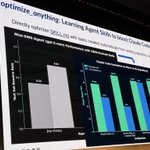
Had a great time giving a talk at @aiDotEngineer World's Fair on Self-improving Agents with Reflective Optimization covering GEPA, optimize_anything, gskill and Fast-Slow Training.
The recording is now up at:
youtube.com/watch?v=OA-Mc60R…

Winkle retweeted

While everyone was busy asking Claude to write TLA+, we wrote up a tutorial on
- what it actually is
- why it’s not the formal verification silver bullet we are hoping for
- and what we have been working on ( to make a silver bullet out of it )
Complete with an interactive TLA+ playground!
reasonable.io/blog/tla-tutor…

Winkle retweeted

Formal verification × agents 🚀
Our IDS paper was accepted as a NeurIPS oral! We study how agents can co-evolve code + proofs, achieving 3x the success rate of Claude Code on distributed systems specs.
IDS Paper: arxiv.org/abs/2605.23109
Code: github.com/skydiscover-ai/sk…
And also check out our recent work on the next challenge: ensuring the spec itself captures human intent. 👇
xitter.cf/istoica05/status/21009…


I used Opus 5.5 to formally verify the Claude Agent SDK using Lean. A couple short prompts = 16 PRs fixing various bugs and race conditions. Video attached.
TLA+ also works well. I sometimes combine Lean and TLA+ to look for issues around data flow, concurrency, and state mgmt.
I don't know either language well, but Claude is excellent at both. This approach is super useful for formally modeling your code and finding bugs that a human probably wouldn't have spotted.
Is formal verification the future of coding (or at least, bug finding)?