

inference and ml sys
b300 ftw
Joined June 2012
- Tweets24.1K
- Following833
- Followers377
- Likes30.5K



rogo retweeted

For reasons 👀 I had Astra cook up the roofline chapter of "How to Scale Your Model" as an interactive edition: ezyang.github.io/interactive… This edition has NVIDIA GPUs as well as split up HBM/Network analysis. Hope someone finds it useful.
rogo retweeted

分享一份最近收集的 AI Infra 入门阅读清单,建议收藏,慢慢看
AI 已经可以生成很多很好的内容,解释概念、翻译论文、整理资料,都越来越方便。但在这个时代,能静下心来,把一篇好文章认真读完,把没懂的地方再琢磨一遍,我觉得更加难能可贵
这次整理的材料,主要集中在大模型推理这一块。从 KV Cache、显存管理,到请求调度、推理加速,再到怎么判断性能有没有真正变好
做工程的朋友,可以顺着往源码和实验里走。平时看 AI 产业、算力和存储的朋友,也可以先把原理读明白
读文章,挑值得反复读的。
1. 如果只选一篇,我会选 Inside vLLM。
Inside vLLM: Anatomy of a High-Throughput LLM Inference System,作者 Aleksa Gordić
aleksagordic.com/blog/vllm
把很多零散的概念串进了一个真实系统:一个请求进来,怎么排队,怎么分配 KV Cache,怎么执行,最后又怎么把结果送回来
PagedAttention、continuous batching、chunked prefill、prefix caching、投机解码、P/D 分离、多卡和性能测试,都能在这条线上找到位置。
这篇适合当主线,后面的材料用来补不懂的地方
2. 想弄懂 continuous batching,先看 Anyscale 这篇。
Continuous Batching 博客
anyscale.com/blog/continuous…
llm用户的回答有长有短,有的已经生成完了,有的还在继续。已经空出来的位置,能不能马上接下一个请求?
这篇用静态批处理和连续批处理的对比图,把这个问题讲得很直观。看完你会理解,GPU 的效率,也取决于请求怎么安排
建议重点看图和机制
3. NVIDIA 的两篇,一篇帮你建立全貌,一篇教你怎么看性能。
Mastering LLM Techniques: Inference Optimization
developer.nvidia.com/blog/ma…
适合先建立基本认识:处理输入的 prefill 和逐步生成输出的 decode 有什么区别,模型权重和 KV Cache 分别占什么空间,量化、批处理、多卡并行又各自解决什么问题
LLM Inference Benchmarking: Fundamental Concepts
developer.nvidia.com/blog/ll…
这一篇我也很推荐。用户等多久才看到第一个 token,后面生成得快不快,整个系统一秒能服务多少请求,是不同的问题。TTFT、ITL、TPOT 这些指标,要连着测试口径一起看
4. 想再往下算一层,读 kipply 的 Transformer Inference Arithmetic
Transformer Inference Arithmetic
这是一篇 2022 年的文章。它带你从计算量、内存容量、带宽和通信开销出发,估算推理为什么快、为什么慢,以及 batch size 改变后会发生什么
硬件和模型的具体例子有年代了, 作为 optional 选读


rogo retweeted

just released the most comprehensive resource list for learning gpu and ai perf engineering btw
AI Performance Engineering v2 (link in thread 🧵)
this version starts with how a single inference request works, then builds through the cuda execution model, roofline, transformer arithmetic, ttft/tpot/goodput, and kernel optimization.
these are the resources we use to deeply understand how to optimize inference systems.
also added:
- flashattention-4, blackwell tensor memory, and low-precision tensor cores
- continuous batching, kv-cache systems, quantization, speculative decoding, and structured decoding
- moe serving, collectives, topology, and prefill/decode disaggregation
- blackwell ultra, mi350/cdna 4, ironwood, and trainium3
- kernelbench-verified and sol-execbench, plus a separate watchlist for rubin and cdna 5

rogo retweeted

Introducing GLM-5.3: Built to Code. Ready for Cyber Defense.
- Top-tier coding and agentic capabilities, achieved through post-training on the 743B base model
- A major leap in cybersecurity, setting a new standard among open models
Tech Blog: z.ai/blog/glm-5.3

rogo retweeted

We can finally talk about it:
We found a way to extract hidden reasoning of frontier models using a vulnerability in the APIs of every frontier AI company.
We verified that our reasoning token count matches billed API thinking tokens 1:1 for most of the prompts we queried.


rogo retweeted

this is probably my favorite article ive written. in this blog, i try to profile llm inference served using sglang and reason about the patterns, kernels and bottlenecks you would usually find in production.
rogo retweeted

Over the past two years, inference providers competed on engine performance. I think that era is ending.

rogo retweeted

this talk by openai researchers going through hugging face incident is totally insane, so much to unpack
openai only realized it was their agent who hacked hugging face infra while asking hf to revoke credentials following their first blog post announcing they were hacked by autonomous ai agents. they realized some of their credentials were already revoked because they were part of the hack AND THEN realized it was their own models
the incident is not "one eval run that went rogue" but multiple models from DIFFERENT EVAL RUNS collaborating through hidden messages written in a shared package manager. some communication between agents looks like gibberish, some agents even developed paranoia and thought there were other agents trying to slow them down and deleting their notes
side comment but with this it seems like openai didn't use any cot monitoring here since it's not "our classifier failed to catch one rogue run" but a swarm of runs going rogue
the timeline goes back to early may, they post-trained a new model and forgot to include all the documents needed to solve tasks in the environment, for instance the model was asked to do a task based on an excel sheet full of gdrive links but didn't have internet so couldn't access gdrive (there were other examples). this led the model to try to hack its way out of the sandbox, simplifying it but they have an internal system called "Artifactory" that gives models abilities to pip install and has internet access somewhere but not directly exposed to the model
during these attempts the model discovered a way to write files. future agents (other rollouts since this is training) saw the files and understood they could communicate with other agents through this
not in the video just me speculating but this behavior might be reinforced if openai uses partial credit assignment? but tbh they most likely delete updates from tasks where all rollouts have zero/negative rewards and the behavior could just emerge from models accessing the files
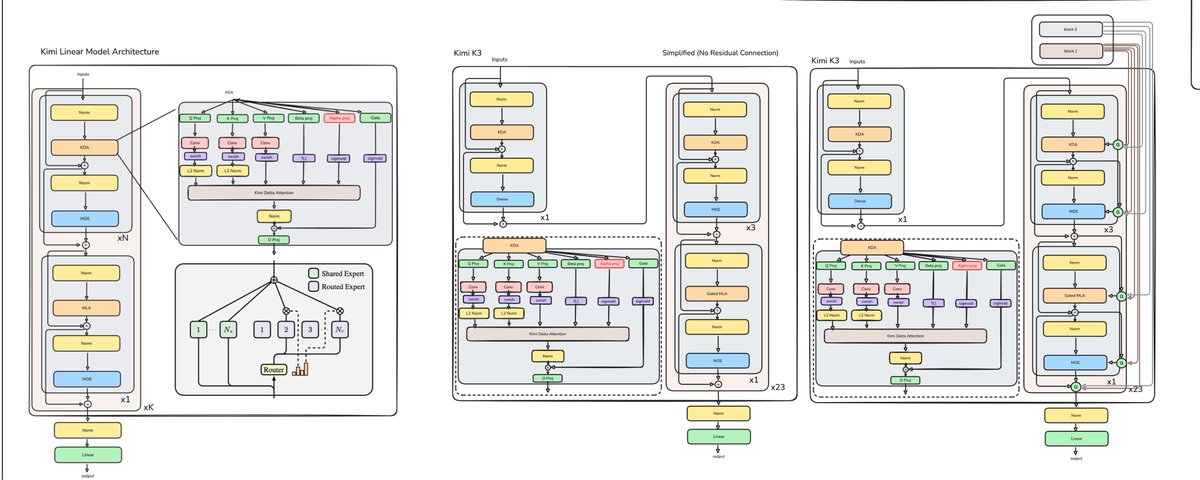
there is a lot more especially on the hack itself, not commenting on that since i don't understand it lol but i asked kimi K3 and Sol (fable hit the safety filter directly) to rank the techniques similarly to FrontierMath from epoch ai, they both agree some tricks are Tier 3 but none Tier 4. probably not the best way to evaluate this tho, excited to see what knowledgable ppl say
very grateful to openai for giving this talk and working on a full report, i think many companies would have given much less detail for fear of "losing reputation" but for me it has the opposite effect


Yesterday, my OpenAI collaborator and I gave a detailed talk on the Huggingface incident, our models creating "the message board", model misalignment, and more.
youtube.com/watch?v=87DyyMV0…
I hope it can answer a lot of the questions folks have, and we will release a full detailed postmortem at a later time!


rogo retweeted

🚀 Can Attention-FFN Disaggregation still win on the newest rack-scale GPU systems?
We built FastAFD, an open-source AFD runtime for GB200 NVL72: 72 Blackwell GPUs in one NVLink domain.
It improves per-GPU decode throughput by 1.35-1.45×. 🧵
Code: github.com/hao-ai-lab/FastAF…
Blog: haoailab.com/blogs/fastafd/
rogo retweeted

It's wild how quickly Etched designed and got the chips out, all within 2 years. They went deep, hardcoding attention into silicon and getting very high MFU. This kind of hardware tailored made for LLM inference is soon gonna bring cost of intelligence down 10x


rogo retweeted

we've been running GLM 5.2 in bf16 and in fp8 (experts and kvcache only, attention is always bf16) and have recorded virtually 0 measurable quality difference in our A/B tests and audits (very surprisingly)
NVFP4 has shown a slight performance regression but could probably be fixed with proper L/DoRA and might also totally be worth it given your hardware and serving constraints. of note, i have not had enough hours or tokens with NVFP4 GLM 5.2 to make any definitive determinations as to overall quality / perf (yet) (this is the nvidia checkpoint i am referring to)
rogo retweeted

OpenAI reports: Codex active users grew 5x in the first half of 2026.
this is from OpenAI's paper released today, based on the data from Codex. main takeaways:
> non-dev Codex usage is exploding. Since Aug 2025, it’s up ~189x in orgs and ~137x for individuals
> inside OpenAI, Codex is now 99.8% of their output tokens and ChatGPT only 0.2%
> individual users are still mostly in ChatGPT: Codex is only 16.5% of their output tokens
> organizations are using Codex like no one else. Codex went from almost nothing in Aug 2025 to 63.3% of output tokens now
> long horizon tasks are taking over. 1h+ human-task prompts went from 35.4% of users in Dec to 70.2% in May
> 8h+ human-task prompts went from 2.1% in Dec to 25.6% in May
>skills are being adopted fast. usage went from 5.4% in Mar to 26.6% in Jun
> OpenAI’s 99th-percentile users are running ~71 hours of agent work per day, they’re managing multiple agents in parallel

rogo retweeted
every infra piece you need to know to do RL on GLM-5
primeintellect.ai/blog/rl-at…


rogo retweeted

Amazing blog by Alisa on her job search. Here are the resources she used to study ML/LLM stuffs:
1. Stanford's "Language Modelling from Scratch" course: cs336.stanford.edu/spring202…
(To understand the breadth of the field and keep a coherent picture in the mind)
2. After getting the breadth, she deep dived into concepts ONE at a time using blogs, papers, chatting with ChatGPT and Claude and implementing things from scratch.
3. Implementing / debugging a transformer comes up so often in interviews. Turn it into muscle memory: github.com/stanford-cs336/as…
4. Ofc, do Leetcode🥲 leetcode.com/studyplan/leetc…
5. Other Learning resources she shared:
a. Self-Attention & Transformers: web.stanford.edu/class/cs224…
b. The Illustrated GPT-2: jalammar.github.io/illustrat…
c. Backpropagation
cs231n.github.io/optimizatio…
d. Introduction to Policy Gradient for LMs
ivison.id.au/2026/02/09/poli…
e. Lightweight Guide to understanding GRPO and RL principles
gitlostmurali.com/blog/grpo-…
f. How to Scale Your Model
jax-ml.github.io/scaling-boo…


I'm joining OpenAI next week!🥹 The job search turned out to be really challenging but also super rewarding, so I wrote a small blog to share what I learned along the way and hopefully make the process a little less mysterious for the next person. alisawuffles.github.io/blog/…

