

I paint what can't be said, so I built a language for it: https://xitter.cf/t.co/jojOSJy9WG . Abstract painter · author · entrepreneur · Phoenix. Art that listens.
Phoenix, AZ
Joined September 2009
- Tweets34.5K
- Following3.3K
- Followers20K
- Likes441





20 Kindle copies of The Shape of Seeing, free to win on Goodreads through Oct 31.
goodreads.com/giveaway/show/…

An algorithm hands you a finished meaning. An abstract painting refuses to.
My conversation with @AuthorityMgzine: medium.com/authority-magazin…

Likes the quote "The soul is the place where we ask "What matters?" before we ask "What works?" goodreads.com/quotes/2424754… via @goodreads

Algorithms pull our strings. In my studio, I let one go.
I spoke with Authority Magazine about thread, gravity, my father’s table in Delhi, and why abstraction might be the answer to an algorithmic world.
Social Impact Heroes: How Ritu Raj Of ArtGraph Is Helping To Change Our World by Authority Magazine Editorial Staff medium.com/authority-magazin…
Social Impact Heroes: How Ritu Raj Of ArtGraph Is Helping To Change Our World by Authority Magazine Editorial Staff medium.com/authority-magazin…
0.2% of people looking at art are said to be equipped for abstraction.
Almost everyone feels something. Far fewer have words for it. Words are teachable.
The 0.2 percent is not an audience. It is a vocabulary gap.
artgraph.co/writing/point-tw…

Semiotics looks through a painting for what it means.
Phenomenology stays and asks what it does to you.
Abstraction gives you nothing to look through. So the trained question finds a locked door.
The painting was never a sign. It was a situation.
artgraph.co/writing/phenomen…

AI will multiply intelligence. But only humans can multiply meaning.
Intelligence multiplies because it copies. Learn it once and it is everywhere by morning, transferable and cheap. Most of what we call expertise turns out to be pattern, and pattern travels.
Meaning does not travel. It is made once, by someone with something at stake. You can be handed a conclusion. You cannot be handed the thing that made it matter.
I paint, and I build a system that reads paintings. A machine reading 224 paintings taught it to name texture, contrast, form. It is better at that than I am. It has also never once been stopped in its tracks by a painting, because there is nothing in it for anything to stop.
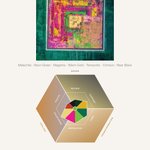
So ArtGraph is built in two halves. Six dimensions read the painting — the part that scales. Three fields read the encounter — what happened to the person standing there. The second half isn't a harder version of the first. It's a different kind of thing, and it has an author.
The scarce thing was never intelligence. It's attention, and the willingness to be changed by what you're looking at.
My father used to say that every great painting begins where language ends.
I didn't paint for decades after I left his house. When I finally did, those words were waiting for me, as if they had never left.
I grew up in Delhi in a house where silence carried the clack of sentences taking shape. Books on every surface. Paintings leaning against the walls, waiting to be hung. The living room smelled of ink, paper and turpentine — the twin perfumes of my parents' worlds.
My father, K.B. Goel, wrote about art with the intensity of someone translating thought into light. He belonged to the generation of post-Independence critics who believed India's modernism could be both rooted and radical. The painters came often. Husain with his sweeping gestures. Souza's sharp laughter. Raza's meditative calm. Swaminathan's quiet mysticism. They talked for hours, not about money or reputation, but about form and spirit. I listened from the edge of the room, too young to follow and old enough to feel it.
My mother was a professor of English literature. She lived by the rhythm of language, every word chosen as if measured against light. From her I learned that words can hold silence as well as sound. If my father taught me how to see, she taught me how to listen.
Two moments from him I have never put down.
Once, in front of one of Souza's angular figures, its face fractured and luminous, he leaned down and whispered: look not at what he painted, but how he thought. That was my first lesson in abstraction. Form is not appearance. It is perception made visible.
And this, which I think about every time someone asks me what a painting means: criticism is not judgment. It is love disciplined by clarity.
They gave me two vocabularies, one of analysis and one of imagination. His world was disciplined and theoretical, hers emotional and interpretive. One sought structure, the other feeling. It took me decades to see that I am the bridge between them, and that my paintings live in the space where their two worlds meet. From him I inherited form: the rigor of composition, the ethics of inquiry. From her I inherited breath: the lyricism of intuition, and the courage not to know.
Together, they gave me abstraction.
When my father died, his books came to me. Hundreds of them. I put them in my studio, not as an archive but as a presence. Some mornings I pull out one of his essays before I begin a painting. His handwriting in the margins, small and exact, reminds me that thought can also be a form of art.
They did not teach me what to see. They taught me how to see: with care, with patience, with curiosity. That, I believe, is the true inheritance of vision. Not taste. Attention.
→ artgraph.co/writing/every-gr…
#artthatlistens #artgraph #artgram

I just published Every Great Painting Begins Where Language Ends medium.com/@ritu/every-great…
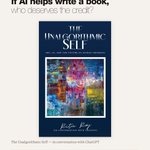
On the cover of my book The Unalgorithmic Self, under my name, it says: IN CONVERSATION WITH CHATGPT.
That line has drawn more questions than anything inside the book, and they almost all arrive as: so who gets the credit?
I think the question is shaped wrong. It folds two different things into one word.
Contribution is what a participant adds. Plenty of things contributed — the model, my editors, thirty years of reading, arguments I no longer remember having.
Authorship is narrower. Choosing which question is worth a year of your life. Judging which claims survive contact with your own experience, and cutting the fluent ones that don't. Standing behind the result when it's wrong.
The model did none of that. Not for want of capability. Because it has nothing at stake.
That's the part people skip. Responsibility cannot be outsourced. You can hand a tool the work. You cannot hand it the consequences — it will accept them without resistance and nothing whatsoever will happen.
The worry is that naming the machine elevates it into a co-author with standing. I don't think it does. We can say what a system did without inventing an inner life for it. Transparency need not become personification.
And originality was never purity. It is the transformation of influence — what you do to what reached you. The question was never whether other intelligences shaped your thinking. It's whether the shaping went through something that could only have happened in your life.
Here's the irony I like: the book argues that lived experience exceeds its computational description. I wrote it in conversation with a computer. Using a system to think harder about what systems can't do isn't a betrayal of the argument. It's how you test it.
So the thing I'd rather we argued about isn't royalties. It's method. Not whether AI was used — how. Drafted and lightly edited? Used to find structure in finished material? Used to argue against me until the weak claims fell over?
Those are three different books. Right now they all carry the same silence.
medium.com/@ritu/if-ai-helps…

A length of string meant to pull a straight line slipped onto the wet canvas. The mark it left was not the line I wanted, and it interested me far more.
I had spent years making systems behave as intended. Now I had a material that refused.
artgraph.co/writing/the-year…

I just published The Years Away Were Part of the Painting medium.com/@ritu/the-years-a…
A description is a map, and a map is not the walk.
AI can name a painting's features and place it in art history. It cannot stand in the room.
The painting is an object. Art is what happens between that object and a person.
artgraph.co/writing/ai-can-g…

Two published, one finished and looking for a publisher.
I did not plan them as a sequence. Set side by side, they are not three subjects. They are three approaches to one question.
Interpretation isn't extraction. It's encounter.
artgraph.co/writing/three-bo…

"What does this look like?" is the wrong question in front of an abstract painting. There is no field on the far side of the canvas.
The better one is quieter: what way of being does this painting invite?
Not what it depicts — what it does.
artgraph.co/writing/way-of-b…

I just published What Happens When a Human Being and Artificial Intelligence Write a Book About What AI Cannot… medium.com/@ritu/what-happen…
A model can write about grief without having lost anything. The sentence may be beautiful. It may even be true. But nobody lived it.
A story told is a pattern. A story lived is a person who was changed by it.
artgraph.co/writing/a-machin…

In 2020 I pulled a length of cotton string through pigment across a canvas. It left a line I could never have planned, and it could not be undone.
Dip, pull, release.
There is no painting over a breath.
artgraph.co/writing/the-line…
#artthatlistens
