

Gathering focused on the use of Open Source in the development of pharmaceuticals
- Tweets576
- Following1.9K
- Followers1.6K
- Likes1.1K





ALT In this hands-on workshop, we will start with a simple example and build it up step by step, using each extension to introduce a new idea and show why it matters.We will use Stan to fit models while developing intuition for priors, likelihoods, posterior inference, prediction, and model checking. We will spend time working directly with posterior draws: understanding what they represent, using them to estimate parameters, and answering questions from fitted models. From there, we will extend the example to hierarchical modeling and see how partial pooling works and when it can be useful.The focus will be on understanding the modeling workflow and the choices we make along the way. Participants should leave with a practical understanding of Bayesian inference, experience fitting models in Stan, and a clear path for applying these ideas in their own work.


ALT With ever increasing complexity of data and analysis, application developers are tempted to put in serious computations into their shiny applications. Given that those shiny applications typically run on infrastructure that has certain resource limitations or sometimes even shared with other shiny apps, more often than not this leads to crashes affecting the overall stability of the system. As a consequence, either other approaches are pursued, or the approach simplified to the point that good science is prevented from happening. in this workshop you will learn how to interact with a remote HPC cluster straight from your laptop. You will run a shiny app locally and remote submit pieces of code to the HPC cluster. By leveraging a multiple of your locally available compute power for a short period of time, you will reduce time-to-result considerably keeping the app fairly interactive. This approach also can be used to connect applications hosted on a Shiny Hosting platform such as Posit

ALT {teal} is an innovative open-source R-Shiny framework that has transformed how clinical trial data is analyzed and visualized in recent years. By streamlining the creation of interactive web applications, it enables R programmers and data scientists to deliver insights faster while promoting efficiency, transparency, and reproducibility in data exploration. This hands-on workshop, built on the latest {teal} 1.0 release, will start from the basics and progressively cover practical topics for building {teal} applications. Together, we will explore key features of {teal} and work through step-by-step exercises designed to build confidence and proficiency in {teal} programming. No prior experience with {teal} or attendance at previous workshops is required - all R users are welcome. Designed to deepen participants’ understanding of the {teal} framework, this session will equip attendees with the skills to leverage the {teal} ecosystem to create scalable, reproducible applications that acce

ALT Join us for an engaging workshop designed to introduce Dataset-JSON, a powerful format for sharing datasets. We'll start with an environment setup and explore the motivation behind choosing Dataset-JSON over other formats like Parquet. The session will include a detailed walkthrough of the Dataset-JSON specification, followed by hands-on demonstrations and exercises in both R and Python. Discover how to implement Dataset-JSON in your workflows, learn about upcoming adoption plans, and explore future roadmap and API integrations. This workshop is perfect for data professionals interested in improving dataset interoperability and sharing standards.


ALT GSK’s journey to Clinical Study Reporting Using Open Source GSK’s Journey to Clinical Study Reporting Using Open Source chronicles the transformation of clinical reporting at GSK, the presentation marks pivotal moments in the pharmaceutical industry’s evolution—from the proprietary, SAS-dominated era of the 1980s and 90s, through the pain of rising R&D costs and global health crises, to the emergence of collaborative models and open-source innovation. The story highlights how industry challenges catalyzed a shift toward openness and collaboration. Key milestones include the FDA’s clarification on software neutrality, the rise of R and open-source platforms, and GSK’s commitment to writing at least 50% of code in open-source languages. The COVID-19 pandemic accelerated this transformation, driving rapid adoption of data science platforms and collaborative tools. GSK’s multi-wave approach to change is shared and candidly addresses ongoing challenges: technical validation, regulatory un

ALT The number of workflows and tools leveraging large-language-models (LLMs) is growing exponentially across the world, and the life sciences industry is no exception. In this session, Eric Nantz takes the role of the curious and savvy data scientist as he is joined by Posit CTO Joe Cheng in a special live demonstration on using Databot to power an exploratory data science analysis. Throughout the demonstration, Joe will share the fascinating origin story of how Databot came to be, along with a deeper conversation on the recent trends and guiding principles of harnessing AI tools for data analyses and software engineering. This interactive, spontaneous format will allow the audience to submit questions and steer the direction of the session, making it a truly engaging, shared experience.

ALT Simon (he/him), an R developer and data scientist. I build tools for data scientists at Posit PBC (formerly RStudio).🐛 focused on helping R users get the most out of LLMs: tidyverse/vitals: LLM evaluation posit-dev/mcptools: Model Context Protocol (MCP) servers and clients in R posit-dev/btw: easily provide context on R stuff to LLMs simonpcouch/gander: high-performance, low-friction chat for data science simonpcouch/chores: an extensible collection of LLM assistants simonpcouch/predictive: an agentic frontend for predictive modeling with tidymodels simonpcouch/kapa: RAG-based search via the kapa.ai API

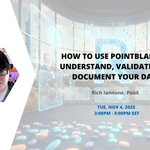
ALT With the pointblank package it’s really easy to methodically validate your data whether in the form of data frames or as database tables. On top of the validation toolset, the package gives you the means to provide and keep up-to-date with the information that defines your tables. https://rstudio.github.io/pointblank/

ALT Polars: The Blazing Fast Python Framework for Modern Clinical Trial Data Exploration

ALT R/Pharma conference registration is now open. R/Pharma is a free conference covering the use of R and other open source technologies in Pharma and Biotech industries. This year the conference will run from 3-7 November with both a Europe/US and an APAC track.