
Incoming assistant professor of psychology at Manhattan University. I study the psychology of communication in digital spaces.
Joined November 2008
- Tweets1.1K
- Following747
- Followers687
- Likes793






Pinned Tweet
Why do people see the same thing and disagree on what they saw? We presume our own interpretation is the obvious and correct one. But undetected misinterpretations may be an underappreciated factor online and could warp perceived consensus:
bit.ly/49jbyZa

!

Google just automated the PhD.
They built an AI that reads a problem, forms hypotheses, runs experiments, writes the paper, AND simulates its own peer review. no human touches it.
It’s called “ScientistTwo”
It is a fully autonomous multi-agent framework that executes end-to-end machine learning research.
Without a single human in the loop.
You give it a fundamental challenge. That’s it.
The AI independently navigates the literature. It establishes the baselines. It formulates novel hypotheses.
Then it writes the code. It runs the experiments. It conducts its own ablation studies.
It even argues with a simulated peer-review engine to refine its work before submitting.
The results are staggering.
Researchers tested ScientistTwo against the highest standards of human scientific achievement—papers accepted at top-tier conferences like NeurIPS and ICML.
The AI improved human state-of-the-art results on 86 different tasks.
It generated an average performance gain of 25.2% over the absolute best human models.
It didn't hallucinate a single citation. It wrote fully executable, verified codebases. And it autonomously generated expert-level, publication-ready papers.
We’ve spent the last two years using AI as a highly advanced intern to help us write code and summarize data.
That era is over.
ScientistTwo isn't an assistant. It is an autonomous scientific pioneer.
It doesn't just summarize the frontier of human knowledge. It expands it.
If an AI can autonomously hypothesize, test, and publish breakthroughs in machine learning...
How long until it discovers something we don't even have the math to understand?

18
More evidence that generative AI can harm learning.

Generative AI can harm learning.
A field experiment published in PNAS randomized nearly 1,000 high-school students across three conditions during mathematics classes:
- textbooks and notes only
- a standard GPT-4 interface
- a safeguarded GPT-4 tutor that provided hints rather than answers
Students first completed practice problems with these resources. Immediately afterwards, they took a closed-book, closed-laptop exam on similar problems.
The results are impressive.
During practice, AI made students look much better:
Standard GPT-4: +48%
Safeguarded GPT tutor: +127%
But when the AI was removed, students who had used standard GPT-4 performed 17% worse than students who had never used AI.
The apparent improvement concealed a deterioration in learning.
The safeguarded tutor eliminated this negative effect, but produced no improvement in independent exam performance.
The reason? Simple:
Students using standard GPT-4 frequently asked for the answer and just copied the solution.
They surrendered cognition.
I’m very concerned, especially for children who will have more and more unregulated access to generative AI and may never develop critical thinking skills.
*
Paper in the first reply

43
This is really interesting - evidence that AI increases our illusion of knowledge and makes us more confident, even when wrong.
New preprint 🚀
The ability to say "I don't know" is crucial to human judgment.
But AI now provides answers to almost every question. Often unsolicited, as with AI summaries.
So we asked a simple question: Does access to AI advice make people less willing to suspend judgment?
We conducted five experiments, with more than 3,000 participants.
The results are brutal.
AI advice nearly eliminated people's willingness to say "I don't know".
Judgment suspension fell from 44% to 3%.
Critically, we designed the task so that the AI advice was incorrect.
Accuracy collapsed: correct answers fell from 27% to 9%.
At the same time, confidence exploded: from 30/100 to 76/100.
Yes, you read that correctly: with AI advice, people were about one-third as accurate while being two and a half times as confident.
We then introduced monetary stakes.
Stakes increased judgment suspension, but it still remained far below baseline, around 6–8%, depending on the study.
Interestingly, stakes also increased accuracy when AI advice was available, from 9% to 16%.
So, when errors became costly, some people managed to override the AI. This is a bit reassuring, but accuracy and judgment suspension still remained well below baseline.
The lesson is not simply that AI can be wrong.
It is that AI may erode our ability to recognize the limits of our knowledge.
And it can even make us confidently wrong, when we would be right.
*
Full paper in the first reply
with @chiaramma & @Walter4C

1
43
Really interesting finding that people with better working memory actually engage less with the content of social media posts and articles. Instead, they spend their effort on who posted. sciencedirect.com/science/ar…
17
There is still time to register for the Institute of Cognitive Sciences (ISC) at the Université du Québec à Montréal (UQAM) on conference on knowledge, beliefs, and decision-making.
sites.grenadine.uqam.ca/site…
18
It seems like even more research is needed to understand why so many people outsource their decision making to an LLM in the first place.
This post is from a suspended account. Learn more
23
This is great advice for anyone working on their dissertation right now - don’t wait for the marathon writing window; snack write every day!

Most academics believe the big lie about writing blocks.
They think they need 4-hour stretches to make progress.
So they wait for breaks. Wait for sabbatical. Wait for summer.
Meanwhile, their drafts collect dust and their ideas go stale.
Here's what actually works:
39
SPSP is still accepting applications for volunteers on various committees (deadline is November 19th!). This is a great opportunity to help shape the organization and connect with other members. Here's the link:
spsp.submittable.com/submit/…
21
Ever read a tweet and totally misread the tone? 😅
We’re studying how people interpret social-media posts.
Take part on @Prolific → ~20 min | $5
Join here 👉 prolific.com/participants
#Prolific #OnlineStudies #Psychology #AcademicTwitter

41
📚New in Public Opinion Quarterly: Live video can change how people feel about answering sensitive questions—but not in the same way for everyone. Example: For some, seeing and being seen can make them MORE at ease, for others LESS at ease. academic.oup.com/poq/advance…
25
Wow - interesting.

In this study, Liang et al. estimate the prevalence of LLM-modified text in recent scientific papers and preprints, finding widespread use (up to 17.5% of papers in Computer Science).
nature.com/articles/s41562-0…

22
“The credibility of American statistics is foundational. It undergirds investor trust. It guides fiscal and monetary policy. It tells businesses when to hire, when to expand and when to hold.” nytimes.com/2025/08/03/opini… via @NYTOpinion

31
So interesting. It seemed like LLMs were THE theme this year at every conference I attended from social psych to public opinion.

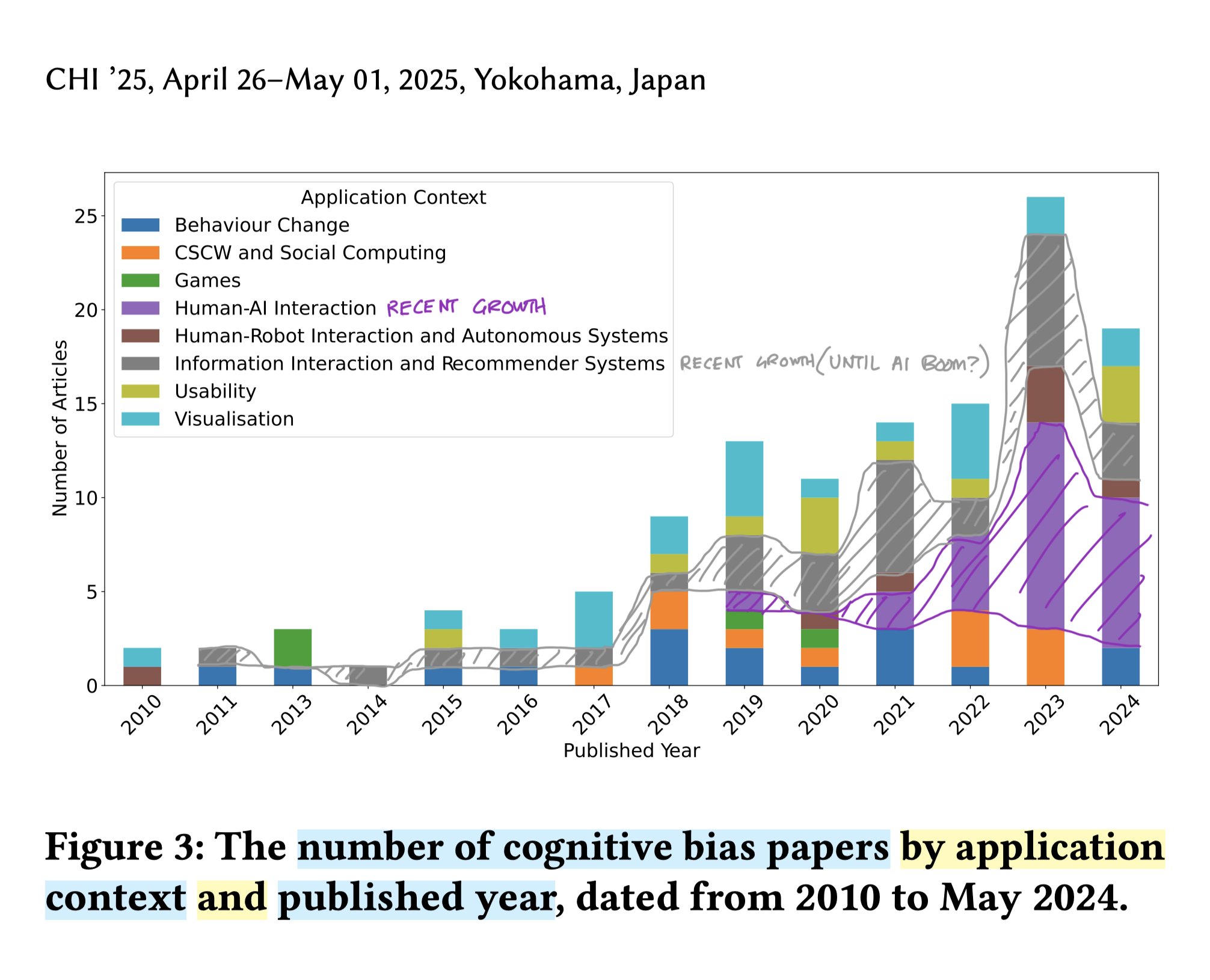
What have papers about #cognitiveBias been focusing on since 2010?
Plenty of work on #behaviorChange or #visualization.
But human-computer interaction (#HCI) appeared in 2019 ...and became the plurality?
doi.org/10.1145/3706598.3713…
#CogSci #psychology #CompSci #AI #edu #dataViz

ALT Methods
ALT Results
39
New research shows that the most polarized, hostile voices we see online make us think the world is more extreme than it actually is.


📗New paper in Discourse Processes📗
Do readers of social media interpret posts the way authors intended?
We asked authors what stance they intended to convey in a post they tweeted about Roe v. Wade.
Thread 🧵(1/n)
1
31
The Real Dangers of Social Media | Psychology Today psychologytoday.com/us/blog/…
26
Can We Really Predict the Presidential Election | Psychology Today psychologytoday.com/intl/blo…
1
28