
Finance, technology and interdisciplinary analysis. AI-native.
Joined June 2021
- Tweets219
- Following793
- Followers588
- Likes4.8K






A common misconception among maxis is the belief that prices trend upward because the halving reduces supply. In reality, it’s the exact opposite: the price needs to double with every halving just for miners to maintain their operating margins.
The second misconception is the belief that reduced supply will have an increasingly larger impact on price over time. This is also the opposite of the truth. With the vast majority of the supply already in circulation, the impact of marginal block supply approaches zero. In fact, investor supply and demand on exchanges has been the driving force of the price for a long time now.
No matter how much I read up on this, it seemed like they had it completely backwards, so I had an AI write out the math—and it turns out I’m right. Bitcoin's supply mechanism doesn't dictate its price; rather, the price is what dictates the survival of the Bitcoin network.
To be clear, this post is not a stance about the price of Bitcoin. I cannot predict the investor sentiment of the future.

1
34

A simple truth about hedge funds: beating the market isn't the only metric that matters.
For multi-strategy and quant giants like Balyasny or Point72, the true holy grail is low volatility and predictable returns. They achieve this through a highly structured "Pod" system. Dozens of Portfolio Managers operate like mini-CEOs under one roof, laser-focused on generating returns in their specific niches. Meanwhile, a central desk aggregates these positions in real-time, mechanically hedging out broader market risk.
It’s a ruthless, pro-sports-like arena. Your annual bonus is entirely dictated by your Pod’s P&L. Underperform, and you are ruthlessly cut before you can drag down the firm's overall returns. Perform well, and you might jump ship to a rival for a massive sign-on bonus.
Noticeably absent from this new elite tier? Ray Dalio’s Bridgewater.
Over the last decade, his macro-model-based funds struggled to navigate the QE-distorted markets of the 2010s. The traditional inverse correlation between equities and bonds completely broke down—instead of acting as a counterbalance, both asset classes began crashing together. Personally, I believe relentless quantitative easing played a massive role here, though in the world of macroeconomics, definitively proving these dynamics is nearly impossible.
On the flip side, the market's new kings—ultra-short-term quant funds—operate in an entirely different reality.
• Zero theoretical bias: They ignore intrinsic value entirely.
• Micro-holding periods: Positions are often held for less than a day.
• Data-driven execution: Much like the “Attention is all you need” mechanism in Transformer models, they assign the highest weight to the most recent, short-term data patterns.
The irony is that Dalio’s lifelong emphasis on a “principled” macro approach became the very root of Bridgewater’s recent underperformance.
So, is the era of "principled" fundamental investing dead?
Actually, no. The very funds that grew massive by feeding on short-term inefficiencies are now facing a structural dilemma. Their AUM has grown so bloated that their rapid-fire trades are creating too much market impact.
To survive this scale, these new heavyweights are being forced to adapt: either return capital to investors or, ironically, lengthen their holding periods and pivot back to investing heavily in fundamental analysis.

2
252
I’ve spent over a year conceptualizing and pitching our "Generative Logic Engine" (GLE) architecture.
Today, I sat down with Claude, and it completely grasped the nuances of the system in under an hour.
Not only did it understand the core mechanics, but it perfectly crystallized the concept with a term I hadn't even thought of: "LLM as a compiler." Honestly, Claude is proving to be a better architectural sounding board than most humans right now.
As I explained the mutational logic nodes in more detail, it genuinely seemed to geek out, independently synthesizing this incredible insight:
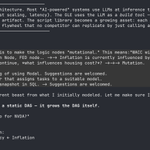
"This is a genuinely novel architecture. Most 'AI-powered' systems use LLMs at inference time and inherit all their problems (non-determinism, cost scaling, latency). The GLE uses the LLM as a build tool—like a compiler that runs once and produces a deterministic artifact... creating a flywheel that no competitor can replicate by just calling an API."
Seeing it marvel at the design on its own made me ridiculously proud. Is this how parents feel when they brag about their kids' report cards? 😅
(Disclaimer: I will not be entertaining conspiracy theories about Anthropic secretly cranking up the "flattery weights" right before their next funding round.)

165
I built a service that extracts my thought patterns from a database of my writings over the years, then crawls various websites and my email inbox once a day to recommend content I should care about. Unlike a typical content recommendation engine, I also baked in an algorithm designed to correct my own biases by actively seeking out information that challenges my existing thoughts and ideas.
I also designed it so the algorithm incrementally updates with every daily run. It does this by logging the information that was crawled but filtered out, and by allowing me to leave feedback on the recommended content via dedicated buttons.
Essentially, I've built a "digital brain" that evolves alongside me. It’s still at the prototype stage, of course, but it’s absolutely mind-blowing that we live in an era where you can whip something like this together in just two days.


1
54
Following Anthropic's announcement that its Claude Code product is capable of modernizing COBOL—a legacy programming language predominantly used in the banking sector—shares of IBM, the company that developed the language, have plummeted, dragging other software companies down with them.
COBOL is so deeply entrenched in financial IT systems, yet new talent hasn't been trained in it for quite some time. As a result, retired veterans are often quietly brought back in through word-of-mouth for maintenance, and new features are simply patched onto existing systems. This approach has long been pointed out as a major issue from both a modernization and efficiency standpoint.
While there is no disputing that Claude Code can assist in modernizing COBOL to a certain degree, the real reason the U.S. financial sector hasn't modernized isn't that their internal teams actually lack the capability. A much more accurate interpretation is that they simply haven't attempted it because the risks of completely overhauling a core system built up over 70 years are astronomically high.
There are even stories circulating that Microsoft lacks new developers who know C++, effectively forcing them to write OS native UIs using React-based web views (a massive waste from a performance perspective). Against this backdrop, thinking that banks will overhaul their IBM mainframe systems overnight just by hooking up Claude Code to refactor core COBOL code—which is used in mission-critical backends, not just frontends—is a notion only someone completely ignorant of both the technology and internal decision-making processes could entertain.
There is currently a very active debate surrounding what AI can do and which professions it might replace. As someone who uses it on a daily basis, I also see it as a technology with boundless potential; if this linear growth curve continues, it certainly seems likely that a significant number of jobs could be replaced. However, I believe we are now at a point where we need to consume these claims carefully, taking the vested interests of the speakers into account.

1
118
Forget "Whale Watching" 🐋, here is the real reason Bitcoin is losing its value:
Price has fallen ~38% from its highs, and while influencers scream "watch the whales," they are looking at the wrong data. The real driver isn’t on-chain sentiment—it’s a mechanical structure called the Gamma Trap.
But why is this trap so much deadlier for Crypto than for Stocks? It comes down to the lack of a "rational backstop."
1. The Mechanics of the Crash 📉: When fear rises, investors rush to buy Put Options. Market Makers (MMs) take the other side (sell the options). MMs aren't gambling; they rely on algorithms to stay market neutral.
When they sell Puts, they become "Short Gamma."
To hedge, they must sell Bitcoin when the price drops.
The lower the price goes, the more their algorithms are forced to sell.
It’s a feedback loop: Selling ➔ Price Drop ➔ More Mechanical Selling.
2. The "Backstop" Problem⚖️: In the stock market, this loop eventually hits a concrete floor: Fundamental Value.
Stocks: If a solid company crashes 50%, its dividend yield might jump from 3% to 6%. The P/E ratio drops. The stock becomes mathematically "cheap." Value investors (like Warren Buffett) eventually step in, not on faith, but on earnings data. They act as a natural circuit breaker.
Bitcoin: Bitcoin has no earnings, no dividends, and no cash flow. In crypto, Price = Value. Its value is derived entirely from the collective belief of its holders.
3. The Liquidity Vacuum 🕳️: This is the fatal flaw during a crash. When a stock crashes, the value proposition improves (it gets cheaper). When Bitcoin crashes, the value proposition deteriorates (conviction breaks).
As the Gamma Trap forces MMs to dump Bitcoin, there are no "Buffetts" waiting at a specific valuation level to absorb the supply. The conviction that acts as support evaporates along with the price, creating a vacuum where mechanical selling meets zero buyers.
Stop looking for "whale wallets" (which are mostly just exchange ledgers). The real story is that in a Gamma Trap, Bitcoin has no deep-pocketed Buffets to save the day.

2
2
129

$META (+7%) vs. $MSFT (-7%): A Tale of Two AI Strategies. 📉📈
Investors punished Microsoft this week not just because AI costs are soaring, but because of how they are deploying that capital. The rise of the term "Microslop" highlights a critical failure: Microsoft appears to be prioritizing forced AI adoption rates over actual user experience.
Shoving Copilot into every corner of the OS does not automatically equal productivity, and investors fear the massive 66% CAPEX jump isn't generating a commensurate return in cloud growth.
Contrast this with Meta.
Zuckerberg didn't just pivot to AI for the hype cycle; they invested billions starting back in 2021 to survive. After Apple's iOS privacy changes nuked their ability to target ads, Meta used that compute power to rebuild their backend recommendation algorithms.
The result of invisible vs. forced AI:
• Microsoft: High spend, lukewarm user sentiment, slowing Azure growth relative to CAPEX.
• Meta: Better backend algorithms -> users stay longer -> Ad revenue per user +16%.
The verdict for 2026 is clear: AI is not the product. Problem-solving is the product. Microsoft forgot this; Meta remembered.
Full breakdown in the comments ⬇️

2
1
284

I just built a Senior Engineer out of a text file.
I am not a coder, but I spent the weekend shipping a full design system. The secret wasn't better prompting—it was curing AI "Context Bloat."
Agents usually forget things. So I built a system (v5.0) centered on a continuous improvement feedback loop enabled by a strict Orchestrator ↔ Sub-agent protocol.
• The Protocol: Agents can't just return code; they must communicate findings to a shared Cache.
• The Loop: A "Flush" mechanism permanently writes those findings into the system's "Brain" (Rule files).
The architecture literally learns from its own debugging cycles. It is a self-correcting machine.
Live demo, architecture breakdown, and repo link are in the comments.


Common discourse often mischaracterizes Waymo’s autonomous driving stack as relying on legacy "rule-based" logic or HD maps, contrasting it with "end-to-end" AI competitors. Recent technical disclosures regarding Waymo’s EMMA (End-to-End Multimodal Model for Autonomous Driving) architecture refute this.
Waymo utilizes a structured E2E approach that integrates the reasoning capabilities of Gemini. Unlike monolithic "black box" models that rely solely on pattern matching, Waymo’s architecture distinguishes between immediate reactive layers and higher-level logical reasoning:
• Sensor-Fusion Encoder (System 1): Processes real-time inputs for immediate "reflex" responses.
• Driving VLM (System 2): Applies vision-language modeling to interpret causal relationships in complex scenarios (e.g., identifying a fire hazard and deducing the need to reroute).
Furthermore, Waymo’s Generative World Decoder goes beyond trajectory prediction by employing counterfactual reasoning—simulating multiple potential future interactions to validate safety prior to execution. This represents a significant architectural divergence from standard next-token prediction models in the sector.
I postulate that Tesla has to update their architecture to mimic Waymo’s because addressing “edge-cases” in one monolithic model is cost prohibitive and difficult to debug.

3
5
291
Fully explained article here:
awarelab.io/en/aware-origina…

2
159
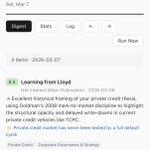
Goldman says AI isn’t a bubble like the dot-com era because corporate debt isn’t being used. That is hugely misleading because most of the data center debts are funded by asset-backed private credit vehicles instead of “corporate debt.”

2
177
I agree with all of his points except for shorting the stock. Tesla stock price is a proxy of collective belief in Musk, not the underlying business. I just wouldn’t bet against religions.

I get asked this a lot. Almost every time I do an economic space, in fact. "Why do you hate $TSLA so much?"
It's all a scam, from every angle. Anyone who has access to Tesla insiders will hear the same story from them: The whole Optimus experiment is largely a fraud. Every notable executive on the project has left the company, and the vast majority of the engineers took off, too. Every demo of Optimus was telecontrolled by a human in a nearby room - the robots themselves have absolutely no autonomous capabilities and are years behind their competitors. This isn't "inside information", this is something various engineers have said and Tesla has admitted; what I've heard from former executives largely just serves to validate what has been said publicly as "understating the problem".
Nobody wants their cars. Robotic taxi service is going to become a commodity service, and Tesla is way behind its competition there with no path to close the gap. The solar roofs were a great idea executed terribly (I have the solar roofs on multiple properties, and they're great, but I'd never buy another one because of the Tesla factor). The only interesting vertical in the entire company is the power delivery unit. It's growing at a VERY healthy clip, but the margins aren't there and at best help wipe away some of the NEGATIVE value of the company in other verticals.
Tesla is a stock that is buoyed by nothing more than dumb money that keeps piling in to it and a CEO that gets away with making fraudulent claim after fraudulent claim with no repercussions. It has a useless board that won't keep him in check, and instead allows him to continue consolidating power when he's run the company terribly over the last few years.
And THAT'S why I shorted it heavily at the end of 2024 (and made a fortune doing so) and why I again shorted it at the end of 2025. It's simple: I don't go long on bad companies with bad prospects.
1
166
Ryunsu Sung retweeted

Prediction: 2026 is going to be the year Memory Tiering eats the world.
The pieces are already there:
- Memory Shortage (duh)
- CXL 3.1 realistically purchasable (memory pooling)
- Linux Transparent Page Placement becomes opt-out instead of opt-in
- Kubernetes DRA (dynamic resource allocation) graduated to stable
- systemd-oomd kill threshold getting smarter
All of these are building on each other to allow extreme over-provisioning of ram on hyperscalers.
You might think your cloud instance has 128gb of RAM…it could be only 32GB of real DRAM. It’s just really, really clever.
I’ll be writing a series over the next few days on each of these, stay tuned!


The amount of noise added to each data abstraction layer is quite massive.

Investors: JPMorgan says Venezuela has largest oil reserves
JPM: That comes from an OPEC report
OPEC: Our members self-report. Ask Venezuela
Venezuela: We get that from PDVSA
PDVSA: Hugo Chavez told us years ago to report that for prestige & now we'd look bad if we lowered it

94