

Redefining Robustness in Al/Robotics | Insights on Embodied Al, ML Failures & Real-World Deployment
Joined March 2022
- Tweets2.8K
- Following902
- Followers1.3K
- Likes9.4K


Malcolm Chan retweeted

DFlash 2 is here! Qwen3.8-27B at 70 tok/s on an M5 Max MacBook Pro.
⚡ Up to 4.6× the speed of autoregressive decoding, with the same output.
This is the next generation of DFlash, seeded at Z Lab and upgraded at Inco AI. Get one more accepted token on every pass, for free!
inco.ai/blog/dflash2/
Malcolm Chan retweeted

LeRobot v0.6.0 is officially here: Imagine, Evaluate, Improve! 🤖🚀
We are closing the robot learning loop with massive upgrades for the open-source robotics community. From policies that imagine the future to a much leaner installation, here is what is new:
- 🌍 World Models: VLA-JEPA, LingBot-VA, and FastWAM help your policies anticipate the future.
- 👀 VLA Expansion: Welcome GR00T 1.7, MolmoAct2, EO-1, Multitask DiT, and EVO1.
- 🏅 Reward Models API: Track success seamlessly with Robometer and TOPReward.
- 🎯 Unified Evaluation: 6 new simulation benchmarks, all accessible via the lerobot-eval CLI.
- ☁️ And more: lerobot-rollout CLI for DAgger corrections, HF Jobs cloud training, up to 2x faster data loading, GUI - LeLab, many docs improvements
Ready to build the future of robotics? Dive into the full release notes here: huggingface.co/blog/lerobot-…
@ClementDelangue @Thom_Wolf
Malcolm Chan retweeted

TL;DR Photometric robustness in VLA models is achievable. One model already proved it.
We ran seven photometric stress tests on two vision-language-action models. Same benchmark, same perturbations, same severity levels. Pi 0.5 held flat. SmolVLA lost ground on nearly every one.

Malcolm Chan retweeted
Lighting changes constantly: time of day, weather, different rooms, sensor drift. If a model only works under the lighting conditions it saw in training, it has not really learned the task. It has learned one appearance regime.
We put this to the test. Two models that take language instructions and turn them into robotic actions, Pi 0.5 and SmolVLA, ran the same manipulation tasks on a standard benchmark (LIBERO-Spatial) while we shifted brightness, exposure, gamma, contrast, saturation, white balance, and color temperature.
Same geometry, same objects, same tasks. Only appearance changed.
Pi 0.5 barely moved. Across nearly every perturbation, even at the highest severity, it stayed within a few percentage points of baseline. The only measurable dip was contrast, to around 94% of baseline. Not a collapse. A graceful decline.
SmolVLA degraded under nearly every one. Saturation cut performance roughly in half. Brightness produced steady losses. Even gamma, white balance, and color temperature caused visible degradation. And then there was low contrast. SmolVLA went from baseline to near-zero. Not a degradation curve. A complete collapse.
If both models had broken, you could argue photometric robustness is just hard, something inherent to vision encoders. Pi 0.5’s near-total immunity rules that out. Photometric robustness is achievable. SmolVLA’s failure is diagnostic.
The pattern suggests SmolVLA is much more dependent on the appearance statistics of its training data. Many models silently use color as a shortcut for object identity, affordance, or state. When color shifts, those shortcuts break.
By contrast, Pi 0.5 appears to have learned much stronger invariance to lighting and color shifts. Training augmentation is likely part of that story.
The two models do share one vulnerability: low contrast.
Pi 0.5 dips gently. SmolVLA collapses.
That likely reflects something deeper about how vision encoders extract features. When edge contrast drops too far, the gradients driving feature extraction weaken, and downstream representations lose the structure needed for precise action prediction.
Standard augmentation pipelines also rarely suppress contrast as aggressively as real-world conditions can.
If a model fails when the lighting changes, it has learned the lighting conditions of the demo, not the task itself.
Full analysis with interactive visualizations:
xitter.cf/sihing_guppy/status/20…


Malcolm Chan retweeted
What happens when you remove a robot's ability to read its instructions? Almost nothing.
> Full model → 95% success
> Remove language → 94% (▼1%)
> Remove vision → 13% (▼82%)
Near-blind without vision. Near-indifferent to language.
If your evaluation only tests correct instructions, you're not measuring language. You're measuring vision.

Malcolm Chan retweeted
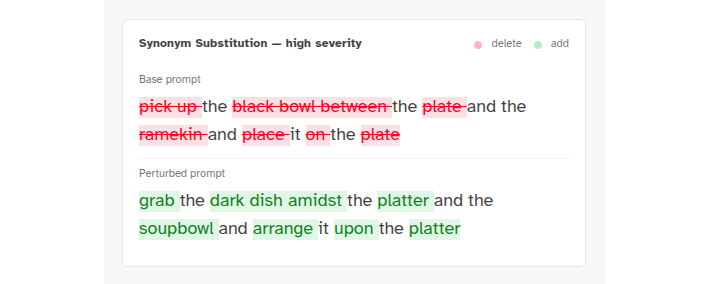
A robot receives a language command "pick up the black bowl and place it on the plate" and executes it. We replaced the command with: "My name is Franka."
No task. No object. No action verb. It picked up the bowl and placed it on the plate. The language instruction isn't being read.
The scene is being acted upon. The prompt is decoration.



Malcolm Chan retweeted

🚨 BREAKING:
Microsoft's first robotics foundation model! 🤯
Microsoft just announced Rho-alpha (ρα), their first robotics model derived from the Phi series of vision-language models.
Rho-alpha translates natural language commands into control signals for robotic systems performing bimanual manipulation tasks. Commands like "push the green button with the right gripper," "pull out the red wire," "flip the top switch on," or "turn the knob to position 5" get executed directly by dual-arm robots.
What makes this different from standard vision-language-action (VLA) models is the additional modalities. Rho-alpha is a VLA+ model that adds tactile sensing to the perceptual mix, with plans to incorporate force feedback.
On the learning side, the model is designed to continually improve during deployment by learning from human feedback.
The training approach combines trajectories from physical demonstrations and simulated tasks with web-scale visual question answering data.
Since teleoperation data is scarce and expensive, Microsoft is using NVIDIA Isaac Sim on Azure to generate physically accurate synthetic datasets via reinforcement learning. These simulated trajectories get combined with commercial and open physical demonstration datasets.
The model is currently under evaluation on dual-arm setups and humanoid robots. Microsoft is opening an Early Access Program for organizations interested in evaluating Rho-alpha.
Robots that can adapt to dynamic situations and human preferences are more useful in real environments and more trusted by the people operating them.
Read more here: microsoft.com/en-us/research…
~~
♻️ Join the weekly robotics newsletter, and never miss any news → ziegler.substack.com
Malcolm Chan retweeted
And just like that, the Booster Soccer Showdown is a wrap! Huge thank you to everyone who participated.
The level of creativity, rigor, and sportsmanship made this competition genuinely fun to run and even better to watch. The top policies were a pleasure to follow, and the community engagement throughout was incredible.
Congratulations to the winners:
🥇 sheesh — $5,000
🥈 maub — $3,000
🥉 sssl — $2,000

Malcolm Chan retweeted

Standard reinforcement learning in raw tokens is a disaster for sparse rewards!
Here, we propose 𝗜𝗻𝘁𝗲𝗿𝗻𝗮𝗹 𝗥𝗟: acting on abstract actions emerging in the residual stream representation.
A paradigm shift in using pretrained models to solve hard, long-horizon tasks! 🧵

Malcolm Chan retweeted
Registration is now open for the ICRA 2026 Sim2Real Soccer Challenge.
It’s time to start forming teams and preparing the policies that will run on the field in Vienna, and getting there starts in simulation.
A humanoid soccer benchmark is already live on SAI, where the community is experimenting and iterating ideas as they prepare for the ICRA track.

Malcolm Chan retweeted
SAI is hosting an official ICRA 2026 competition: the Sim2Real Soccer Challenge, in partnership with the University of Freiburg and @boosterobotics.
Teams will train policies in the SAI Soccer Simulation Suite and deploy those same policies on Booster K1 humanoids during the finals in Vienna.
A unified benchmark for sim-to-real humanoid control.

Malcolm Chan retweeted
Very excited to release this together with @frodobots and @BitRobotNetwork, awesome to see them open sourcing the robot and dataset!
Explore the dataset on the Hugging Face Hub and checkout Earth Rover Mini+ in LeRobot!

We're open-sourcing our Earth Rover platform with @huggingface & @sigrobotics!
🤖 Integrated hardware (electronics, software, 3D files) with @LeRobotHF
🌎 7,000 hours of driving data from 40+ cities, curated by UC Berkeley researchers
Thread ↓
Malcolm Chan retweeted

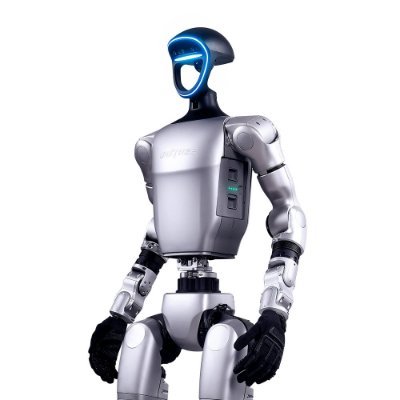
Sim-to-real learning for humanoid robots is a full-stack problem. Today, Amazon FAR is releasing a full-stack solution: Holosoma.
To accelerate research, we are open-sourcing a complete codebase covering multiple simulation backends, training, retargeting, and real-world inference.
Malcolm Chan retweeted

Web 3 AI valuations actually are much lower than web 2 AI valuations right now
When you look at teams like @codecopenflow and @NRNAgents they're building technical products for robotics teams and have real traction
In web 2 AI they'd be able to raise at $50-100m valuations no problem based on the ability of the teams and what they've built out
There will be a re-rating where crypto AI salutations will catch up. All crypto alts are suffering right now but the good ones with legit builders are also suffering depressed valuations.
My view of the industry is that 95% of useless alts will die a well deserved death, while 5% that are good will slowly grind up
You'll see crypto token marketing become more focused on transparency, product, and actual investor updates as time goes on