

✦SEO Expert ✦Entrepreneur ✦DataPrivacy #Pragmatic #OpenNetworker #StockMarket
Pune, India
Joined March 2010
- Tweets1.2K
- Following1.3K
- Followers302
- Likes2.8K





Rohit Bhalunkar retweeted

Here is the full video. 😂
I don’t think anyone in Ajay Devgn’s entire career has roasted him like Sumit Saurav just did. 😂
This 9-minute video will have u laughing harder than some of the best comedy films u’ve ever watched. 😭
Rohit Bhalunkar retweeted

Clayton Christensen studied why successful companies collapse. In his final Harvard class, he asked students to apply the same theory to their own lives.
Bookmark & watch today, no matter what.
Rohit Bhalunkar retweeted

LISTEN FROM A MAN WHO BEAT S&P500 A SON OF WILLIAM O'NEIL.
Topic: How Leading Stocks Act in A Bear Market
Rohit Bhalunkar retweeted

Tony Robbins literally explained why the same person can make a fortune one year and lose it the next with the exact same brain. It is not the market. It is not the strategy. It is the state your body is in when you decide.
He coached a trader named Paul Tudor Jones for 22 years. In 1987 the stock market had its worst single day crash in history. Jones made 200 percent while everyone around him was destroyed.
Then he went cold. Same brain, same data, same models. He started losing money month after month and could not figure out why.
Robbins flew in and watched him trade all day. Shoulders down, breathing shallow, slumped in his chair. He pulled up footage of Jones at his peak. Standing, moving, voice raised, commanding the room.
Jones watched both tapes. He said those are two different people. Robbins told him the fix was not a new strategy. It was a new posture.
He changed how Jones stood, breathed, and used his voice. The trades came back on their own.
Robbins said the body decides first. Posture, breathing, voice. The mind follows. Change the body and the choice changes. Most people check their money slumped on a couch after a long day.
This interview is sitting on the internet for free. Almost nobody changes how they sit before they open their banking app.


Rohit Bhalunkar retweeted

MIT professor Denis Auroux teaches the one optimization trick behind every AI model at OpenAI, Google DeepMind, and Meta - and why every quant at Two Sigma uses it to build $10 billion trading strategies.
It's called Lagrange multipliers. One lecture. Changes how you see every optimization problem.
Most optimization is simple: minimize a function, set derivatives to zero, done.
But real problems have constraints.
Build the smallest pyramid with a fixed volume. Train a neural network with a fixed compute budget. Find the portfolio with the highest return at exactly this level of risk.
You can't just set derivatives to zero anymore. The constraint changes everything.
Watch the moment (around 6 min in):
He draws a hyperbola on the board and asks: what is the closest point to the origin?
You could solve for y in terms of x and substitute. But that only works when the constraint is simple.
Instead, he draws the level curves of the distance function as circles around the origin. Then he shrinks the circles until one of them just barely touches the hyperbola.
That touching point - where the circle is tangent to the hyperbola - is the answer.
And the geometric key: at that point, both curves have the same tangent line. Which means their gradient vectors are parallel.
That's the entire method. Gradient of f equals lambda times gradient of g.
This is the math behind every Support Vector Machine at Google and Meta - the algorithm that classifies billions of images and ads daily.
SVMs are literally a Lagrange multiplier problem. Maximize the margin between classes subject to the constraint that all points are correctly classified.
Every time Instagram decides what ad to show you, it runs this calculation.
Neural network training with weight constraints, portfolio optimization at Bridgewater, drug molecule design at Pfizer - all Lagrange multipliers.
OpenAI's RLHF method that made ChatGPT actually useful is constrained optimization at its core.
The lecture ends with a harder problem: build a pyramid with a fixed volume and minimum surface area. Where do you place the top?
Lagrange multipliers give the answer in a few lines: the top should sit directly above the incenter of the triangle - the point equidistant from all three sides.
A result that would take pages of geometry falls out of one equation.
MIT 18.02, Lecture 13. Denis Auroux. Free on YouTube.
bookmark this if you're learning calculus or machine learning

Rohit Bhalunkar retweeted

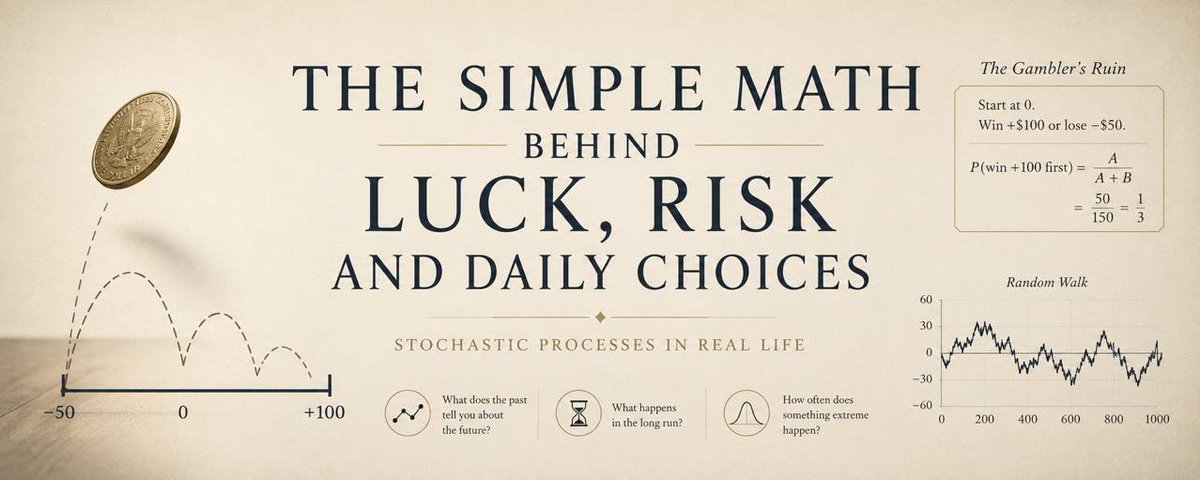
Ignore the crowd. Make concentrated bets. Buy when everyone else is selling. Thanks @BillAckman for sitting down with me and @christopherzook of @caz_investments on The Holy Grail of Investing Podcast. New episode out now.
Rohit Bhalunkar retweeted

The hedge fund manager who taught Michael Burry to pick stocks accidentally destroyed the mutual fund industry in a free Talks at Google lecture on the two-line formula that turned $10,000 into $8.3 million.
His fund charged 2 and 20. He gave the strategy away in a $12 book.
Almost no one paying a financial advisor 1 percent of their retirement has finished the lecture.
His name is Joel Greenblatt. He founded Gotham Capital in 1985 and compounded roughly 40 percent a year for twenty consecutive years. He returned all outside capital in 1994 because his edge was too crowded to scale.
He has been teaching value investing at Columbia Business School every year since 1996. Michael Burry - the doctor who shorted the housing bubble in "The Big Short" - learned to pick stocks from Greenblatt's 1997 book.
The 55-minute clip in this video is Greenblatt at Google in 2017 walking a room of engineers through his Magic Formula.
The whole framework fits on one napkin. Rank every stock in the S&P 500 by return on invested capital, highest first. Then rank every stock by earnings yield, highest first. Sum the two rankings. Buy the top twenty. Hold for one year. Sell. Repeat.
That single formula would have beaten the S&P 500 by roughly 14 percent a year over the last three decades if any retail investor had actually followed it.
"Cheap and good beats expensive and average. Every time."
That is Joel Greenblatt at Google in 2017. He has repeated the sentence in every public talk since. Almost no retail investor buying Nvidia at $140 has heard it.
Every hedge fund on Wall Street pays $500,000-a-year analysts to backtest more sophisticated versions of the same equation. Every financial advisor in America charges you 1 percent of your account per year to underperform it.
The Talks at Google video is free on YouTube. "The Little Book That Beats the Market" is twelve dollars on Amazon.
Almost none of the millions who watched have ever run the two-line formula on their own portfolio.
The framework is free. The willingness to actually run it before your next stock pick, retirement rebalance, or brokerage transfer is the entire edge.


Rohit Bhalunkar retweeted

Governments bailed out private banks with taxpayer money for one reason nobody said out loud. The banks were holding the money supply itself.
Almost nobody watches the whole hour.
A 3-day conference on the creation of money, October 2011. A white shirt, a spotted tie, a wooden lectern, a plain hall.
The speaker is a retired lecturer and industrial researcher in artificial intelligence. PhD in mathematics, MSc in computer science, MA in philosophy. Not an economist.
He starts from the everyday experience of money and works backwards to who issues it.
Watch the stretch where he connects the credit crunch to the fact that no public source of money exists.
15 years of bailout debate. The reason was structural, not moral.


Rohit Bhalunkar retweeted
Almost all the money in circulation was created by private companies as debt. Part 2 is where he shows the mechanism instead of asserting it.
Almost nobody watches the whole tape.
A 3-day conference on the creation of money, October 2011. A white shirt, a spotted tie, an old projector on the side table, a plain hall.
The speaker is a retired lecturer and industrial researcher in artificial intelligence. PhD in mathematics, MSc in computer science, MA in philosophy.
Part 1 set up the question. This one takes the process apart.
Watch the stretch where he follows a single loan through the system and shows what exists at the end that did not exist at the start.
A mathematician had to draw it. The banks never did.

Rohit Bhalunkar retweeted
He won a Nobel for game theory and Hollywood made a film about his illness. He spent his last years working on money instead.
Almost nobody watches him present it.
John Nash, November 2011, the Harry Mullin Memorial Lecture at Scranton.
A purple curtain, a wooden podium, a bottle of water, a pair of crutches leaning at the side of the stage.
His subject is ideal money and what makes people save at all. The proposal treats a currency as something that should be judged against a standard rather than managed by whoever issues it.
Watch the stretch where he explains why inflation changes the decision to save before it changes any price.
Hollywood gave you the breakdown. The lecture gives you the work.
Rohit Bhalunkar retweeted
Skip Netflix for one night.
Use that same 1 hour to study an MIT lecture on money, investing, and wealth creation.
The knowledge you gain may be worth more than 20 years of traditional finance experience.
Rohit Bhalunkar retweeted

In 1986 a guy got kicked out of every casino in Vegas for counting cards. So he flew to Hong Kong with $180,000 and started betting on horses instead.
He walked away with almost $900 million.
It was Bill Benter.
He realized horse racing was just another counting problem same math, more moving parts.
He and a partner built a computer model that estimated the true odds of each horse. If his numbers showed an edge, he bet. If not, he skipped it.
That’s the whole trick:
Expected value.
EV = p · b − (1 − p)
Only bet when the probability of winning × the potential payout is greater than the chance of losing.
What’s even crazier is that Benter once gave a 45-minute lecture explaining the math behind his system.
That recording was never supposed to become public.
And almost nobody knows it exists.
This is the lecture that professional bettors and hedge fund analysts studied.
The answer is in this video.
Rohit Bhalunkar retweeted

Harvard needs 8% return every year just to keep the lights on. 5% spending plus 3% inflation. Miss that number and buildings stop, professors leave, research dies.
40% of the operating budget comes from one portfolio. Not tuition. Not grants. One fund.
Jake Xia manages that fund's public markets. He also teaches the math behind it at MIT for free. One of the top five most-watched courses on OpenCourseWare. Millions of views. Almost nobody changed how they invest.
Every year he hands students a blank page. Build a portfolio. No rules. Someone writes 100% Apple. Someone writes rare coins. Confident picks. Same blind spot, every time.
Not one student asks the only question that matters: how much goes in each position. They all pick what to buy. Nobody sizes it.
Sizing is the entire job. The answer won the Nobel Prize. It's called the efficient frontier. Xia draws it on the board in under a minute.
Five equations sit underneath it. Compound growth. Present value. The geometric mean. The Rule of 72. Real return. All older than any bank on earth. All fit on a napkin. None behind a paywall.
A "guaranteed 5% bond" during 4% inflation is a 1% return. The industry doesn't hide this. It just hopes you never run the equation yourself.
The lecture is free. The napkin is free. The only thing that costs anything is not knowing
The answer is in this video.
Rohit Bhalunkar retweeted

A billionaire literally explained how the entire economy works in 42 minutes better than most $200k MBA programs ever could.


Rohit Bhalunkar retweeted

The prof. who almost could not give away the idea that eventually made it into Apple's supply chain :))
Suhas Patil grew up in Jamshedpur, where his father worked at Tata Steel. He studied at IIT KGP, then went to MIT for his master's and PhD, becoming a prof. there in 1970.
In 1971, he formally described something computer science students worldwide still study today as a foundational puzzle in concurrent computing: the "cigarette smokers problem."
Most people assume that kind of textbook canon concept came out of an anonymous Western lab. It came from a young Indian prof's paper.
Then, working across MIT and the University of Utah, he built something genuinely clever: SLA, Storage/Logic Array, not a single chip, but a structured IC design method, a silicon compiler approach that let complex chips for storage, video, and other applications be designed faster and more consistently than the ad hoc methods common at the time.
In 1981, believing the industry needed this, he founded Patil Systems in Salt Lake City to sell it.
And for 3 years, almost nobody wanted it.....
Patil himself put it as bluntly as you can: "I made the rounds and could not give it away."
The company stayed stuck at ~11 employees, technically sound and commercially going nowhere, the exact kind of quiet, unglamorous failure that never makes it into "visionary founder" narratives, because most companies in that position simply die there.
What saved it was Patil recognizing what he was not good at, and going and finding someone who was.
He recruited Michael Hackworth, a semiconductor marketing and management veteran from Signetics, who saw a path Patil's own pitch had not been landing: generalize the SLA method into a platform for building specialized chips fast, for a PC industry about to explode.
The company moved to Silicon Valley, was renamed Cirrus Logic, and Hackworth was named president and CEO in Jan 1985.
This is also where the real technological leap happened.
Rather than build their own chip fabrication plants, the standard, capital crushing approach most semiconductor companies used, Cirrus Logic paid existing foundries to manufacture their designs under contract.
This is the fabless semiconductor model, and Patil's company was genuinely 1 of the early successful firms to run it, alongside a handful of others in that same early-1980s wave, like LSI Logic.
Today it is how a huge share of the global chip industry works, Nvidia and Qualcomm included.
Patil's near-failed company was one of the 1st to help write that playbook.
From there, the wins compounded.
When IBM unveiled the VGA graphics standard in 1987, Cirrus Logic shipped some of the earliest VGA-compatible chipsets on the market, and the company would go on to become a major, low-cost VGA/SVGA vendor.
It went public on NASDAQ in 1989, acquired Crystal Semiconductor in 1991, the deal that actually built the company's real strength in audio and Wolfson Microelectronics in 2014.
Today, Cirrus Logic carries a market capitalization in the billions, on annual revenue of ~$2B, and as of its last fiscal year, 89% of that revenue came from a single customer: Apple (a figure that climbed to around 91% the following year).
Cirrus Logic genuinely is a major audio and mixed-signal chip supplier to Apple today. The same company that nearly died trying to sell an unwanted idea in Salt Lake City now earns the overwhelming majority of its revenue from Apple.
Also, in 1992, a group of Silicon Valley entrepreneurs founded TiE, The Indus Entrepreneurs, and Patil, as one of that founding group, became its 1st official president in late 1993, the organization went on to become one of the most influential mentorship networks for Indian-origin founders anywhere in the world, years before "Indian-American tech founder" was a familiar cultural archetype.
And his son, DJ Patil, became the 1st Chief Data Scientist of the United States, serving in the White House under President Obama from 2015-17, meaning a father who spent 3 years failing to give away a chip-design idea in Salt Lake City raised a son who held the very 1st version of that job title inside the U.S. federal government.


