

Research Scientist @GoogleDeepMind | PhD @UofT 🇨🇦 ex-@MetaAI | efficient ML · data · lifelong learning · AI agents |🏃♀️🎸🧘♀️🧋| made in 🇺🇦
Joined January 2023
- Tweets521
- Following191
- Followers243
- Likes891
Pinned Tweet
Happy to share that I started a new role as a Research Scientist at Google DeepMind Toronto working with amazing @kswersk and the team! Looking forward to new adventures 🥳🤩🚀🇨🇦
Anastasia Razdaibiedina retweeted

This paper is one of the coolest angles on Post-Training you will see.
Researchers have spent a lot of time thinking about why language models struggle so much with genuine spatial and geometric common sense.
The obvious culprit is that human web text is mostly cheap conversational shortcuts; it rarely forces a model to ground itself in strict, multi-dimensional physics.
The authors asked a really clever question here: what if you use solved protein structures as a reasoning teacher?
A single folded protein has thousands of mathematically rigid, verifiable topological facts baked in.
They built a framework called Fold2Reason that trains the model on both structural Q&A and continuous 3D coordinate decoding.
Naturally, it folds proteins way better than base Qwen3.5-9B, but what grabbed me was the transfer.
When they tested it out-of-domain on 10 standard reasoning benchmarks, accuracy jumped across the board on spatial visualization, graph puzzles, scientific logic & even BBH.
My immediate cynical reaction was "surely this is just generic post-training regularization noise," but their controls are what sold me.
When they ran the same setup on random, synthetic, or shuffled structures, the gains completely evaporated.
The model is actually feeding off the coherent physical logic of real biology.
This makes a strong case for looking beyond human language when we want to teach models how to think systematically.
Read the full paper here: arxiv.org/pdf/2609.38879

Anastasia Razdaibiedina retweeted

The idea of an intelligence explosion caused by recursive self improvement has been around for a long time but until very recently it did not seem imminent. Now many leading researchers think it may happen quite soon. You can read our paper about it here:
casp.ac/reports/intelligence…

Anastasia Razdaibiedina retweeted

SFT is not dead! 🥳
We found a way to make SFT rival current prevailing posttraining methods, often generalizing better and forgetting less than RL and OPSD. 🤯
Following our prior work on reasoning with sampling, we now introduce sampling to the posttraining stack.
1/n
Anastasia Razdaibiedina retweeted

To tackle new scientific problems, we often get inspirations from prior work.
Can Deep Research agents and search help us to identify such “catalyst” papers buried in literature?
Our new benchmark, built with hundreds of scientists, shows substantial room for improvements.


Anastasia Razdaibiedina retweeted

we squished 24 encoder blocks into one and somehow improved ASR performance.
looped Orukeet runs the same block repeatedly, giving it another pass at the audio without adding another set of weights.
@OrukLabs
Anastasia Razdaibiedina retweeted

Today, we're launching ScienceBuddy — a free workspace for scientific agents.
Get GPT-6 at no cost, fully GPU-accelerated, and fused with our JEV framework.
The engine behind it relies on two loops:
🔹 Inner loop — refines the agent harness as you collaborate
🔹 Outer loop — trains the model via rubric-guided RL
Together, it drives Recursive-in-Recursive Self-Improvement.
We genuinely want to see how agents improve through sustained, real-world collaboration.
Try it out, push its limits, and let's build better AI for science together!
🔬 science-buddy.io
#ScienceBuddy #PhAILabs #AI4Science
Anastasia Razdaibiedina retweeted

ICLR 2027 has received more submissions than all previous years (2013–2026) combined

Anastasia Razdaibiedina retweeted

Sharing my first of hopefully many research blog posts! jasperlu.com/blog/training-s…
This one is the kind of educational blog post I wish I'd had when I started with RL for LLMs.
I tried to make it as open as possible. Every rollout is browsable, the code is open source, and I walk through my entire thought process, from learning rate sweeps to reward shaping.
Anastasia Razdaibiedina retweeted

I put together a mega write-up on GPT-6 Astra & looped transformers.
How looped transformers / recurrent depth works, cost-tradeoffs, whether it hides reasoning traces, with lots of figures and a tour of recent looped transformer research.

Anastasia Razdaibiedina retweeted

interesting work! sophisticated ways to remove past LLM context ("kv-cache eviction") seem to mostly come down to how much of the prefix they preserve
it's a cleaner motivation for prefix sliding than ours in arxiv.org/abs/2608.26070


Every KV cache evictor for efficient long reasoning scores cached tokens to decide which ones to keep. We find the score buys almost nothing: keep the prompt, evict at random per head, and you match the strongest evictor at 32–43% higher throughput.
Paper: arxiv.org/abs/2609.03430
Page: arthur-heng.github.io/Random…

Anastasia Razdaibiedina retweeted

we published a blog on hugging face at possibly the worst time yesterday lol
congrats to the HF team on the big news! 💚
here's a fine-tuning tutorial showing how to
• fine-tune a tiny LFM2.5-350M model
• in 100 GRPO steps using TRL
• for better structured outputs
blog: huggingface.co/blog/grpo-wit…
colab: colab.research.google.com/gi…


Super happy to share our intention to join forces with NVIDIA in a $12,930,300,000 acquisition 💛💚
10 years after starting Hugging Face, open-source AI is at an inflection point. Thanks to the community, we’ve shown that it can be a complement, and even an alternative, to closed-source APIs. But for it to happen at larger scale, it needs more compute, more support, more collaboration and more visibility. That’s why we went to talk to Jensen, who offered to do exactly that with us.
In addition to doubling down on NVIDIA’s massive contributions to open-source AI (I called them the “King of American open-source AI” earlier this year), they’ve committed to strongly supporting Hugging Face and our mission while keeping the platform open, independent and compute agnostic. The founders and the team are all staying to keep pushing this mission forward.
Together, we think we can make open source the default way to build AI, with the goal of empowering 100 million AI builders to own their intelligence rather than rent it.
Excited about the next 10 years! 🤗🤗🤗

Anastasia Razdaibiedina retweeted

I don’t often write up my thoughts, but here’s a new blog post summarizing some of my recent musings on RSI and verification: Recursive Self-Inflation.
A lot of it is informed by my own research experience and by grappling with the fact that the strongest recent RSI results depend, and quite reasonably so, on fast, automatic feedback: we generate candidates, evaluate them, retain the ones that work, and keep iterating. The problem, however, is that every practical verifier has holes in it, and sustained optimization will eventually find and exploit them.
That matters a bit differently in a recursive loop than in a static eval. In a static eval, a verifier mistake just gives you the wrong score. In an RSI loop, an accepted mistake becomes the seed for the next round, so errors can compound over time while the curve still looks like the model is progressing.
I recently went through evidence of verifier failure across coding and science benchmarks, reward hacking, model judges, and formal proofs, and tried to characterize what I think credible RSI results would need to report, and what they need to rule out. As always, feedback welcome!
mariya.fyi/posts/recursive-s… – at San Francisco, CA

Anastasia Razdaibiedina retweeted

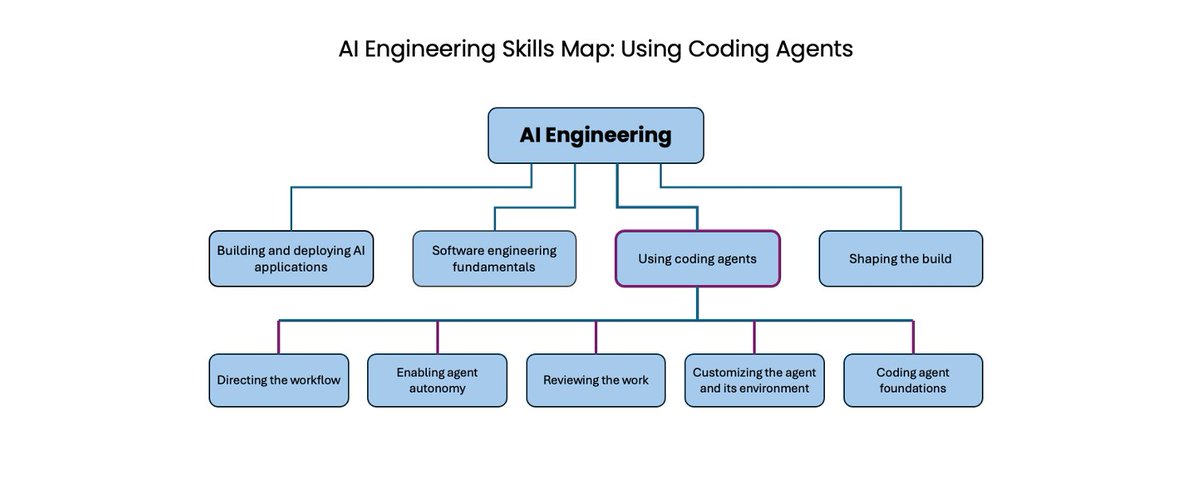
The most important skills for using AI coding agents effectively. Presenting the AI Engineering Skills Map for using coding agents.
Anastasia Razdaibiedina retweeted

How does one RL post-train a 397B model for long-horizon knowledge work? 👩💼
We share every step we took to bring Qwen 3.5 397B from 16.1% Pass@1 to 27.3% on APEX-Agents using DPPO, including final models weights and the full training script🚀 This is the first of many works from Mercor Research on open model training research.
Full blog: mercor.com/blog/training-fro…
Source code: github.com/Mercor-Intelligen…

Anastasia Razdaibiedina retweeted
Just finished reading this fascinating new paper and it has genuinely fliped my intuition about On-Policy Distillation.
We have always assumed that students in OPD improve by absorbing dense knowledge from a bigger teacher model.
But the authors show teacher signals are surprisingly full of off-policy noise, which actually gets worse as the teacher scales.
When they investigated where the gains actually came from, they found it’s almost entirely just the student learning to penalize its own low-probability tail tokens.
To prove it, they stripped away the teacher completely and introduced OPSA (On-Policy Self-Adaptation).
It applies entropy-adaptive negative advantages to unlikely tokens with zero external supervision or verifiers.
On Qwen3-1.7B, it jumped +35 points on AIME24, easily beating standard OPD.
So it’s a neat reminder that half of reasoning improvement is just regularizing the model so it stops making unforced errors on its own tail distribution.
Definitely worth a read if you work on Post-Training or RLVR.
Read the fully paper here: arxiv.org/pdf/2608.31046

Anastasia Razdaibiedina retweeted
A lot of hype around OpenAI's Astra model here on my timeline today. Apparently, this goes back to a new article from The Information, which said Astra is a "recurrent depth or looped transformer".
It's always interesting to read about new or different approaches (including rumors about what the closed labs may be up to), but let's debunk this a bit.
About 2 months ago, I shared the architecture details of Nanbeige, for example, where "Nanbeige4.2-3B is pretrained from scratch on 28T tokens with a Looped Transformer that reuses the layer stack to increase capacity without adding parameters."
Yes, that's it. The looped transformer idea is just reusing layers in the transformer block.
In the case of Nanbeige, the main idea is to reuse the same 22-layer stack (=transformer block) twice instead of once. So, effectively it extends the 22-layer architecture to 44 layers, but without duplicating the weights.
In simple terms, this roughly doubles the size of the model (if we ignore the embedding and output layers for a second). But instead of requiring 2x the storage and RAM to host this model, it stays at the same size since we reuse the components. However, it's almost 2x as expensive in terms of compute, because we run the embedded text through almost 2x as many layers.
Why? In the Nanbeige 4.2 technical report, the researchers found that two passes gave the best trade-off and retained about 75% of the token efficiency of a standard architecture. (More passes gave barely any gains but made the training much slower and much more expensive.)
While, as far as I know, Nanbeige 4.2 is the first notable open-weight model that adopted this approach, the idea goes back to the NeurIPS paper "Mixture-of-recursions: Learning dynamic recursive depths for adaptive token-level computation". Actually, this paper proposes a mechanism that is a bit more sophisticated by adding a learned router that determines whether each token receives one, two, or more passes. So, easy tokens can exit early while harder tokens receive additional computation.
In sum, Astra may be a really good model, but this shouldn't be about this "looped transformer aspect," which is just a tiny architectural tweak.
Also, the statement "the new technique works in a way that obscures some or all of the AI's reasoning, otherwise known as 'chain-of-thought'" is not necessarily true with respect to the looped transformer method. It's possible that The Information journalist refers to some other technique or misunderstood the looped transformer method.
Reusing layers does not by itself suppress visible chain of thought. It adds computation in hidden states before the next token is emitted, just as ordinary transformer layers do.
But based on the information we have, the only plausible interpretation here is that if a model uses more of these recurrent passes, it may need to generate fewer intermediate reasoning tokens. So then more of its computation happens in latent activations that cannot be read as text. But we would get the same effect if we were scaling up the model size, like GPT 5.6 Luna -> GPT 5.6 Sol.

Anastasia Razdaibiedina retweeted

Why some generative models take 100s of steps and others take only a few.

Anastasia Razdaibiedina retweeted

Neoclouds have limited cybersecurity. Next time agents successfully go rouge, they'll try taking over a neocloud to run more copies. This is bad.
Thus: neoclouds should greatly strengthen their cybersecurity and every company with strong cyber models should help with that.
Anastasia Razdaibiedina retweeted

Recursive Self-Improvement through Multi-agent RL Post-training and Unsupervised Environment Design (UED)… but it actually works!
Delighted to finally release this paper, which trains a single LLM to act as both an Environment Designer to build new multi-turn RL training environments (using the Gym step()/reset() API), and a Reasoning Agent that learns to solve them. Resurrecting ideas from our work on UED, the Designer is trained to maximize a proxy for the Agent’s regret, computed using privileged hints.


