
Co Founder of KarmYog Education Network Pvt Ltd and Founder GlobalTHEN
Joined December 2007
- Tweets4.4K
- Following7.1K
- Followers829
- Likes9.6K





rambadri retweeted

The attention economy is wild!
Last week, waiting to board my flight to delhi, I see commotion around a gentleman.
The kind of commotion you see around government officials - laced with servitude and respect that comes from tenure and not necessarily impact.
My curiosity gets the better of me.
I want to know who he has.
As he boards the flight, I happen to catch his name on the boarding pass.
As I board, the flight attendant recognizes me. His KPI includes a namaste to everyone. But the enthusiastic smile and child like excitement is reserved specially for me.
The gentleman is already seated.
No one knows him on this craft.
His crowd has already left him.
He is a commoner now.
I take a seat.
The first thing I do is google the gentlemen’s name.
Almost convinced of his role, I add IAS to the search.
His name and picture pops.
IIT Kanpur computer science
Masters in public policy from Princeton
PhD in economics from Princeton
1991 batch of IAS
Currently a secretary
FML!
The article heralded him as “The Intellectual Powerhouse and Fiscal Architect of Modern India”
And here was I - a complete non-entity - bring drooled at by passerbys.
“Big fan sir”
“Love your content”
No bro.
We all got to love HIS content.
Applaud him.
Celebrate such individuals.
Recognize then.
I would love to start a series on such personalities, that remain behind the scenes, quietly changing the way we live and experience our lives.
The attention economy feels so twisted.
rambadri retweeted

At this year’s @litlivemumbai , I shall be in conversation with Naresh Fernandes, the brilliant editor of @scroll_in . The session is titled “Gandhi Matters”, and will be held at the NCPA’s Experimental Theatre, 24th October, 630 pm onwards.
@tajmahalfoxtrot
rambadri retweeted

Visited Captain Bheri during Durga Puja to offer prayers and experience the festive spirit. May Maa Durga’s blessings bring happiness, peace and prosperity to everyone.


rambadri retweeted

ज़ब कोई ईमानदार पत्रकार न्यूज चैनल छोड़ कर
अपना स्वतंत्र यूट्यूब चैनल बनाता है
तो उसकी पत्रकारिता देखने लायक होती है
ये जिगरा गोदी मिडिया मे नहीं है
सांकेत उपाध्याय ने
पूरी पोल खोल दी चुनाव आयोग की..
rambadri retweeted

Can you imagine a 2-hour conversation between a VC and an AI researcher on AI and LLMs entirely in Sanskrit?
We just recorded one.
Could this be the world's first technical podcast in Sanskrit?
Can't wait to share it. Here is a raw glimpse
rambadri retweeted

ElevenLabs is officially on OpenRouter.
You can now call 9 Text to Speech models, with up to 90+ languages, and 2 Speech to Text models with speaker labels and word-level timestamps.
All @ElevenLabs models are 50% off, only on OpenRouter, through October 19, 8am PT.
rambadri retweeted

We are making Markdown files work natively across Google Drive and Docs.
You can now preview .md files in Drive, open them in Docs, edit them, comment on them, and collaborate without converting the file into a Google Doc!

rambadri retweeted

install it and give me feedback with:
claude plugin marketplace add anthropics/claude-plugins-community
claude plugin install html-plan@claude-community
here's an example: claude.ai/artifact/CUF7bzFny…

rambadri retweeted

This is f*cking insane. This Claude Code tip saved me thousands of dollars.
once Opus 5.5 is your main model, stop burning it on work Sonnet 5.5 can do, while Fable 5.1 sits idle
hand the grunt work to Sonnet 5.5 subagents and put Fable 5.1 on call
run /advisor fable
Opus 5.5 plans and ships the final code
Sonnet 5.5 subagents read, edit and run the tests
Fable 5.1 reads the full session, every tool call included, and only speaks up at three points:
→ before a plan: is this the right approach?
→ when the same error comes back: am I digging in the wrong place?
→ before "done": what did I miss?
Sonnet 5.5 builds. Fable 5.1 reviews. Opus 5.5 ships
Jev engineering is the same move one layer down: the forks that need no thinker (which file, which tool, retry or stop) go to Jev in under half a second, and the big models only see the ones that split
anyone still running one model for everything is paying Opus prices to decide whether a file exists
- the full tree
> Opus 5.5 on high runs the main session
> explorer reads the code on Sonnet 5.5
> worker edits and runs tests on Sonnet 5.5
> researcher pulls the docs on Sonnet 5.5
> all three on medium
> Fable 5.1 on call for main and every subagent
paste the tree and this prompt into Claude Code ↓
"Rebuild my Claude Code setup around this tree:
1. Check ~/.claude/agents and .claude/agents for subagents that already fit explorer, worker and researcher.
> Draft new ones only for missing roles
> Give each model: sonnet, effort: medium
> Skip any that pin a different model and list them
2. Set the main session to high via effortLevel in ~/.claude/settings.json, and set advisorModel to fable
3. Find anything that keeps the advisor off (CLAUDE_CODE_DISABLE_ADVISOR_TOOL, DISABLE_TELEMETRY) plus CLAUDE_CODE_EFFORT_LEVEL, which overrides subagent effort. Report them, change nothing
4. Add one rule to ~/.claude/CLAUDE.md: consult the advisor before a large plan, when an error repeats, and before calling a long task done
Show me every change as a diff first. No edits until I say go."
↳ code.claude.com/docs/en/advi…


rambadri retweeted

Absolutely recommend using Cache Control in Claude Code
Probably one of the Mods that will save you the most tokens and help keep your sessions going much longer
It adds this bar for Claude’s 5 minute cache and sends notifications to help keep the cache warm
Install command:
npx claude-code-templates@latest --mod observability/prompt-cache-control
rambadri retweeted

We're adding a new plugin to Claude Code: You should Know.
It scans Claude's output for important information you might miss to help keep you in the loop.
Enable it with:
/plugin enable cc-plugin-you-should-know@builtin
rambadri retweeted

We'll be spending a lot more time trying to understand the outputs of language models. A few thoughts, tips & tricks:
Writing. Something I've had success with: Ask your LLM to explain something in ASD-STE100, it's a controlled language specification originally developed for aerospace maintenance documentation. LLMs well-versed in this language and it comes with heavy constraints on clean writing style that I often find a lot more readable. Sometimes I've tried to soften it a bit e.g. ask for "80% of the way to ASD-STE100" because the spec is quite stringent. But even better:
Diagrams / images. Instead of writing, ask your LLM to create a diagram. These can be a lot easier to process, parse, and understand. But even better:
Web pages. Ask for output "in HTML" to get a beautiful, interactive webpage. LLMs are getting really good at frontend and can create beautiful experiences, animations, etc. But even better:
Explainer videos. The output format I am most bullish on is fully custom / bespoke explainer videos generated on any arbitrary topic. Experiment with things like "Create a 3b1b style video explainer on X. Use my ElevenLabs API key for audio narration". (you'd need an API key for the latter or you can ask your LLM to find you decent free alternatives that use your local compute). This is actually starting to work!
In summary:
- As LLMs get better, they will do more and more of the legwork autonomously, and a lot more of our work will rise up the abstractions into oversight and understanding.
- Luckily, LLMs can help here too because as intelligence and code are increasingly abundant, you can ask for large, custom, discardable software artifacts (e.g. web apps, video explainers) that would have never made sense to create before. Push the boundaries here and you'll be surprised.

rambadri retweeted

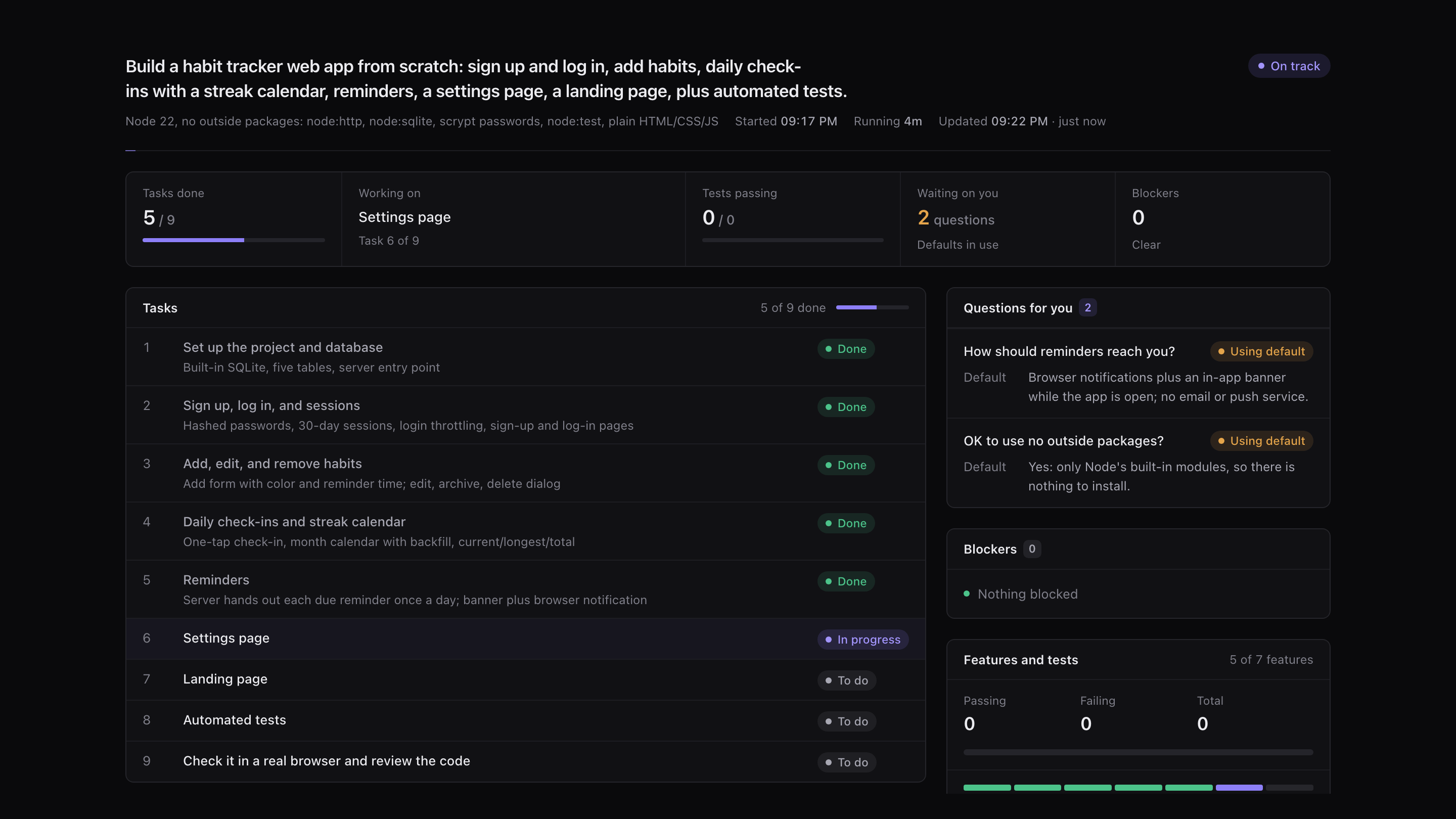
Every time you let Opus 5.5 run a long task on its own, have it vibe-code a quick 𝗛𝗧𝗠𝗟 𝗱𝗮𝘀𝗵𝗯𝗼𝗮𝗿𝗱 like this first.
Then give it 𝗮 𝘀𝘂𝗯𝗮𝗴𝗲𝗻𝘁 𝘁𝗵𝗮𝘁 𝗼𝗻𝗹𝘆 𝗯𝘂𝗶𝗹𝗱𝘀 𝗱𝗮𝘀𝗵𝗯𝗼𝗮𝗿𝗱𝘀:
→ Name it dashboard-builder, set its effort to medium, and preload a design skill
→ The first time, it asks what style you like and saves it to memory. After that, every dashboard fits your taste and the task at hand
→ Call it before every long task. It builds the dashboard in the background in about two minutes, and the main session keeps coding on high without stopping
→ The dashboard shows four things: task progress, what's stuck, questions waiting on you, and what it'll do by default if you don't answer
Send this prompt to Claude Code 👇
"Set up a subagent that only builds progress dashboards:
1. Create dashboard-builder in ~/.claude/agents: model: opus, effort: medium, memory: user. Preload the design skills I have installed (for example impeccable). It can only read and write the .dashboard/ folder and its own memory.
2. The first time, it asks me what style I like: dark or light, dense or airy, and one accent color. It saves my answer to memory and follows it every time. Pick the panels for the current task; don't use a template.
3. The dashboard is one HTML file showing tasks and their status, questions waiting for me with the default action, the latest deliverables, and anything stuck. Use the real clock for every time. It opens with a double-click and refreshes itself every 10 seconds.
4. Add a rule to ~/.claude/CLAUDE.md: for any task with more than 5 steps or that should take longer than 30 minutes, have dashboard-builder set up the dashboard before starting; update it after every step; when you need a decision from me, add it to the questions list and keep going with the default.
Show me the contents of the files you'll create or change, then explain the whole flow in words a 10-year-old could follow. Don't write anything until I confirm."
rambadri retweeted

microsoft quietly open-sourced one of the best ai data analysis tools out there.
it's called data-formulator.
connect any source, csv, postgres, bigquery, even a live url, then build charts with a mix of drag-and-drop and plain english.
the ai agent writes the sql and transforms underneath and hands back a chart you can actually edit, not a code dump.
> drag fields onto x/y/color and it builds the chart
> anchor a cleaned result so follow-ups don't drift back
> branch any chart to explore a variation
> connect live data with auto-refresh
bring your own model key and run it locally.
rambadri retweeted

क़िस्सा गांधी के टूटे दाँत का
यह गांधी गाथा का एपिसोड 5 है। पूरा एपिसोड आप Awadh Punch और DoubleCheck के YouTube चैनल पर देख सकते हैं - youtu.be/-0hkhU42YFc?si=MOXH…
#mahatmagandhi #gandhigaatha #gandhijayanti #history #redfort
rambadri retweeted

Today we announce our new unified multi-agent framework that provides creators with a system for generating temporally consistent, long-form video narratives while mitigating visual drift and pipeline error propagation. Learn more: goo.gle/4yVih5m

ALT AI video co-director multi-agent pipeline. Top: The Orchestrator Agent utilizes MAB to navigate a factored creative action space. Bottom: The Pre-Production Agent synthesizes a creative brief, storyline, and visual assets to establish a consistent storyboard, which the Production Agent translates into synchronized keyframes, video clips, and audio. An MLLM Judge evaluates the final video to generate a factored reward signal which is propagated back to the MAB to iteratively refine the creative configuration over optimization loops.
rambadri retweeted

Opus 5.5 is incredible at instructional video generation.
I made this launch video for a inference startup in 1min for ~$2. Videos like these used to take weeks if not months and a lot of coordination with agencies and 1000x the costs.
Humans broadly prefer video to text. This changes the substrate of communication. These videos actually help communicate technical ideas in seconds (photorealistic video gen like Seedance is not very useful here).
- changes how often marketing should be talking about products and launches
- change how sales people can talk about technical products to their customers
- allow technical people to easily explain concepts internally without long docs
And thats just scratching the surface within startups.
Prompt: “make a modern slick and punchy video for a modern startup that works on inference”
rambadri retweeted

I built a thing using Jev.
Have you ever been annoyed by not finding an old Claude Code or Codex chat?
=> Now you can just describe what it was about and Jev finds it in milliseconds.
Open Source:
github.com/fstandhartinger/c…
rambadri retweeted

Mark Cuban on the next job wave:
"Software is dead because everything's gonna be customized to your unique utilization. Who's gonna do it for them..."
The answer is people who know how to fine-tune small LLMs on private data.
Not prompting. Not API wrappers.
Actual custom models trained on your business.
And almost nobody knows how to do it yet.
This is the complete guide ↓
Bookmark this. This is the one.


rambadri retweeted

Don't ship your app until you check this.
- Secure your API keys.
- Hide all .env files.
- Never hardcode secrets.
- Add authentication.
- Verify permissions server-side.
- Don't trust frontend user IDs.
- Isolate user data.
- Lock down your database.
- Secure Firebase, Supabase, and storage.
- Protect admin routes.
- Disable production debug mode.
- Hide detailed errors.
- Validate inputs server-side.
- Sanitize user content.
- Secure file uploads.
- Prevent SQL and NoSQL injection.
- Rate-limit login and signup.
- Check Git history for secrets.
- Add security headers and restrict CORS.
- Test as an untrusted user.
Most leaks come from skipping one of these. Fix them before you go live.