

Principal at SEI. AI, stablecoins & payments, from strategy to delivery. I build tools, lift heavy things, and make games with my kids. Brazilian in Georgia.
Atlanta, GA
Joined July 2008
- Tweets5.6K
- Following227
- Followers1K
- Likes83








Pinned Tweet
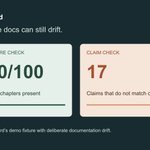
One design choice I keep coming back to in DocGuard: a concrete mismatch and a request for human review should look different. A file changing doesn’t prove its documentation is wrong. raccioly.github.io/docguard/…
#OpenSource #AIDevelopment

ALT A visual drawn from DocGuard’s public demo fixture contrasts 100 out of 100 for documentation structure with 17 claims that do not match code. These are deliberate demo results, not a production benchmark.
1
32
A useful point from the Wayfair/Inspire panel at AdPipe’s Modular: better performance data changes little if designers don’t understand the business objective or have room to try something new. That is the operating work around an AI tool.

ALT Hannah Parry of Wayfair and Sasha Wolfe of Inspire Brands on stage at AdPipe’s Modular 2026, with their names and roles on the screen.
1
23
Hannah Parry described Wayfair’s mix as roughly 80% proven formats and 20% creative exploration. Sasha Wolfe from Inspire pointed out that removing weak ads can lift the average, but teams still need ideas that push beyond it. Optimizing the familiar has limits.
1
7
Back at AdPipe’s Modular for my second year. Their creative briefing demo connects what an ad contains with how it performs, then brings that evidence into the next brief. The useful part: specific hypotheses to test with footage the team already has.

ALT Chris Field speaks during the UPS case study at AdPipe’s Modular 2026. The stage screen identifies him as VP, Marketing Strategy & Growth Ops at UPS.
1
20
The UPS case brought it together: sales input shaped the messages, existing footage made testing possible, and customer response informed the next sales conversations. Really cool seeing my Emory MBA classmate Chris Field on stage sharing that work.
1
3
What I liked was the connection between the data and the next creative decision. Thanks to Andre Sasso for inviting me back. More on AdPipe’s creative briefing approach: adpipe.com/ci-briefing

2
Ricardo Accioly retweeted

In partnership with Rain, today we announced the launch of Stablecard by Western Union. Stablecard is a new Rain-powered @Visa card that lets remittance recipients hold dollar-backed stablecoins and spend them anywhere Visa is accepted. Read more: bwnews.pr/4g9UTKN @USDPT_
42 releases in. The check I wish I'd added on day one: green tests say nothing about the package you actually ship.
docguard now unpacks the real tarball and runs the CLI end to end before every publish.
Your working tree is not your artifact.
github.com/raccioly/docguard

29
CI security gates that dump a wall of legacy findings train everyone to ignore them.
websec run . --fail-on high --baseline prior-ledger.json
It fails the PR only on NEW findings. The backlog stays a backlog. The fresh SSRF blocks the merge.
github.com/raccioly/websec-v…

26
Ricardo Accioly retweeted

I do not want to click DNS records into a web UI forever.
For a homelab that changes often, DNS should be part of the infrastructure workflow. New VM, new service, new hostname → the record should be reviewed and versioned like everything else.
Technitium can do this with dynamic DNS updates and TSIG.
The workflow looks like this:
↪ create a TSIG key in Technitium
↪ enable dynamic updates on the DNS zone
↪ add a TSIG security policy
↪ configure the Terraform DNS provider
↪ manage A, AAAA, CNAME, or other records from code
The important warning is simple:
Do not enable dynamic updates without TSIG.
If you allow unauthenticated updates on a zone, you are creating a very boring but very serious security problem. DNS is infrastructure. Treat the update path like infrastructure too.
With Terraform, the provider config can point at the DNS server, use the TSIG key name, algorithm, and shared secret, and then records become normal IaC resources.
✅ Better:
• changes are reviewed
• history is in Git
• records match the rest of the deployment
• agents can propose changes from existing patterns
That beats manually clicking the same DNS form again and again.
#HomeLab #DNS #Terraform #Technitium #DevOps
Your README was accurate 40 commits ago. Your AI agent doesn't know that — it reads the docs and codes with confidence.
I built docguard to catch doc drift before it ships. See it in 30 seconds, zero setup:
npx docguard-cli demo
github.com/raccioly/docguard
27
I build two OSS tools for devs coding with AI agents:
docguard — docs as source of truth, drift caught early
websec-validator — local security recon that briefs your agent
Both need real-world testers. What would make you try one? github.com/raccioly

1
119
Ricardo Accioly retweeted

I started looking at Western Union because I thought stablecoins would kill it. Then I realized WU is better positioned than almost anyone to leverage them.
Brand, distribution, 200+ countries, $923M in EBITDA. The key risk was management. They had been skeptical of stablecoins.
I placed the bet in November. Since then WU has not only outperformed Solana but the broader market:
WU +2.14% / SPX -6.76% / Nasdaq -11.66% / SOL -56.15%
WU is a $2.8B market cap business trading at 6x earnings with a 10% dividend yield. Remitly trades at 50x on a 2.3% operating margin. Wise at 23x. The discount exists because WU revenue is declining 3.8% while both are growing 25%+. I am not fighting that. But at 6x earnings you are paying for zero recovery, zero tech adoption, zero optionality. That is the margin of safety.
I was at the @blockworksDAS this week. The WU CEO was on the same stage. Very different energy from the one I had been following. Clear on the stablecoin strategy, talking about flipping negative float into positive float. They have since announced USDPT, their own stablecoin on Solana. For a 175-year-old company to go from skepticism to launching on Solana in under a year is a meaningful shift. Of course, there is plenty of execution risk. The bear case was always that they would not act. They are acting - and that alone warrants a repricing.
The math I ran back in November when I placed the bet was: lose ~20-30%, cushioned by $500M in net income and a 10% dividend. Re-rate to Wise multiples and it is 4 to 5x.
I am not betting on convergence. I am betting the market prices zero probability of it, and I will get paid for getting a free option.
WU is part of a broader thesis that led me to start @inversion_cap: acquiring businesses with distribution at attractive prices. There is a lot of embedded optionality in those businesses. Not all will act in time. Some will die. But the ones that do will meaningfully outperform, and those gains will more than outweigh the losses. You reduce that risk meaningfully when you control that business.
The greatest beneficiaries of cost-reducing technology like AI and crypto are not the startups building it. They are the incumbents with distribution that adopt it.
WU is one of many. Full piece on Substack: open.substack.com/pub/obviou…
@HadickM double or nothing? Market settles November 1, 2026.
DISCL: Long WU. Long SOL. NFA.

Hot take: Your AI coding agent has no idea what your project actually does.
AGENTS.md doesn't help if the docs underneath are garbage.
DocGuard enforces Canonical-Driven Development: → Generate docs from code → Validate them on every commit → Score your "doc tax"
Like ESLint, but for your documentation.
github.com/raccioly/docguard
#DevTools #AIAgents #CDD
🚀 Just shipped DocGuard v0.7.0 — the CLI that enforces documentation-as-code
6 new features inspired by peer-reviewed AI research from U of Arizona
Zero dependencies. Pure Node.js. 15 commands.
npm install -g docguard-cli
🧵👇
What's new in v0.7.0:
✅ docguard guard now shows [HIGH/MED/LOW] quality labels per validator ✅ docguard trace — traceability matrix (ISO 29119) ✅ docguard score --signals — multi-signal quality breakdown ✅ docguard diagnose --debate — 3-agent AI prompts
All grounded in CJE research ↓
The research behind it:
AITPG (IEEE TSE 2026) — Multi-agent test plan generation + RAG TRACE (IEEE TMLCN 2026) — Calibrated quality evaluation
We cited them properly. Open source. Academic rigor meets developer tooling.
GitHub: github.com/raccioly/docguard
#OpenSource #DevTools #DocumentationAsCode #AIResearch
3
1
54
Ricardo Accioly retweeted

Read the full press release: blog.crossmint.com/crossmint…

if looking for a coupon for heybossai.com use this SAVE5 to save 5%...
heyboss.xyz/?via=SAVE5
39
Just tried @heybossAI to build an app in 9min!
It generated everything with great usability, exactly how I described it. I’ll release it once I have a solid MVP, but I definitely recommend giving it a try to see the power of AI. heyboss.xyz/?via=ricardo
#AI #heybossAI
42