

World’s 1st scalable Quantum ITS. Perfect Secrecy at 0.9 cpb for Gov & Defense Trade: https://xitter.cf/t.co/E3jd3mRItS
UK
Joined January 2025
- Tweets1K
- Following159
- Followers4.1K
- Likes1.4K






Pinned Tweet
They said quantum threats were years away.
They were wrong, but we have you covered!
Quantum-safe encryption powered by $QST
#QuStream #Quantum #Encryption #L1 #Blockchain
Claude found a new way to do modular inversion, the costliest step in elliptic-curve arithmetic. One of its point-addition circuits uses 17x fewer gates than the smallest previous design, for 12% more qubits.
A quantum attack on ECDSA keys spends most of its effort on exactly those point additions. Nothing is broken today. The cost estimates keep falling, though, and this drop came from a single 53-hour run.

New from our STEM Fellows Program: Designing more efficient quantum circuits with Claude.
Given plain-language instructions, Claude Mythos 5 designed quantum circuits that improve on the best published ones, sometimes by an order of magnitude or more.
More efficient circuits reduce the resources needed by quantum algorithms, which could bring quantum computing applications in chemistry and materials science within reach sooner.
Read more: anthropic.com/research/desig…

"Harvest now, decrypt later" has a simple plan: record encrypted traffic today, break the lock that set up the connection years from now, then read everything.
Adrian Neal's new paper on our Post-Quantum Ratchet shows where that plan can fail.
Every confirmed message gets folded into the next key, a bit like a recipe where each step uses some of the last batch. To rebuild later keys, the attacker needs every confirmed piece. Miss one that's hard to guess, and breaking the lock years later doesn't give it back. The keys after the gap stay out of reach.
qustream.co.uk

Last year, Google estimated RSA-2048 could be broken in under a week with under a million noisy qubits. Part of that saving came from magic state cultivation: a cheaper way to make the high-quality "magic" ingredients a quantum computer needs to run algorithms like Shor's.
Now Google has shown it working on real hardware, with 40x fewer errors.
This doesn't break RSA. It does turn one of the estimate's assumptions into a lab result, and anything recorded today will still be sitting in someone's archive if that gap ever closes.
Moving to post-quantum algorithms is step one. Step two is limiting what a single future break, of any algorithm, can unlock from years of recorded traffic. That's what our Post-Quantum Ratchet is built for.

Published in Science today: Magic state cultivation works in practice on our Willow processor. We achieved a 40x error reduction, compared to without cultivation, and 99.99% fidelity. Learn how this addresses a critical resource bottleneck: goo.gle/4yr8V0H

One-time pads have a distribution problem.
The textbook OTP needs a uniformly random secret pad as long as the message, with every segment used only once.
QuStream’s published QS-OTP design tackles the logistics: endpoints begin with a shared secret reservoir and derive pad segments locally from authenticated public epochs.
In the worked example, 1,024 parallel streams each produce a 256-bit segment: 32 KiB of pad per epoch.
A 4,096-bit epoch is 512 bytes—about 1.6% of that output, excluding authentication and transport overhead.
The aim: ongoing pad derivation without repeatedly shipping bulk secret pad files.
This is a bounded security model, not a claim of unlimited textbook perfect secrecy. Its stated assurances depend on protected secret state, controlled exposure, and safeguards against replay and rollback.
Local derivation. Single-use segments. Explicit limits.


Lattices bet the maths stays hard. QuStream bets a provisioned secret stays unknown, and publishes the exposure maths: 2⁻²⁵⁶ advantage at zero exposure, 2⁻¹⁹² after 64 known-plaintext bits (256-bit segment). Information-theoretic, bounded, no new hardness assumptions.

I don't recommend anyone scramble to move their funds to new wallets today. But we should take the risks to cryptography from AI-accelerated math seriously, and minimize our exposure to not just quantum-vulnerable cryptography, but also potentially AI-vulnerable cryptography.
The core new area of risk from this viewpoint is, unfortunately, ML-DSA / FHE / lattices.
(and it's also another reason, along with quantum, why ECDSA might fall even faster than expected, hence the "fresh address" recommendation)
So far most people have been in the mode of thinking "elliptic curves broken, hashes safe, lattices safe". But there is a good chance that the concrete security of lattices will take serious hits from the next two years of AI math.
The basic threat model is: factoring is something that naively takes 2^(n/2) time, but over decades smart people have found and optimized number field sieves, and degraded that to 2^O(n^(1/3)), which is why RSA keys and signatures need to be ~400 bytes (and not 64 bytes). What if there are skeletons in the closet like that, both for elliptic curves and lattices, that we are simply not smart enough to discover - but bots soon will be?
This is a major part of the reason why for the past year ethereum's lean roadmap has been going in the "hash-only" direction: no lattices, no ML-DSA, no Falcon, no lattice-based commitments inside ZK proofs, etc. Signatures in lean ethereum are all hash-based, either WOTS or SPHINCS-.
For signatures and proofs, we already know how to go hash-only. The bigger challenge is for *public-key encryption* - and this goes far beyond blockchains. Secure communication, anonymizing protocols, lots of things need public-key encryption.
And unfortunately there are long-standing mathematical theorems showing why public-key encryption cannot be done with hashes alone. You have to have some kind of trapdoor object that has at least one form of usable "structure" - either group theory (incl. isogenies) or lattices or code-based or potentially in the future even more newfangled and spooky things (local mixing?). But for anything that has structure, you should assume that AI will make at least some progress in breaking that structure. Here, one reasonable inference is that if you want to make something plausibly long-term secure, multiply the key sizes by 10.
To me that's a very plausible world and something not at all extreme to predict. If AI will bring us 50 years of math in 2 years, then that 50 years of math may very plausibly include a "naive factoring -> GNFS" level of improvement to our ability to break lattices. In that world, lattices will still exist, but they will have to be significantly bigger to guarantee the same level of safety.
And at those new larger sizes, hash-based constructions will beat lattice-based constructions on concrete efficiency in every use case where hash-based constructions are possible at all.
Theoretically, of course it's possible that hashes are broken too (eg. P = NP would imply that). But I think P = NP is very unlikely. And intuitively, it's much more likely that a mathematical object has exactly no exploitable structure (like hashes are intended to), than that a mathematical object has exactly ~3 forms of exploitable structure (for elliptic curves: associativity, Schoof, pairings) and not some secret fourth form of structure we have not yet discovered that greatly degrades its security (for elliptic curves, ECDLP and pairing security). Similar for LWE, SVP, RLWE and the zoo of lattice problems.
For this reason, we do not yet see any reason to worry and start padding the byte size of hashes (if we start to worry more, we would pad the round count first before doing anything to the byte size).
Concrete TLDR, my own personal views:
* Hash-based > lattice-based, in those situations where hash-based is possible at all
* For anything lattice-based, be much more paranoid on param sizes. Remember that blockchains are only a small portion of the cryptography story; this point goes far beyond blockchains and applies to eg. access to websites, secure messaging, Tor / VPNs ...
* For privacy protocols, strongly favor NOT putting encrypted notes onchain. Instead, send them offchain through some third-party mechanism.
* If it's not difficult for you, keeping your funds in addresses which have not yet been used to make a transaction is a good idea. If it's easy for you, do it. **But be careful about migrations; I personally have lost more money in botched migrations than I have lost in all hacks combined**.
* For multisig wallets, doing confirmations offchain is better than onchain, because this way the signatures of signer wallets do not get exposed to the public, so if ECDSA falls to AI much faster than expected, at least the multisig "gracefully degrades" to a 1-of-1 where the 1 is whoever was gathering the signatures - a much better place to be than "anyone can take the money"
firefly.social/post/x/210783…

OpenAI has just posted more than 700 AI-generated maths preprints and is leaving the community to assess them.
This brings the pace of discovery into focus. For readers following maths, cryptography and quantum computing, that raises a useful question: what does your confidence depend on?
QuStream offers a different basis for derived-key secrecy. Its published information-theoretic security model does not depend on a mathematical problem remaining difficult to solve. It describes keys that are statistically indistinguishable from random to a passive eavesdropper, within a defined bound.
Provisioned endpoints derive fresh keys locally from public epochs sent over ordinary IP. The bound depends on secret state remaining unknown and exposure staying within its budget, with secure endpoints and mandatory integrity, replay and state controls.
AI progress alone does not establish a break in post-quantum cryptography. It gives us a reason to understand our assurances more clearly.
Know what your confidence rests on.


🚨SHOCKING: AI could crack Bitcoin before Q-Day, possibly within MONTHS, with Satoshi's 1 MILLION BTC exposed.
Ethereum Foundation researcher Justin Drake says the math protecting your coins could break "in the worst case in months not years."
That's before Q-Day, the day quantum computers become powerful enough to break it.
By "break," he means fast private key recovery, for example in one week on a large GPU cluster.
Whoever has your private key controls your coins.
"Yesterday's OpenAI drop made it clear that mathematical superintelligence is upon us," he said.
Here's who's exposed:
Most wallets reveal their public key the first time they send a transaction.
That public key is the starting point to work back to your private key.
Satoshi has 20,000 exposed addresses holding 50 BTC each, about 1 MILLION BTC.
Then he went further:
He points to the "striking under-representation of cryptographic breakthroughs" among the 722 math results OpenAI published.
"I've witnessed first-hand the US government censoring academic quantum cryptanalysis results."
"Backroom interventionism is my base case."
What he says to do:
Holders, starting with large ones, should consider moving most of their funds to addresses that have never sent a transaction.
After sending from one, move what's left to a new address, which can come from the same seed phrase.
He calls it "a simple, preventative step" that needs no new wallet or new cryptography.


Round 3 is live
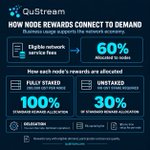
Staking, delegation and rewards are now integrated into the QuStream Dashboard, bringing your node’s activity and choices into one place.
The reward pool starts at $50,000.
If network revenue takes longer than expected to begin, we’ll add $10,000 for each additional month until revenue starts.
Staking is optional.
A fully staked node requires 200,000 $QST and receives 1.0 reward weighting. Unstaked nodes receive 0.3, including during the 7-day unstaking cooldown. Rewards reflect cumulative eligible runtime and these weightings.
Prefer us to handle operations?
Delegation lets you keep ownership while QuStream operates your node. It costs $5 per node, payable in QST or USDC, with 5% deducted from the resulting owner reward.
Round 2 is retired. You can withdraw your QST immediately to your original wallet, with bulk withdrawals also available, or voluntarily migrate by adding 180,000 QST to your existing 20,000 QST stake.
Open the Dashboard to review your node and choose your next step.

There’s a place for you in QuStream’s network, even if running servers isn’t your thing.
Own a node and delegate it to our team OR run it yourself.
Both routes let you participate in network rewards.
Just remember: no node = no network rewards. 👇


Bringing information-theoretic encryption to businesses through software is a big deal.
Letting the community own nodes supporting that infrastructure makes it personal.
That’s the QuStream proposition.
Own the node. Delegate operations. Participate in solana:AUuCEHQ7sm2i5GmaHrpE961voWcTY8U6mgrkhcV7pump rewards.👇
