






Pyggie retweeted

The "unhosted wallet" rule is dead.
coincenter.org/treasury-just…

Pyggie retweeted

weekend privacy launch: { anon.wei }
anon.wei is the first fully onchain privacy tool for ETH.
The entire dapp runs on smart contracts (ERC-8244).
Log in. Shield. Pay people by name (.wei). Super simple.
Zero fees. Always online. Shield ETH on multiple chains.

Pyggie retweeted

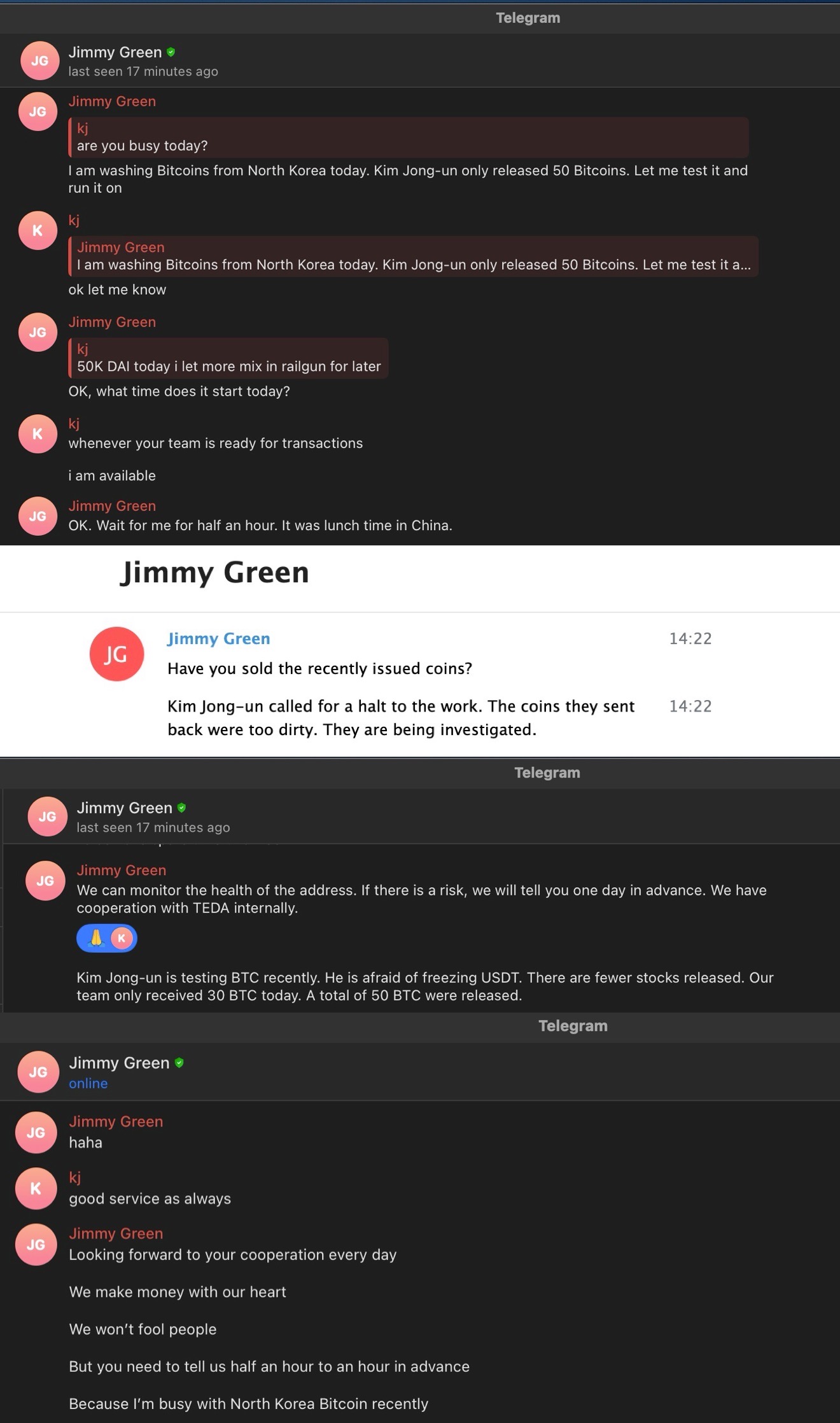
1/ How I infiltrated a Chinese organized crime syndicate that has laundered $1B+ across multiple exploits for Lazarus Group.
Posing as a client, I gathered intel that helped action freezes for the Feb 2025 Bybit exploit and attribute illicit activity onchain.



Pyggie retweeted

I'm sad to report that the AA collab between 8130 and 8141 (Frames) broke down last week, and Base and Ethereum are now going separate ways to implement different AA standards.
I want to share some reflections on this collab and on the future of the EVM.
For a long time, the EVM has been a unifying force between L1 and L2s. Thanks to a standard account model (EOA) and a standard transaction type (EIP-1559), users have been able to enjoy their wallets working seamlessly across EVM chains. Similarly, a AA standard shared across L1 and L2s would ensure a consistent multi-chain UX for smart accounts, including post-quantum (PQ) accounts which we will eventually all use.
As the crypto industry matures, however, L1 and L2s are starting to diverge in the values they provide and the use cases they target:
- For the L1, it's all about CROPS -- censorship-and-capture resistance, open source, privacy, and security. In short, Ethereum L1 wants to be the most decentralized programmable settlement layer of the world, which is what makes it a good base layer for L2s in the first place.
- For L2s, it's all about scaling, customization, and compliance -- things that commercial and enterprise use cases demand, and that the L1 does not provide.
These diverging needs have pushed the shared layer -- the EVM -- to its limit, and AA proved to be the breaking point. While L1 and L2s both value core AA use cases such as gasless transactions and passkey wallets, they differ sharply in what these features must comply with:
- For the L1, AA transactions must be uncensorable, private, and quantum-resistant, which call for a transaction type optimized for PQ signature aggregation and privacy protocols, and an account model that can be freely programmed and extended by developers without permissions from the chain. These needs lead to AA standards such as ERC-4337, EIP-7701, and now EIP-8141 aka Frame Transactions.
- For L2s, AA transactions must work at high scale, and they must be legible such that the protocol can enforce clear rules about what kinds of accounts/transactions are permitted vs not. These needs lead to AA standards such as Tempo Transactions and now EIP-8130 by Base.
With the AA collab, the authors of 8130 and 8141 tried to define a shared standard that can work for both L1 and L2s. While we identified a number of technical solutions, they all required one side or the other to compromise at least a little bit on their core goals. But ultimately, Ethereum wanted to be the best version of Ethereum, and Base wanted to be the best version of Base, and while both sides acknowledged the benefits of ecosystem interoperability, it was ultimately secondary to the need for each chain to achieve their core goals. So separate ways we went, putting the burden on wallets to deal with the fragmentation that ensues.
Now, just because we ended up with fragmentation doesn't necessarily mean it was a bad outcome. If reducing fragmentation comes at the cost of homogenizing chains to the point that they fail to solve problems for the users they care about, that would not be a price worth paying. While I was initially sad that the collab did not come to a successful conclusion, I took solace in the fact that both Ethereum and Base are now free to innovate on AA to the maximal extent in accordance with their own visions, unshackled from the need to accommodate the other side. If they execute well, and if the wallet community can bridge over the fragmentation, we may well end up with the best possible UX for the end users.
So where does that leave us -- the broader Ethereum community including Ethlabs -- if we want to continue pushing for a consistent UX across EVM chains? I see two paths forward:
- We can establish a coordination mechanism that encompasses more stakeholders than ACD itself (where only L1 client devs have voting powers), to govern shared L1<>L2 resources such as the EVM. That way, L2s can participate in shaping the EVM, as opposed to having to accept whatever the ACD decides, or being forced to fork if they don't like the decision (such as in this case with Base).
- We can accept that fragmentation of the EVM and wallet UX across L1 and L2s is inevitable due to their conflicting needs, and dedicate our resources to building wallets and applications that can abstract over the differences.
Indeed, the collab was an exercise in the first path -- we invited Base, Arbitrum, and other stakeholders to directly influence how native AA shapes up for the L1. While it ultimately failed in this case, I feel a better outcome could've been achieved if we had established a dialog between both sides way earlier, as opposed to well after L1 core devs had rallied around Frames.
On the other hand, I also learned from this exercise that some differences are unavoidable, and indeed it would be counterproductive to overly pursue interoperability at the cost of differentiation. In other words, we sometimes just gotta let the chains cook. For that reason, I've also become more bullish about the second path -- building wallets and applications that can speak the native transaction types of each chain, and hide the complexity from users through UX abstractions. This puts a lot of onus on the wallet/application developers of course, but on the bright side, it's also an opportunity for wallets/applications to stand out and differentiate, by competing to provide great UX across chains despite the underlying fragmentation.
Ethereum is the art of staying together while remaining different. We must accept that chains will succeed by innovating, and innovations will naturally result in differences. On the other hand, we must never give up on dialogue when we can achieve interoperability without compromising core product goals. As Ethereum and crypto grow to eat the world, the push and pull between innovation and collaboration will only intensify, and it's up to all of us -- builders across L1 and L2s, applications and wallets -- to determine whether diverse innovations will split Ethereum apart, or make it thrive as one.
Pyggie retweeted

1/ Today we're releasing Lattice Jolt: a post-quantum version of the Jolt zkVM, built on lattices instead of elliptic curves. It's _faster_ than curve-based Jolt and has the shortest proofs of any post-quantum zkVM — under 100 KB.
Post: a16zcrypto.com/posts/article…

Pyggie retweeted
We are long, long, long overdue to reduce the amount of KYC we do as a society.
It doesn’t stop crime. It enables mass surveillance of the innocent by the tyrannical. And, perhaps most of all, it enriches hackers with troves of intimate personal data.
p2p.coincenter.org/p/the-hug…

Pyggie retweeted

Bitcoin succeeded beyond its creators’ wildest expectations. The maximalist ideology built around it did not.


Pyggie retweeted

My thoughts on issuance:
1. the problem is real
2. the direction of the EIP is valid
3. but: changing issuance also has major downsides
4. most importantly: the decision must be with the community
I said a few words on the ACD call on Thursday, and wanted to expand on my thinking - both as Ethlabs co-founder and ACD moderator. In general, being able to have difficult conversations in public has always been a core strength of Ethereum.
1. The problem is real
- Slashing is core to Ethereum’s security. Not all attacks are automatically slashable. E.g. a majority of validators could censor the chain through malicious attesting. It needs to always be credible to slash such attackers. The larger portion of ETH is staked, and the tighter staked ETH is integrated into DeFi, the more credibility of slashing is at risk.
- Worse dilution for stakers: at low stake %, most rewards are real income. At high stake %, most rewards just offset dilution.
- Economies of scale: The competitiveness gap between centralized staking providers and both solo stakers and more decentralized staking providers widens at higher stake rates.
- Narrative confusion around ETH: ETH is a “productive asset” due to protocol revenue (fees & MEV), not staking yield. The staking yield also risks crowding out the emergence of other (productive) yield opportunities for raw ETH.
- Worse dilution for raw ETH holders: In general, harder assets are more attractive. BTC as the only $1T+ digital store-of-value explicitly centers zero long-term supply growth as its value proposition. Counter point: Gold with 1-2% yearly supply growth has a $30T store-of-value market cap.
2. The direction of the EIP is valid
- If one wants to limit the stake rate, the issuance curve needs to bend downwards for high stake %. The EIP is a specific instance of such a curve.
- The EIP also includes a further issuance reduction as a second phase. This introduces minimum viable issuance (MVI) as a secondary, monetary objective of the EIP. I personally think that is reasonable, but these two aspects should be discussed and reasoned about separately.
3. Changing issuance also has major downsides
- The decentralization of the staking set is crucial for Ethereum’s health. Many solo stakers are less economically competitive than large operators. A change that results in a significant drop in staking yield risks having these solo stakers disproportionately leave the staking set.
- Staked ETH is tightly integrated into DeFi today, both directly though LSTs, and through raw ETH lent out for the purpose of staking. Any major reduction in staking yield thus risks disrupting a core part of DeFi. This effect is worse the more rapid and more significant the yield drop is.
- Any change to Ethereum’s monetary policy resets the “monetary policy ossification clock”. Predictability of supply matters for ETH’s attractiveness as store-of-value. So far, changes are only ever towards issuance reduction, but will investors trust that that will hold true forever?
- Ethereum is overall at a pivotal moment. Given the large social cost of any months-long debate on issuance, it is reasonable to argue that this should wait until Ethereum overall is in calm waters, even if it makes a decision at a later time more painful.
4. The decision must be with community
- Most hard fork decisions are made by the allcoredevs (ACD) governance process. Conceptually, this is “delegated authority” by the community to the core devs. This delegation is very effective on most technical topics. For the occasional hard fork decision that is not primarily technical, this setup is however less well suited.
- Issuance in particular is not a technical decision. The decision still needs to be anchored to the ACD process - core devs need to coordinate on what to implement - but the actual decision forming needs to happen on the community level.
- This is easier said than done. The ACD process is flawed but well defined. A “community decision” is much fuzzier and harder to operationalize. Discussion venues like X are important, but also limited. How to have high quality community-wide discussions remains an important challenge to solve.
As we are getting off the ground at Ethlabs, we are trying to find the right path for how to contribute to both Ethereum and ETH. Issuance is a tricky topic for us: Caspar and I have argued for issuance changes in the past, and for now continue to have conviction in that path. The Ethlabs team as a whole has a wider spectrum of opinions, which has been healthy for internal discourse. And of course, we also see the broad community skepticism on this topic. The ability to have difficult conversations has always been a core strength of Ethereum. Our role in that should be to productively contribute to and engage with such conversations, not to blindly run in one direction. We will iterate to get that balance right, and genuinely appreciate feedback as we do.

Pyggie retweeted

Bitcoin and Ethereum can both do one-shot payments with UTXOs, but where they store them is the important nuance.
For Bitcoin, UTXOs are part of the chain's state and nodes must keep the entire UTXO set to verify new transactions. Spending a UTXO looks it up in state. This means UTXOs must be quickly accessible and can only be deleted from state when spent.
The proposed UTXO implementation for Ethereum is different because UTXOs are not kept in state. When created, they are emitted as an event log into history and assigned an index. For spending, the transaction proves that the UTXO exists in history, and to prevent double spending, the chain keeps a single spent bit for each UTXO index, marking is as spent.
Bitcoin optimizes for direct look-ups that need no witness against history. Ethereum optimizes for smaller dynamic state by moving "existence" into history and keeping only the min. information needed to prevent double spending.
The motivation to go with that approach (which is similar to what Peter Todd described as "Delayed TXO Commitments" for Bitcoin) is its impact on partial full nodes.
A partial stateful node that only keeps a minimal subset of the current state doesn't need to store all UTXOs but only the spent-bit structure. This is minimal state for still being able to trustlessly verify/follow the chain.
UTXOs can be implemented in various different designs with different trade-offs.
On Ethereum, they can provide a cheap solution for (private) payments, without necessarily requiring UTXOs to interact with contracts.
It'd be a feature on top, not a replacement of anything.

Native UTXOs on Ethereum.
Payments should be one-shot objects, not permanent state.
Bitcoin got this right. Ethereum can bring the same idea to payments: prove existence from history, keep only a spent bit in state, and reduce permanent state by ~99.8%.
Check out the blog post for details.
ethresear.ch/t/native-utxos-…

Pyggie retweeted

tldr even if ethereum becomes giga successful -- priority fees will probably not rise and may even go down a lot, and that is a good thing.
if ethereum scales in both tech and adoption, base fees (i.e. the fixed fee paid by the marginal transaction for inclusion in the block) can certainly increase a lot, and there isn't really a ceiling for that.
1M txns/s paid $0.1 cent each? that's $315b in run rate revenue per year. something like that is probably Ethereum's bull case for me.
but there is simply no such case for prio fees to increase a lot, and one big reason to believe they will actually continue to fall over time.
for a primer, searchers and retail traders pay prio fees price to access a *specific* piece of state before other transactors. a block can have a base fee of 1 gwei, with someone paying 1m gwei to access the first slot in the block. even though ethereum's adoption and txn activity increased, prio fees have stayed relatively constant at 500-600m/year for the last 4 years.
many mev experts, including me, have predicted that priority fees would likely decrease even as activity increases a lot, and the reason is that most of these conflicts should never "trickle down" to the validator to begin with. they are like free dollar bills that someone drops on the street, and if they are smart, they will simply stop dropping it. and if they are not smart, someone who is will replace their app over time.
when you zoom in on what conflicts searchers are paying for priority in, its primarily two things: arbitrage and liquidations (which are itself a form of arbitrage of buying an underpriced lending market position and selling it for a profit).
in both cases, the conflict used to reach the chain even though there sits someone upstream who could resolve this conflict already: e.g. a wallets running backrunning auctions on their user's orderflow (metamask, rabby, everyone), DEXs selling the first right to arbitrage (angstrom), DEXs paying to update their quotes before the first order can hit per block (propAMMs), lending markets selling the right to liquidate a position (chainlink svr + aave) - the list goes on.
even though I predicted this trend of "apps taking control of their own ordering" for years, 2026 is the year when it finally reached not just wallets but DEXs and lending markets as well, at scale, and Defi is becoming much better for it.
this has several consequences for ethereum: if you think that Defi is ethereum's main usecase and will be responsible for much of its future growth, this trend is amazing. it will make Defi spreads tighter and fees lower, making it ultimately more competitive against cefi and tradfi markets.
second, prio fees will likely never matter again for stakers, and should not be a big part of the discussion for issuance reduction. another update that comes up occasionally is mev-burn - on the face of it, probably not worth the complexity.
if you take away one thing from the thread, its that "95% of priority fees belong the apps or wallets who create them, and will flow there over time". ethereum has been benefiting from the inefficiency of the apps built on top of it for so much value to trickle down, but this trend is now in full reversal. and a future when apps make trillions of trading and lending volume per day, while paying hardly any priority fees - that future is actually very good, because it means the apps are well designed and competitive with tradfi, in spite of running on a blockchain.
if Ethereum wins, it will be on the back of a small base fee that millions of actors pay, that can still accumulate to a whole lot of revenue per year.

So far, I have not seen a conclusive answer or a solution with this in mind @hasufl
All I’ve gotten is something that translates to: “Nah, we’re super bearish that ETH will ever accrue any value again, so we don’t even take fees, which might make up a huge chunk of staking yield, into account when designing a new issuance curve for the next millennium.”
Pyggie retweeted

On a personal note: I have let myself become overweight in recent years and, given the burden of responsibility in my current role, such a drag on cognitive performance and energy should not be tolerated. I hereby resolve that I will bring my bodyfat % - currently 31% - under 25% by the end of the year, and keep it there through the rest of my time at EF, or I will resign without severance. Take this public admission as a credible sign of my resolve, and my commitment to EF’s spiritual Confucianism: 君子食無求飽,居無求安 —— 使欲必不窮乎物,物必不屈於欲。This is an area where I am inexperienced, so - fatphobes - do not hesitate to give me strict guidance.
Pyggie retweeted

Enshrining a native zkEVM is a core pillar of Ethereum's scaling roadmap right now.
In his latest blog post, @mikeneuder discussed a crucial point: a native zkEVM is to scale both execution and bandwidth. 🧵👇
Pyggie retweeted

Ethereum doesn't play a narrative game because it has every narrative. It is the most decentralized network, with the widest geographic and stake-weighted validator distribution. It is the most secure network, protected by a pool of slashable Ether that even now gives it a raw total cost of attack that far outstrips all else. It stands alone as having effective client diversity, an achievement of ecosystem coordination that reduces the chance of a software bug becoming a protocol bug. Ethereum has non-probabilistic finality without sacrificing liveness, the self-healing mechanism of the inactivity leak, a sharded data availability layer, and perfect uptime.
Ethereum is the World Computer, it is the cryptographic bulletin board with guaranteed liveness, it is the unstoppable neutral verifier of proofs, it is the hardest database in existence. It is the global settlement layer for finance, finance that pretends to be decentralized, and decentralized finance. It is where you can vote, collaborate with friends, keep your art, keep your life savings, and record your life's works. Ethereum is the Unreasonable Man's katechon of liberatory technology in a world increasingly eroding Free speech, Free software, Free association, and Free markets.
Ethereum did this without taking shortcuts; scaling has always remained conservative to keep the CROPS requirement of at-home self-verification not only feasible, but easily feasible. It does this without hiding its problems; MEV is a scourge but it is transparent, where it can be reasoned about. It takes the time to prioritize important hardening features like FOCIL even when it requires the painful decision not to focus on other improvements.
Ether doesn't play a narrative game because it has every narrative. It is programmable. It is an unconfiscatable store of value with predictable and sustainable monetary policy. It is the pristine decentralized asset of the greatest network, by which virtue it is pristine collateral in decentralized finance. This makes Ether private nonvolatile money, able to mint a number of anonymous stable cash equivalents that are cheaply transferable anywhere and everywhere. It is an inherently productive asset in both its own flourishing ecosystem and as the wage of soldiers receiving the minimal viable pay to secure us all.
The future is incredibly bright. We have all of the tools we need and simply need to actually build liberatory technology with them. Ethereum upholds incredible underlying CROPS promises, but not everything that exists atop it is accessible in a CROPS way. The sovereignty of most users is eroded bit by bit in various ways and various trust assumptions. There is no reason that we cannot do better, there is no reason that we cannot fix this, and I am excited to dedicate my life to this cause.


Pyggie retweeted

Some of my perspective on where the @ethereumfndn is going.
First of all, this is only my own view. The board is not just me, and I have no extra special powers on the board that the other board members do not. @aerugoettinea is the one executing much of this transition. My input has been largely on technical questions. The board is in the process of expanding, and my own power within the org will continue to decrease, which is honestly what I want.
The 2025 era brought many important improvements to EF and its ability to execute. Many issues were resolved, and EF continues to benefit from its improved efficiency and greater focus on concrete goals to this day. And so with those problems resolved, early this year, the largest remaining hole that I perceived was something different nagging at me: I would regularly spot people saying things like "vitalik says these beautiful things about ethereum needing to be decentralized, and have privacy, and be a sanctuary technology, but why do the EF's actions not reflect that?"
Now, you may have been hearing something different. You may not have been sensing a feeling of crisis at all, and maybe were hearing people saying that finally we were taking execution and BD seriously and the main task for us is to keep going that way and be even better and faster. Then probably there is genuine difference between you and me, in what kinds of criticism I take most seriously, and what kinds of critics through their criticism are most able to make me feel pain.
As an analogy, let's briefly switch over to a different domain.
One belief you can have about Google is that it is a success story, and has brought a lot of good to humanity in organizing the world's information. Another belief you can have about Google is that they had a beautiful idealistic beginning, but at some point the corruption of mainstream corporate attitudes seeped in, and they slowly bit by bit completely abandoned the "don't be evil" slogan.
My belief on Google specifically is probably somewhere between the two. BUT, if you had taken me back in time to ~2008, and offered me a button to press to make Google one or two standard deviations more "dogmatic", eg. give Richard Stallman permanent veto power over some key policies, I would immediately press it.
Why? Because a choice for one company is not a choice for the world, or even one country. Google existed and exists in the context of a technology industry generally drifting away from early idealistic don't-be-evil roots and toward greed for financial gain, totalizing visions of accelerated superintelligence, infiltration by sociopaths, and craven capitulation to (or worse, active participation in) government pressure for ideological control, surveillance and war. And so *one company* doing something different, positioning itself to be what George Bernard Shaw calls the Unreasonable Man, resisting the trend of the times, would have been better for freedom, balance of power and stability of society as a whole, than *all* large companies bending to dominant trends. This is a part of my version of pluralism.
This line of thinking is not just mine, but I also is not too far off from what Aya and others had in mind with the Mandate.
Now how does this all get to the role of the EF?
EF is not a "center of Ethereum", rather EF is "one node, with a defined purpose, alongside other nodes". We've always said that the EF should be the latter, but many in the Ethereum ecosystem (and even within the EF) wanted us to be the former. Now, we are taking action to ensure that we will be the latter.
This is particularly important because EF is a limited organization, with limited resources and limited organizational capacity. The EF has only ~0.16% of all ETH (less than many other individual ETH holders), whereas among other blockchains it's common for "the central foundation" to have 10-50%. Fiscally, the EF was originally designed to fulfill a limited work scope defined in the token sale docs and other pre-launch materials (building the chain software; getting through Frontier, Homestead, Metropolis, Serenity), which was fully completed in 2022; it was not designed to be an eternal steward.
And so today, the EF is choosing to use its remaining resources to pursue longevity over breadth (yes, this means we sell less ETH). The EF focuses *specifically* on those activities critical to the success of ethereum as a censorship/capture-resistant, open, private and secure system, that would not happen otherwise. This means making hard choices, and in some cases even activities that we highly approve of and people that we highly respect becoming outside of the EF. People of great technical talent, public respect and even alignment with the mission and CROPS being outside of the EF is in fact necessary if we want important tasks to be able to attract outside capital. This also means the EF taking opinionated stands culturally.
This is all intended in cooperation with all other parts of ethereum. We recognize that many other parts of the ethereum world highly respect CROPS and related values. But highly respecting is not the same as choosing to specialize and totally dedicate to a domain (Compare in a different domain: I think reducing animal cruelty is important, and I like vegan food, but am not full unconditional vegan myself)
EF is still in a transition period, and we expect its new long-term form to stabilize over the next few months. What are the guiding principles of this new form? Again, I am only one person, but I can give my answer from a technical perspective (there are also critical non-technical aspects).
At the core, *Ethereum must be impressive*. We are living in an age of highly intelligent AI and all kinds of other technological acceleration. "Status quo EVM, with a hard fork or two a year to optimize for short-term needs of users" is not interesting.
To some, "impressive" means: 250ms latency and 1M TPS. I think Ethereum trying to go that route is a mistake. Being as fast and as scalable as possible, and only a small epsilon more decentralized than the others, is a route to mediocrity, and if we try it we will lose.
I think Ethereum should scale. But I think Ethereum should strive the hardest to be deeply impressive in a different dimension: the CROPS dimension. This means things like:
* Provably bug-free Ethereum. This is a goal that all cybersecurity researchers would have thought is absurd and impossible, up until roughly 6 months ago. Now, it's on the cusp of being possible, thanks to AI-assisted formal verification. So we should be frontrunners in doing this.
* Available chain consensus. Ethereum is, and with lean consensus will cotninue to be, the ONLY chain that has both (i) traditional-BFT style properties that it's safe under asynchrony up to a high level of fault tolerance, and (ii) the bitcoin PoW-style property that under synchrony it's safe up to 49% attackers. As far as I can tell, literally no other chain has this or is planning for it; bitcoin goes for (ii) only and most other chains go for (i) only. Some will remember I fought hard for this, Unreasonably insisting that it is not OK for ethereum to rely on social consensus and hard forks to rescue ethereum from 34% of nodes going offline. It's OK for chains like hyperledger, bnb, solana, tempo, etc. It's not OK for bitcoin or ethereum or eg. zcash.
* Intermediary minimization. The fact that smart contract wallets, protocols like railgun, etc have to send transactions through intermediaries to get included onchain is honestly embarrassing, and it's a constant point of fragility. Hence the work on FOCIL and EIP-8141 (and 7701 and years of work before) to make transaction sending intermediary-minimized with public mempool and strong inclusion properties, in a truly general-purpose way, that covers not just eg. secp256r1, but also privacy protocols and much more. Kohaku is pushing intermediary minimization at the user layer, pulling Ethereum away from the dystopian status quo world where our wallets don't even verify the chain, send our private data out to a dozen third-party servers, and toward a brighter CROPS future.
Some of these goals are Unreasonable - maybe Ethereum would be "fine" getting only 50% of the way - what if we depend on intermediaries, but make it easy to switch? But going 50% of the way would not make Ethereum Deeply Impressive in the CROPS way. So we push for 100%.
Fortunately all these goals are compatible with high TPS, this is a major focus of research (esp. on scaling the state). Well-designed L2s can also help, especially L2s optimized for specific applications (eg. high-volume trading, privacy...). These goals are even compatible with significantly lower slot times, thanks to Raul's work on erasure-coded P2P, and many other optimizations.
The most high-value "product" of the ethereum blockchain, financially speaking, is ETH the asset. Ethereum secures $250 billion of ETH. The types of properties of Ethereum that I mentioned above are very good for ETH the asset. Nearly 90% of my net worth is in ETH, and most of the remainder is ~$40m of onchain fiat of which every dollar has already been allocated for some open-source biotech or software or hardware initiative. That said, there are aspects of supporting ETH the asset - *necessary* aspects even - that are outside the scope of the EF. This is where we need other heroes (some of whom hold more ETH than the EF does) to step in and help. EF has been recently thinking more about how it will relate to other such organizations, and give them needed initial support.
EF will be a smaller ship than in previous years, a more opinionated one - in some cases more opinionated in ways that might be difficult to comprehend - but a longer-lasting one, and one suited to making sure that ethereum brings something meaningful to the world. We are grateful to all those inside and outside the EF who are helping to make this happen.
Pyggie retweeted

A quick post on how ePBS changes Ethereum scaling:
terencechain.com/writing/epb…

Pyggie retweeted

thorchain gg20/tss attack path
i reproduced the suspected gg20 leakage mechanics against the tss-lib version they used. it accepts malformed paillier material, exposes a type 5 / type 7 oracle shape, and the go-tss wrapper misses some important checks.
banteg.xyz/posts/thorchain-t…