

Java for Ubuntu | Tweets are my own.
India
Joined July 2009
- Tweets18.1K
- Following489
- Followers655
- Likes12.9K







Pushkar N Kulkarni retweeted

Unpopular Opinion: you don't need Go or Rust for high concurrency backends anymore.
Java virtual threads handle millions of concurrent I/O tasks with simple, readable blocking code.
Basic if you were retarded 😂

C is an underlying standard because for some reason we decided we needed 10,000 new trendy languages rather than agree on a new standard.
I feel people only begrudgingly use C or C++ because of this.
What's crazy was we didn't have this issue in the 80s or 90s. We had the holy trinity of C, Pascal and Basic. C if you wanted absolute power and control, Pascal if you needed training wheels, and Basic if you were retarded.
3
52
Pushkar N Kulkarni retweeted

This is f*cking insane. Fields Medal winner Terence Tao, the greatest living mathematician:
"We've learned almost nothing mathematically from what they did. It's like strip mining the landscape. You get all the fruits, but then the landscape is barren afterwards"
In under 2 minutes, he kills the "AI solved it, so we're winning" story: a 100-page proof that no human fully understands yet, bought with millions of dollars of compute
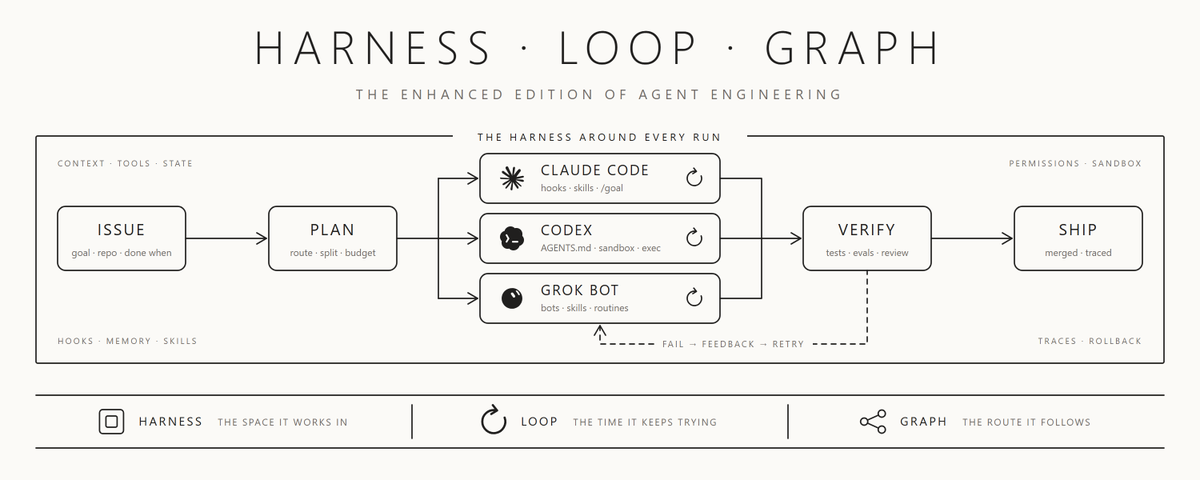
Output → Proof → Understanding → Harness → Work You Can Actually Trust
An answer nobody can explain is a result you can't build on
A harness is what makes the model show its work, check it and leave you something you understand
Everyone is cheering the answers. Almost nobody builds the system that makes them usable
Bookmark it, watch it tonight, then read the harness engineering guide below ↓

Reminds me of a post that said: "Rust killed Haskell more than C".

Co-creator of Haskell on why C is a dangerous language
Simon: In C, you program by mutation. So it's unsafe in the sense that any function can mutate any variable at any time. It has a lot.
You pass pointers around a lot, and functions mutate the memory pointed to by those pointers. And moreover, typically they can mutate it anywhere. There's no array bounds checks or anything.
So it's kind of like super unsafe. And in fact, and this is demonstrated by the fact, can you imagine all of these exploits that we get every day, right, that Mythos is discovering in huge numbers? But why is the Internet so insecure?
Primarily because all of our software infrastructure is written in unsafe languages. If we'd written all of our Internet software and operating systems in Haskell or maybe in OCaml or ML, 99% of all these exploits would be removed by construction.
It's like we've built a boat out of paperclips and we're surprised that it's leaky. You shouldn't build boats out of paperclips, right, because they have holes in them. You should build it out of a secure substance, right?
But then it's too late. So we spend incredible amounts of human ingenuity and effort patching the holes in our boat built of paperclips. It's tragic.
52
Both?

In 1975, Steve Jobs told Steve Wozniak that Atari had paid them $700 for a game they built together. He handed Woz a check for $350.
Atari had actually paid Jobs about $5,000.
In the video below, Woz says: "Who cares about money? Well, you do care about friendship and honesty."
Jobs was working the night shift at Atari. The company wanted a new arcade game called Breakout, built with as few chips as possible.
Jobs couldn't build it. Woz could. He already had a full-time job at Hewlett-Packard, and Jobs said they had four days. Woz went four days with no sleep. Both of them came down with mono.
Woz did it in 45 chips. Atari's own engineers were using 150 or more.
He took his $350 and was happy with it. Jobs took the rest and went up to Oregon to buy into a farm.
About ten years later, Woz read the real number in a book about Atari. By then the two of them had built Apple, and Woz was a multimillionaire.
If Jobs had just told him he needed the money, Woz says, "I would say take it all."
It wasn't the last time. Before Apple went public in 1980, Jobs refused to give stock options to Daniel Kottke, his friend since college, who had helped build the first Apple computers.
Woz did the opposite. He sold his own shares cheaply to Kottke and other early employees who had been left out.
One friend kept almost all of a $5,000 bonus. The other gave away millions.
Was Jobs a genius who knew what business takes, or just a bad friend?
1
52
Pushkar N Kulkarni retweeted

Security is more sexy and interesting nowadays than coding - change my mind


Pushkar N Kulkarni retweeted

Big day in the Spring ecosystem. There are 127 open source releases on the calendar for today.
The headliners:
Spring Boot 4.2.0
Spring Framework 7.1.0
Spring AI 2.1.0
Spring Security 7.2.0
Spring Data 2026.1.0
Spring Cloud 2026.0.0
Spring Batch 6.1.0
Spring Modulith 2.2.0
What are you upgrading first?
calendar.spring.io
When main-stream media became more of a bluff than substance, I turned to social media for news. SM has now become a pile of bs 🙏
43
🍎 vs. 🍊 ?

With this latest rust release, why would anyone use Zig anymore? blog.rust-lang.org/2026/11/1…

59
Pushkar N Kulkarni retweeted

With this latest rust release, why would anyone use Zig anymore? blog.rust-lang.org/2026/11/1…
Pushkar N Kulkarni retweeted

De-slopping is twice as hard as vibing the code in the first place. Therefore, if you vibe the code as quickly as possible, you are, by definition, not smart enough to de-slop it.
(With apologies to Kernighan.)

Pushkar N Kulkarni retweeted

libghostty 1.0 is here! I started Ghostty ~5yrs ago to work towards this. Today, libghostty is in hundreds of projects used by tens of millions of people. 1.0 marks ABI stability, quality, and an invite for distros to begin packaging. mitchellh.com/writing/libgho…
Since starting the Ghostty project in 2022, the most common question I've been asked is "why?". Today, I'll answer this by showing the broad industry impact libghostty has already had.
On top of JetBrains and Neovim already mentioned (that alone being over 10 million users):
-KDE developers are experimenting with a Konsole replacement built on it.
- Vercel's Turborepo uses it to render task output in its TUI.
- devenv uses it to drive shells.
- Antithesis used it to fuzz TUI programs and found real bugs in btop and others.
-Ghostel brings it to Emacs.
- ghostty-web is the WASM build with an Xterm.js-compatible API.
- Commercial products like OrbStack embed it.
- And a whole wave of new terminals and "agentic" coding tools, such as herdr and cmux, have been built on it rather than writing yet another emulator.
There are community bindings for Rust, Go, JavaScript, Swift, Python, .NET, Elixir, Dart, Java, and more, and the awesome-libghostty list tracks well over a hundred projects.
More people today use a terminal powered by libghostty than use Ghostty the application, by a very large multiple. And libghostty is having a much larger impact than being "just" a terminal emulator.
I'm excited to see where people take it from here.
Pushkar N Kulkarni retweeted

Java is a language that arrives late to things. Let me prove it: lambdas, records, virtual threads, generics. Many other languages had them long before.
Now you might be thinking:
- Elder, are you trashing Java?
- Quite the opposite. To me this is one of Java's big advantages.
Before I tell you why, think of a company that's an expert at arriving late: Apple. It wasn't the first to launch a tablet, or a smartphone like the iPhone, or an iPod. It always got there later. And what's the advantage of arriving later? You get to avoid the mistakes others made.
A great friend of mine says Java has always been a production language.
- Yeah, but every language is a production language.
- True, every language is made to put things in production. But not every ecosystem has the culture of looking at production before shipping something. In Java that was always priority number zero.
The practical consequence? Lambdas, records, virtual threads, generics, and plenty of others went in without bugs in production. You won't find stories of "wow, records blew up in prod because they got the implementation wrong."
I've been at this for 27 years and I don't think Java will ever race to ship something before other ecosystems. And to me that's a career lesson too. Do I really need to rush to be the first to do something? I don't know. Looking at a language with over 30 years in the market, still evolving like no other, I think they know what they're doing.
Pushkar N Kulkarni retweeted

Build a fully local AI coding agent on Ubuntu using Canonical Workshop and the Qwen3-Coder Inference Snap.
In this step-by-step demo, you'll set up an isolated development environment, connect your coding agent to a locally hosted LLM, and run coding tasks without an internet connection.
Follow along to recreate the setup on your own machine, using CPU or GPU inference: youtu.be/u5Q149jlMQ8
#Ubuntu #Linux #AI #Agents #Workshop #OpenSource
Pushkar N Kulkarni retweeted

Claude is pretty useless when the code you're trying to write has never been written before.
#TIL Duck typing comes from "If it walks like a duck, swims like a duck, and quacks like a duck, then it probably is a duck."
46
Pushkar N Kulkarni retweeted

In September 1992, Unicode had a problem on Unix. Storing characters as 16-bit values could introduce zero bytes that C programs mistook for string terminators. Earlier encodings had compatibility problems of their own.
One evening, Ken Thompson and Rob Pike went to a diner in New Jersey. Thompson sketched a new encoding on a paper placemat.
ASCII stayed exactly as it was. Other characters used multiple bytes, without accidentally introducing null bytes or Unix path separators.
They went back to Bell Labs and started coding. By Friday, their Plan 9 operating system was running entirely on the new encoding.
They called it UTF-8.
Today, it powers over 99% of websites with known character encodings.

Pushkar N Kulkarni retweeted
Ghostty 1.4 is now out! Full Kitty graphics with animation (the first terminal besides Kitty to do it), scrollback compression for much lower memory usage, macOS 27 support, a new OpenGL renderer on Linux, ghostty +ssh, big performance gains, and hundreds more changes.
The highlights:
- Scrollback compression: scrollback compresses ~90+% on average, meaning your terminals use that much less live memory
- Huge memory savings across the board: no single large thing, just lots of good improvements lowers memory usage everywhere, netting anywhere from 50 to 90% less memory usage depending on workload
- Kitty graphics is now 100% complete, including animation and relative placements, after a full conformance pass against the spec and Kitty itself
- The Kitty clipboard protocol, with an image preview when a program asks to read your clipboard
- Split drag and drop on Linux, including between windows
- ghostty +ssh installs terminfo on remote hosts automatically, so things just work over SSH
- Lots of terminal emulation accuracy fixes
This release is 7 months of work from 172 contributors over 2,889 commits. It also fixes 10 security advisories, so please update.
Full release notes: ghostty.org/docs/install/rel…

Good explanation about chain of trust, something essential to understand the eMudhra security failure
youtu.be/heacxYUnFHA?si=CsyY…
69