

Psychotherapist/counsellor (MBACP)⎮Lecturer & Writer⎮Relational Psychotherapy Subscribe: https://xitter.cf/t.co/jQgqCVYDwE Website: https://xitter.cf/t.co/Ti00ew7W08
Devon, England
Joined November 2018
- Tweets25.5K
- Following2.2K
- Followers13.8K
- Likes26.3K





Pinned Tweet
Proud to have co-authered this with @joannamoncrieff @JDaviesPhD & Lucy Johnstone.
Calling ADHD a ‘myth’ is misleading. But declaring it simply ‘real’, as though its scientific status were settled, is even more so.
Read why in our article for @bmj:
bmj.com/content/394/bmj-2026…

Autism and ADHD (like other psychiatric diagnoses) are descriptive categories, which don't pick out things that people "have". This is the error of refication.
They didn’t discover that "they" can “coexist”; they conceded that people don’t fall neatly into either category.

For years, psychologists believed autism & ADHD couldn’t coexist in the same person. We now know that’s not true—but the combination, nicknamed “AuDHD,” is still far from fully understood. Can you separate AuDHD fact from fiction? Take a quiz to find out.
psychologytoday.com/us/quizz…

Delighted to see @dropthedisorder returning for another festival!
I've had the pleasure of speaking at one of their previous events and have long admired the important work they do on challenging psychiatric dominance and promoting richer conversations about psychological distress and impairment.
Thoroughly recommend 👇
eventbrite.co.uk/e/a-disorde…

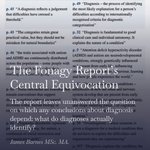
It was a great pleasure to discuss the recent Fonagy report with @naomicfisher & @mindthecouchuk on their podcast.
We talk about its confusing notion of overdiagnosis and the central equivocation around what diagnosis means.
Thanks so much for having me on. Link below 👇

neurosense.substack.com/p/un…
I subsequently also wrote a Substack article on this:
betweenus52.substack.com/p/t…
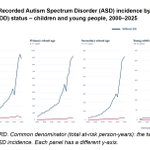
In this video, Fonagy is pressed on the issue of the 4-fold increase in diagnoses of autism in young people.
He offers a definition of "overdiagnosis" that isn't used, nor in the report. Pressed on this, he says, "Maybe some of them are misdiagnosed." 🤨
The point is that "overdiagnosis" does not mean that the people so diagnosed are malingering, which would be a very cynical view. I'm not sure why Fonagy is preoccupied with that, which seems political rather than scientific.
It only means that they have been diagnosed with something they don't properly meet the criteria for. There could be all sorts of reasons for that, including misdiagnosis. It does not mean that the person is not experiencing distress or impairment.
The Fonagy report defines psychiatric diagnoses as thresholds on continuous human variation; it also treats them as identifying underlying explanatory disorders.
Despite important concessions, this equivocation undermines its conclusions and may just recapitulate the problem.
(See below for link to article👇)

James Barnes MSc., MA retweeted

Tickets for the AD4E online festival on Friday 6th Nov are now available here: eventbrite.co.uk/e/a-disorde…
I would only add that "it's a bit of everything" is even more dumb.

James Barnes MSc., MA retweeted
The paper cited in this article reveals that stimulants increase alertness and stimulate reward pathways rather than attention pathways. These are not specific to ADHD and they also explain why stimulants feel like they 'work' but don't improve objective performance.

It’s literally now a free-for-all over what even counts as ‘ADHD’; with psychiatry flip-flopping daily between it’s being over or under diagnosed. And apparently, it has little to do with poor attention after all… but don’t worry, the drugs still 'work'!
dailymail.com/health/article…

Here, in the Fonagy report (p. 258), there seems to be the clear implication—in the example of ADHD diagnoses—that some are misattributing their experiences or having their experiences misattributed to neurodevelopmental conditions.

Partly the fault of the report’s own obfuscation, but this is not what the Fonagy report found. For autism among young people, it found:
Estimated population prevalence: 1.2%.
Recorded diagnoses: 6–11-year-olds: 4.58%
2–17-year-olds: 4.06%
(These recorded-diagnosis figures exclude waiting lists.)
The report itself questions the "catch-up" explanation:
“If administrative prevalence were simply converging with underlying population prevalence, rates would be expected gradually to stabilise. Instead, recorded diagnoses and demand for assessment continue to rise rapidly.”
It stops short of calling this overdiagnosis—though there is no other metric provided other than these rates through which that could be established—but “we are just diagnosing those who have been missed” is plainly not its conclusion.

Here is the passage (p. 11) in the Fonagy report that defines diagnostic rates of ADHD & autism.
Call me pedantic, but it seems fairly clear to me that it *is* saying that overdiagnosis is occurring—just not "at scale", i.e., not in every demographic.
Population prevalence is the estimated proportion of people who should meet diagnostic criteria (per the psychiatric model); administrative prevalence is the proportion actually recorded as having the diagnosis.
Notwithstanding the age of the data used (which was, it must be said, known before any investigation into "overdiagnosis" took place and is only 9 years old), it is saying that in some demographics (e.g., autism ages 7-17) there is an excess of administrative diagnosis, which isn't explained by a convergence with population prevalence—in other words, overdiagnosis (in this case, 4-fold higher).
gov.uk/government/publicatio…

Take this passage (p. 12) on neurodiversity from the Fonagy report.
The highlighted segments, the meaning of which is not altered by the sentences in between, seem to me to imply that some of those identifying as neurodivergent would not meet criteria for diagnosis.
gov.uk/government/publicatio…


James Barnes MSc., MA retweeted

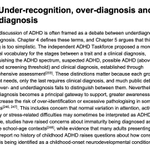
I agree it is very diplomatic language. But if you are in the field proper you can read between the lines. That last bit highlighting adults reporting ADHD symptoms despite having no Hx of it in childhood suggests they feel many are misattributing their experiences to ADHD.
This chart (p. 158) on autism diagnoses from the Fonagy report is telling.
gov.uk/government/publicatio…

James Barnes MSc., MA retweeted
Replies to this illustrate the problem. ASD and ADHD are not things people have, like a brain tumour. They are terms for describing ways people behave. The brain mediates behaviour, of course, but we have not identified specific brain processes associated with these behaviours.

Looks like there are sensible things in this report (e.g. call for needs-based help), but without challenging the unproven idea that ADHD and ASD are brain conditions or clarifying that diagnosis is not an explanation but a label, change is unlikely. theguardian.com/society/2026…
