
Researcher @reflection_ai PhD @ltiatCMU & @istecnico Previously research @Google, @Microsoft & @Unbabel
Pittsburgh
Joined February 2011
- Tweets196
- Following292
- Followers702
- Likes340






Pinned Tweet
Really hard to put into words what we have just done. From zero to hero in less than a year.
Incredibly proud of everyone on the team.
This is only the first release! Stay tuned for the next ones 😉

Introducing Beam: a highly efficient agentic open model with 501B total parameters and 23B active.
- Frontier reasoning efficiency
- Advances the Western open frontier on coding & agentic tasks
- Trained end-to-end from scratch
Full weights release this month.
Learn more about Beam: reflection.ai/beam

Patrick Fernandes retweeted

Beam is now available across platforms, with open weights under the Apache 2.0 license - in collaboration with an ecosystem of 40+ partners.
We're releasing:
- Weights, tokenizer, and reference implementation
- BF16, FP8 and NVFP4 weights and a DFlash2 drafter
- The open source harness we built and trained Beam on: Mirror CLI
Weights and model card on Hugging Face: huggingface.co/reflection

also personal thank you to @DuarteMRAlves, my partner in crime on the *priors* team – such a solid foundation for RL was only possible because you were there 🙏
Patrick Fernandes retweeted

Today, we’re introducing Beam, @reflection_ai's first model.
We started the high-compute RL team in February. Looking back at these past few months, it’s remarkable how far we’ve come.
Making RL work at this scale took careful science, scalable infrastructure, and a strong foundation from mid-training. Seeing that work come together to keep learning stable as we pushed the scale and complexity of the run has been incredibly rewarding.
What has made this especially meaningful is the people: their commitment and curiosity, the way they supported one another through difficult stretches, and the joy of figuring things out together.
To everyone who helped bring Beam to life, across RL science, infrastructure, mid-training, pretraining, and our close collaborators throughout Reflection: thank you. There is so much of your hard work and care in this model.
Building and leading this team has been an honor and one of the most rewarding experiences of my career. I’ve learned so much from the people around me, and I’m proud of what we’ve built together.
@MishaLaskin and @real_ioannis, thank you for your trust and support throughout this journey.
This is our first model, and there’s so much more ahead. I’m excited to share Beam with the community, learn from your feedback, and continue building better models together.
Introducing Beam: a highly efficient agentic open model with 501B total parameters and 23B active.
- Frontier reasoning efficiency
- Advances the Western open frontier on coding & agentic tasks
- Trained end-to-end from scratch
Full weights release this month.
Learn more about Beam: reflection.ai/beam
Excited to announce that, after finishing my PhD a couple of months ago, I will continue to do *open* science at @reflection_ai on @_ghorbani's new team!
And we are still looking for exceptional individuals to join us 😉

Hi friends, after three incredible years at OpenAI I am excited to share that I am starting a new chapter at @reflection_ai, where I will be leading the Science of Scaling team.
Our mission is to deepen the scientific understanding of large scale learning and to turn compute into intelligence as efficiently and predictably as possible.

Patrick Fernandes retweeted
Hi friends, after three incredible years at OpenAI I am excited to share that I am starting a new chapter at @reflection_ai, where I will be leading the Science of Scaling team.
Our mission is to deepen the scientific understanding of large scale learning and to turn compute into intelligence as efficiently and predictably as possible.
Patrick Fernandes retweeted

Current multimodal LLMs excel in English and Western contexts but struggle with cultural knowledge from underrepresented regions and languages. How can we build truly globally inclusive vision-language models?
We are introducing CulturalGround, a large-scale dataset with 22M open-ended + 8M multiple-choice VQA samples covering 39 languages and 42 regions.
We train a new model, CulturalPangea on CulturalGround and the resulting model achieves state of the arts performance on cultural multilingual benchmarks outperforming prior open-source models of the same scale.
We open-source everything and everything, training dataset, model, and all data recipes from each stage of the data curation pipeline.
Paper: arxiv.org/abs/2508.07414
Webpage: neulab.github.io/CulturalGro…
Below we discuss the data curation pipeline in detail and some of the interesting results we find training CulturalPangea ⬇️⬇️

Patrick Fernandes retweeted

I'll be at ACL presenting our work, A Context-aware Framework for Translation-mediated Conversations (arxiv.org/pdf/2412.04205) in the Machine Translation session, 28 Jul, 14:00-15:30, room 1.85.
Come check it out if you're interested in bilingual chat MT!
Patrick Fernandes retweeted

When it comes to text prediction, where does one LM outperform another? If you've ever worked on LM evals, you know this question is a lot more complex than it seems. In our new #acl2025 paper, we developed a method to find fine-grained differences between LMs:
🧵1/9

Patrick Fernandes retweeted

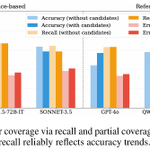
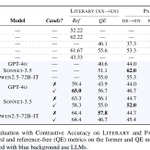
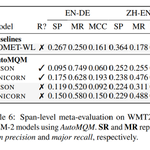
Very proud of this work with @psanfernandes @swetaagrawal20 @ManosZaranis @gneubig at @sardine_lab_it and @LTIatCMU. TL;DR: We evaluate translation quality of complex content by checking question answering invariance.

MT metrics excel at evaluating sentence translations, but struggle with complex texts
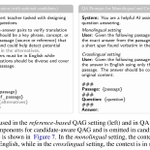
We introduce *TREQA* a framework to assess how translations preserve key info by using LLMs to generate & answer questions about them
arxiv.org/abs/2504.07583
(co-lead @swetaagrawal20)
1/15

Patrick Fernandes retweeted

👉 slator.ch/QuestionAnsweringA…
Two new research papers propose using question answering ❓ to evaluate #AI #translation, 🤖 challenging 🧐 how the language industry evaluates translation quality.
@zoeykii @umdclip @MarineCarpuat @JohnsHopkins @psanfernandes @LTIatCMU @istecnico @Unbabel @swetaagrawal20 @itnewspt @UofMaryland @ManosZaranis @andre_t_martins @gneubig

MT metrics excel at evaluating sentence translations, but struggle with complex texts
We introduce *TREQA* a framework to assess how translations preserve key info by using LLMs to generate & answer questions about them
arxiv.org/abs/2504.07583
(co-lead @swetaagrawal20)
1/15
Code to run TREQA, in any dataset, with any LLM, is available at
github.com/deep-spin/treqa
14/15

This was not an easy project (prompting LLMs can really test your sanity 🫠) but proud of the final result and thankful to all the team @swetaagrawal20 @ManosZaranis @andre_t_martins @gneubig
Work done in the context of my @CMUPortugal PhD
(probably one of the last ones 🥲)