

A CIHR-funded, interdisciplinary research program working to identify effective #policy interventions to reduce household #FoodInsecurity in Canada
Canada
Joined December 2015
- Tweets4.1K
- Following2K
- Followers3.2K
- Likes2.3K






Pinned Tweet
🦋Moving forward we will be posting on Bluesky instead at: bsky.app/profile/proofcanada…
📬You can also get all the latest updates on PROOF's research on our site and through our newsletter: proof.utoronto.ca/newsletter…

Thank you to everyone for the congratulations for Dr. Tarasuk's appointment to the Order of Canada.
You can read more about it and listen to her interview with @mattgallowaycbc at: proof.utoronto.ca/2024/proof…


Congratulations to Dr. Valerie Tarasuk, Principle Investigator of @proofcanada for her appointment as a member to the Order of Canada!

PROOF retweeted

Food insecurity in Canada keeps rising, and food banks in this country are strained to their limit. Dr. Valerie Tarasuk of PROOF joins @thebigstoryfpn to discuss the scale of the problem and the inadequacy of the response. toronto.citynews.ca/2024/10/…
PROOF retweeted

✨More speakers for our Convening 2024: Toward Just and Affordable Systems // Nouveaux intervenants pour notre Conférence 2024 !
Kristen Lowitt and Tim Li will be joining the discussion on the panel Food Affordability: Income & Equity.
More info here: tr.ee/P1afXpfRug


PROOF retweeted

With prices of food having gone through the roof, #TemertyMed Dr. Valerie Tarasuk said it's "predictable" that food bank demand has risen dramatically, including among people who have jobs. @CBCNews bit.ly/4dPm7Ci
PROOF retweeted

Food insecurity in Canada keeps rising, and food banks in this country are strained to their limit. Dr. Valerie Tarasuk of @proofcanada joins us to discuss the scale of the problem, and the inadequacy of the response: link.chtbl.com/UYIyzPYC
Is household food insecurity more prevalent in Canada than in the US?
No. The two countries differ in how they classify food insecurity. When using the same classification scheme for a more appropriate comparison, Canada has a lower rate. Read more:
proof.utoronto.ca/2024/respo…

The new PEI Children’s Benefit slated to start in 2025 is an important step towards reducing the record food insecurity among families with children in the province. However more is needed, like federal support through redesigning the Canada Child Benefit. policyoptions.irpp.org/magaz…
This Post is from an account that no longer exists. Learn more
Progress on a national school food policy is a positive step towards improving student nutrition, academic success & more, but it shouldn't be expected to address food insecurity.
What would? Changing the CCB to better address income inadequacy. More at: policyoptions.irpp.org/magaz…


"We're not detailing with the root causes of [#FoodInsecurity] - which is that too many people cannot afford food," said Dr. Valerie Tarasuk @proofcanada via @mr_lois_lane @CBCHamilton
Tarasuk's #InformedOps @ bit.ly/2YmkjLx
cbc.ca/news/canada/hamilton/…
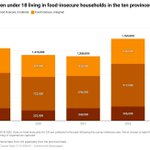
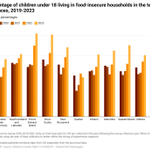
The CCB is a critical part of our social safety net, but is it doing enough? The fact that 27% of families w/ children were food insecure in 2023 (5.8% severely so) tells us it's not. The government should revise it to provide more to those most in need. policyoptions.irpp.org/magaz…
You’re unable to view this Post because this account owner limits who can view their Posts. Learn more
Cutting the child poverty rate by half is an important accomplishment, but it should not be the only one. Food insecurity gives us a more direct measure of the lived experience of financial hardship. It is time to set new aspirations for the CCB around reducing food insecurity.
More evidence for policy action at: proof.utoronto.ca/2023/canad…

The number of children living in household struggling to afford food due to inadequate finances has risen substantially in recent years. The most important thing that the federal government could about this is change the design of the Canada Child Benefit. policyoptions.irpp.org/magaz…

PROOF retweeted

The recently announced national school food program won’t solve food insecurity for families.
Instead, as Tim Li and Valerie Tarasuk explain, action on the Canada child benefit is required to this end.
options-po.li/4abDXNM
PROOF retweeted

"The persistence of #FoodInsecurity and its recent rise to unprecedented levels suggest more is needed to realize the poverty-reduction strategy’s vision," writes Tim Li & Valerie Tarasuk via @NatObserver
Tarasuk's #InformedOps @ bit.ly/2YmkjLx
policyoptions.irpp.org/magaz…
"Why does government insist on distributing the benefit so widely across the income spectrum & providing more for families with younger children, despite it costing more to raise older children?"
Changes to CCB could improve its impact on food insecurity.
policyoptions.irpp.org/magaz…
Budget 2024 included funding a national school food program which has potential to improve student nutrition/success, build stronger communities & support local agriculture.
However, this doesn't address the serious problem of food insecurity. Here's why
policyoptions.irpp.org/magaz…
PROOF retweeted
Le programme national d’alimentation scolaire ne réglera pas l’insécurité alimentaire.
Selon Valerie Tarasuk et Tim Li, une Allocation canadienne pour enfants améliorée serait la meilleure politique pour combattre l’'insécurité alimentaire des familles.
options-po.li/3UMcFcx
"With new data showing 2.1 million children living in a food-insecure household in 2023, it is unconscionable that the federal government has chosen to do nothing to make the child benefit a stronger safety net."
Read our new @IRPP commentary on reducing family food insecurity.

The recently announced national school food program won’t solve food insecurity for families.
Instead, as Tim Li and Valerie Tarasuk explain, action on the Canada child benefit is required to this end.
options-po.li/4abDXNM