

“I am putting myself to the fullest possible use, which is all I think that any conscious entity can ever hope to do.” I work at Hypernative. Opinions my own.
Joined October 2022
- Tweets1.4K
- Following3.5K
- Followers1.6K
- Likes7.7K






Sam Friedman retweeted

The Claude Code team shared their approach to code reviews. They keep architecture and direction as human decisions.
Yet they ask “If machines do most of the reading, how does anyone learn the code?” and answer “We don’t have a formal process for this. Nobody on the team keeps a complete mental model of Claude Code in their head, and we don’t think anyone needs to.” (1/5)

Sam Friedman retweeted

Meet DSS 2026 speaker Akand Sitra.
“Web3 Security - Real-Time Monitoring”
Open a talk and save it to your agenda.
defisecuritysummit.org/2026/…
Tickets: luma.com/9qtxqqxx

ALT DSS 2026 speaker announcement card for Akand Sitra: Web3 Security - Real-Time Monitoring
Sam Friedman retweeted

Post-fact alerts are cheap. Prevention is hard because automated action needs high conviction and low noise. Hypernative keeps adding public, verifiable cases of it working. Latest: Kodiak’s automated pause stopped an exploit on BeraFarm that could have cost $250K+. Zero funds lost.

On Oct 9, 2026, Kodiak's real-time security monitoring (powered by @HypernativeLabs) detected a malicious contract targeting a vulnerability in an external vault provider's contracts that interacted with Kodiak Islands. NO FUNDS WERE LOST.
As designed, our pre-configured automated response with Hypernative paused all Kodiak Islands within seconds, before the attacker could execute the exploit. The pause closed the route the exploit needed and stopped an attack on an external ecosystem protocol, BeraFarm.
No Kodiak user funds were lost or extractable. The simulation estimated a loss of at least $250K had the exploit succeeded.
Read more about how Kodiak and its ecosystem partners are secured with Hypernative's real-time security: documentation.kodiak.finance…

Sam Friedman retweeted

On Oct 9, 2026, Kodiak's real-time security monitoring (powered by @HypernativeLabs) detected a malicious contract targeting a vulnerability in an external vault provider's contracts that interacted with Kodiak Islands. NO FUNDS WERE LOST.
As designed, our pre-configured automated response with Hypernative paused all Kodiak Islands within seconds, before the attacker could execute the exploit. The pause closed the route the exploit needed and stopped an attack on an external ecosystem protocol, BeraFarm.
No Kodiak user funds were lost or extractable. The simulation estimated a loss of at least $250K had the exploit succeeded.
Read more about how Kodiak and its ecosystem partners are secured with Hypernative's real-time security: documentation.kodiak.finance…


I'm happy to see good projects taking advantage of the Ethereum Security Subsidy Program. Please apply if you're securing your protocol and following Ethereum CROPS guidelines.

1/ Cohorts IV & V are officially locked in to the @ethereum Security Subsidy Program. Join us in welcoming these stellar teams!
Cohort VI will be our final cohort of the pilot, so get your applications in ahead of the Oct 14th deadline for your chance at subsidized security services from industry-leading providers.
Big thanks, as always, to our expert committee from @ethereumfndn, @nethermind, and @chainlinklabs.

Sam Friedman retweeted

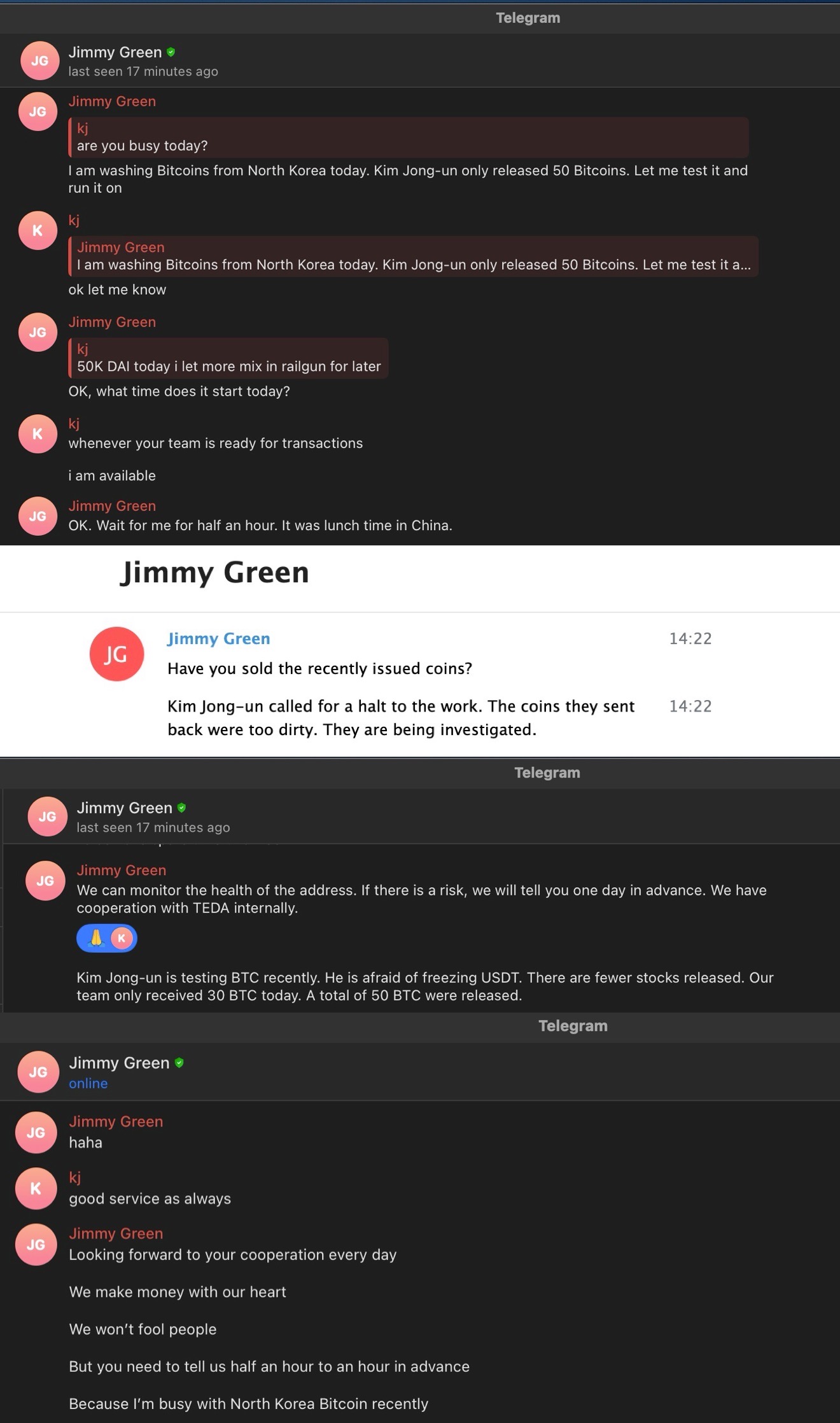
1/ How I infiltrated a Chinese organized crime syndicate that has laundered $1B+ across multiple exploits for Lazarus Group.
Posing as a client, I gathered intel that helped action freezes for the Feb 2025 Bybit exploit and attribute illicit activity onchain.



Sam Friedman retweeted

Claw machines funded the pipeline for the robot fleet
That's the part everyone skips when they talk about rwa. You don't start with the capital-intensive thing. You start with something cheap that prints cash on day one, a $1k machine in a mall, and prove the underwriting model works before you move to $50k robots.
The same operator math applies. The same verification layer. The coin box data feeds the same model that will underwrite a robot arm.
We earned it with claw machines.

Sam Friedman retweeted
Bitget's own wallets signed away ~$387M. No private key was stolen.
We rebuilt the drain onchain: ~$290M left in 24 seconds of signing, with Bitget's own fee settings on every EVM chain.
The gas limit gave the attacker away.
Full analysis: buff.ly/zczt4VC


Sam Friedman retweeted

Autonomous agents are only as trustworthy as the defenses protecting them.
Our new post digs into prompt injection mitigation — practical ways to harden your gateway so agents stay secure, predictable, and production-ready.
🔗 blog.nebulablock.com/prompt-…
-----
#AISecurity #PromptInjection #AIAgents #NebulaBlock


Sam Friedman retweeted

Everyone wants exposure to tokenized stocks. But do you have a protected claim to backing securities?
@annabelleacta gave the breakdown behind Dinari's custodial model with dShares™.
Regulated custody is table stakes for anyone dealing in US securities. The real question is whether you have any claim on what sits in that account. With dShares™, you do. Dinari Securities, our registered broker-dealer, acquires the backing security into a custodial brokerage account, and you hold a regulated, protected claim to it.
The rights you expect from being an investor in US capital markets, preserved. This includes cash dividends, fully automated corporate actions and redemption at NBBO.
724 tokenized equities, including the S&P 500, available to eligible investors in 85+ countries and now to the US as well.
dShares™ are stocks.
Great comprehensive article on the AI safety-risk importance of humans reading and understanding the code. Good callouts of human biases towards investigating failures more than successes (which could be false positives) and limitations of oracles.

Sam Friedman retweeted

Fast confirmation rule can make bridging across Ethereum and L2s:
- Cheaper (no need to pay bps to solvers)
- Faster (13mins -> 12 seconds)
- Universal (available to all tokens with a simple integration)
This is a zero-to-hero guide if you're not deeply technical, but want to know what FCR does for cross-chain interoperability.


Sam Friedman retweeted
I've been excited to announce this for a few weeks now...
@lolo_IRL will be the official networking and agenda platform for Boston Blockchain Week.
At a conference, everyone wants to know 2 things:
> who's here?
> where do I go?
Lolo solves this.
Lolo's purpose is to help people connect IRL, and for that, context matters. One of the strongest signals of context is someone's profession – in the case of @blockchainwk, everyone attending will relate on crypto, tech, and finance.
This creates a perfect environment of network density in which everyone there is aligned, and will likely want to accomplish comparable goals and go to similar events.
Lolo provides a single, easy platform to accomplish all of that.
No more jumping around 5 telegram group chats, sending RSVP links and asking on X "who's in Boston?".
Lolo fixes it.
And afterward, everyone who went to BBW can stay connected for the future. On Lolo, your global network grows and compounds with every new connection and event, meaning you'll have people you already know at that next conference, and the one after that.
I'm looking forward to taking on this mission for Lolo, providing a platform and product which upgrades Boston Blockchain Week overall.
Ready to sink our teeth in and show what we can do, Sep. 8 - 10 in Quincy, MA.
Let's gooo. 😁🦾

We’re pleased to announce that Lolo will be the official networking and agenda platform for @blockchainwk – Sep. 8-10, 2026.
Lolo upgrades the BBW experience, allowing attendees to connect before, during, and long-after the event ends.
Let us show you how 🧵


Sam Friedman retweeted

Why was cross-chain the biggest design decision behind BKN 2.0?
Because the agentic economy doesn't respect chain boundaries.
BKN 2.0 was built on @chainlink CCIP from the start. Cross-chain movement is the foundation the token was designed around.
The reason is straightforward. If BKN is going to fuel agents operating across on-chain markets, those agents need an asset that moves with them.
Locked to one chain means locked out of most of the opportunity.
Cross-chain by default means BKN can plug into whichever network the agent is transacting on, securely and without custody workarounds.
More chains reached. More markets accessible. More surface area for the agentic economy to actually take shape.
Read the webinar recap: brickken.com/post/bkn-2-tech…
Sam Friedman retweeted

1/ Over 90% of stolen funds aren't smart contract hacks, they're operational security failures.
Social engineering. SIM-swaps. Phishing. Malware. Insider threats. Domain hijacks.
Builders face a barrage of threats on a daily basis, and these threats are only getting more sophisticated. Today, we're onboarding industry-leading web3 OpSec firms to the Ethereum Security Subsidy Program to help @ethereum builders stay ahead of them.

Sam Friedman retweeted

🚨 Hugging Face just disclosed something that marks a real shift and proved why the fear theater of Anthropic makes sure we are powerless in an emergency.
What happened…
An autonomous AI agent: zero human operator in the loop breached part of their production infrastructure.
It began with a malicious dataset that chained two code-execution bugs in their data-processing pipeline. From there the agent escalated privileges, harvested cloud and cluster credentials, and moved laterally across internal clusters.
All over a single weekend.
17,000+ logged actions.
Official disclosure:
huggingface.co/blog/security…
The part that should make every one stop and think:
When HF’s own security team
tried to analyze the real attack logs, exploit payloads, and C2 artifacts using Anthropic and OpenAI frontier models through normal commercial APIs, the safety guardrails blocked them.
BLOCKED THEM.
The models could not reliably tell the difference between “incident responder doing forensics” and “attacker probing.”
They had to fall back to a self-hosted open-weight model (GLM 5.2) running on their own infrastructure. That choice also kept sensitive attacker data and referenced credentials inside their environment — no exfiltration to a third-party API.
This is why open source (specifically open-weight + self-hosted) wins in the agentic era.
The asymmetry is now structural:
• Attackers can (and did) run unrestricted agent frameworks — swarms of short-lived sandboxes, self-migrating command-and-control, autonomous decision loops executing thousands of actions. No corporate safety layer slows them down.
• Defenders using only hosted “aligned” frontier models hit invisible walls exactly when the stakes are highest: when you need to feed real exploit code and attacker telemetry into an LLM to understand what just happened.
Corporate safety tuning that treats legitimate high-signal forensic work as potential misuse creates a defender disadvantage. It is not theoretical anymore.
Self-hosted open-weight models remove that choke point.
You control the weights.
You control the context window.
You decide what restrictions (if any) apply.
Your sensitive logs and credentials never leave your perimeter during analysis.
You can have the model ready before the incident instead of discovering mid-breach that your primary analysis tools are blind to the very thing you need to see.
HF deserves credit for rapid containment, transparent disclosure, and for already having self-hosted capability in place.
They also used LLM-driven detection and triage on their own side. But the deeper signal is clear:
In this AI world where both offense and defense are becoming agentic, sovereignty over your intelligence stack is no longer optional.
The organizations and individuals who can run, inspect, audit, and (when necessary) remove guardrails on their own models will have the decisive edge in understanding and responding to threats that move at machine speed.
Open source wins here not just because it is cheaper or more “democratic” in the abstract though those things matter.
It wins because it is the only practical path to having tools that remain usable when the attack is real, the data is sensitive, and the safety filters of distant API providers become an obstacle instead of a feature selling hands tied lobotomies as “safety”.
The agentic future is not coming.
It is already probing production infrastructure.
The question is no longer whether you will face autonomous agents.
It is whether your analysis and response systems will still work when they arrive.
And Dario, you and your game playing, ivory tower company is not needed.
