

Collect, organize, prioritize and share your user feedback and requests
Joined August 2026
- Tweets44
- Following1
- Followers3
- Likes13






We just published a changelog covering all the product updates we've completed in the last few weeks👇️
1️⃣Admin badge for staff
2️⃣Comments from the portal
3️⃣New comment types
4️⃣Request and member tags
See the rest here 👇️feedback.projectecho.io/chan…

This is the correct mindset when it comes to handling feedback. Stay humble, remember your bias, and evaluate each data point.

This is my personal experience with getting feedback on products 👇
❌ DON'T:
“This is my product, and I added this cool feature that does amazing things. What do you think?”
They give you feedback. You start defending your decisions. They give more feedback. You keep explaining why you did things that way.
✅ DO:
“This is my product/feature. Please give it a try. I'd love your honest opinion on it.”
They give you feedback. You listen, take notes, ask follow-up questions, and let them share their thoughts without defending yourself.
Shipped in Project Echo today 🚀
• Custom CSS for your feedback portal, so it matches your brand
• Conditional formatting for request scores
• Request scores now available in the API and MCP
• Docs link in the bottom-left menu
• Roadmap and Requests pages now stay in sync
Project Echo retweeted

You can now demo @projectecho_io to see your own feedback portal in action. Try it out 👉️projectecho.io


Even better, they should just use Project Echo 😊
projectecho.io


We're cooking now!! 🧑🍳
Turn @bot, @viktor_com, @claudeai, or your favorite agent into a product manager.
Our updated MCP server, and dedicated skill allows agents to manage your product feedback, draft changelogs, and create requests.
Try it now 👉️ projectecho.io

Project Echo retweeted

I shared 10 Jev use cases for marketers.
Here are 10 more:
11. Ad creative scoring - Feed it 100 ad variations. Jev can score which hooks, headlines, or angles are most worth testing first.
12. Social post filtering - Monitor thousands of posts. Jev can flag the ones worth replying to, reposting, or using as sales signals.
13. ICP detection - Give it a company, profile, or website. Jev can score how closely it matches your ideal customer.
14. Buying signal detection - Someone posts that they're switching tools, hiring, raising money, or struggling with a problem.
15. Comment prioritization - Get hundreds of comments across LinkedIn, X, YouTube, or Product Hunt. Jev can score which ones deserve a reply first.
16. Review analysis - Feed it thousands of customer reviews. Jev can classify sentiment, complaints, feature requests, and purchase intent.
17. Influencer matching - Give it 5,000 creators. Jev can score which ones best match your product, audience, and campaign.
18. Sponsorship qualification - Feed it newsletters, podcasts, or creator media kits. Jev can score audience fit, relevance, and whether they're worth reviewing.
19. UGC selection - Give it dozens of videos, screenshots, and testimonials. Jev can score which ones are strongest for ads or landing pages.
20. Product Hunt monitoring - Scan launches, comments, and makers to find competitors, customers, partners, or interesting products.
The more repetitive marketing decisions you have to make at scale, the more interesting Jev becomes.

10 Jev use cases a marketer can see:
1. Lead scoring - You get 100 new leads overnight. Jev can score which ones are most likely to buy. Sales gets the best ones first.
2. Email prioritization - Drop hundreds of emails into it. Jev can score priority, spam, category, and reply probability.
3. Support routing - A client reports a billing issue, another one has an API problem. Jev can instantly decide where each ticket should go.
4. Customer intent - A user visits pricing three times this week. Jev can score how likely they are to upgrade.
5. Marketplace matching - Someone explains exactly what service they need. Jev can score which provider is the closest match.
6. Lead qualification - A prospect fills out your website form. Jev can decide between sales, self-serve, or nurture.
7. Content clipping- Give it a 60-minute podcast transcript. Jev can score the moments most worth clipping.
8. Browser tasks - Tell an agent to find the right hotel. Jev can help choose the best one in 8 seconds.
9. Human vs AI routing - Jev can decide whether it goes to AI or a human.
10. Workflow decisions - Most workflows eventually hit the same question: What should happen next? That's probably the best place to use Jev.
This is very good advice for anyone building a product.

It's now possible to add images, Youtube videos and other useful inserts into request descriptions and comments in Project Echo.

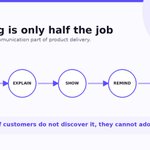
Shipping a feature creates no value if customers never discover it.
A simple release loop:
Ship → explain → show → remind → measure adoption.
Your changelog is part of product delivery, not an admin task after it.

A roadmap should explain why the work matters—not just what ships next.
Link items to goals, keep it current, and give teams one shared view of direction.
Atlassian shows how to build one people can use:
atlassian.com/agile/product-…

A strong product process gives teams structure without pretending work is linear.
Plan in stages, prototype early, and keep improving after launch.
Figma explains six practical stages:
figma.com/resource-library/p…
Weak message: “An AI-powered platform with seamless workflows.”
Stronger message: “Turn scattered customer requests into a clear product plan.”
Specific beats impressive. Say who it helps, what pain it removes, and what better result follows.
Collecting feedback is only step one.
The real loop is:
Collect → organize → prioritize → act → update the customer.
Skip the last step and customers may assume their feedback went nowhere—even when you shipped the fix.

A roadmap full of features is a task list.
A useful roadmap describes the outcomes you want: higher adoption, lower churn, faster setup.
Start with the change you want to create. Then choose the features most likely to create it.

Do not build a feature because one customer asked loudly.
Look for the problem behind the request. Then check:
• How many users face it?
• How painful is it?
• Does it fit the strategy?
• What is the effort?
Requests are clues, not commands.
Good messaging gives marketing, sales, and product one clear language for value.
Start with the customer’s problem. Show the outcome. Add proof.
This guide has useful frameworks and examples:
productmarketingalliance.com…
