

🎓 Finance professor + MBA | 450K+ on YouTube 📈 Learn investing the way it should've been taught in school!
Joined July 2026
- Tweets152
- Following11
- Followers634
- Likes66




Pinned Tweet
Hey everyone,
I'm Nolan Gouveia. Most people know me as Professor G from Investing Simplified on YouTube, where 450K+ investors learn long-term investing with me. I also teach finance at the university level.
This is my X account and everything here will be long-term investing: portfolios, ETFs, dividends, investing psychology and more.
This is my only account on X. I will never DM you first about an "investment opportunity." That's always a scam.
Just education, not financial advice. Let's get to work!
P.S. I have something big launching in a few days. So make sure to stick around!
#investing #finance
A stock with a P/E of 30 can be cheaper than one with a P/E of 15. The PEG ratio is how you see it.
PEG takes the P/E ratio and divides it by the expected yearly earnings growth rate.
Company A: P/E 30, earnings expected to grow 30% a year. PEG = 1.0.
Company B: P/E 15, earnings expected to grow 5% a year. PEG = 3.0.
A looks more expensive on P/E, but it has the lower PEG, so it's cheaper for its expected growth. Peter Lynch popularized the idea, and a common rule of thumb says a PEG under 1 is cheap for the growth.
The catch: the growth number is an estimate. If the growth doesn't show up, the PEG was off from the start.
Always check where the growth number comes from! 🔍


Feel behind on retirement savings in your 50s? Turning 50 opens extra room in your 401(k).
2026: $24,500, plus an $8,000 catch-up once you're 50, so $32,500. If you're 60 to 63 and your plan offers it, the catch-up is $11,250, for $35,750.
A married couple in their 50s, each with a 401(k), can put away $65,000 a year between them.
New this year: if you earned over $150,000 in wages from that employer last year, your catch-up goes into the plan's Roth account.
Use the room while you have it! 📈
Collecting Social Security before full retirement age while you're still working? Earn past a certain amount and Social Security starts holding back benefits.
For 2027, if you're under full retirement age all year, the limit is $25,560. Above that, $1 of benefits is held back for every $2 you earn. Wages and self-employment income count; pensions and investment income don't.
In the year you reach full retirement age, the limit jumps to $67,920, and it's $1 for every $3. Only earnings before the month you reach full retirement age count.
From that month on, there's no limit at all.
Here's the part a lot of people miss. At full retirement age, Social Security recalculates your benefit to credit the months it held back, which raises your monthly check from then on.
Know the limit before you claim early and keep working! 💼

Medicare Open Enrollment started October 15 and runs through December 7. Whatever you change starts January 1.
Here's what you can actually do in this window. Switch from one Medicare Advantage plan to another. If you're in Original Medicare, join, drop or switch a Part D drug plan. Or move between Original Medicare and Medicare Advantage.
The easiest step a lot of people skip: read the notice your plan sends each fall about next year's changes. Drug lists, premiums and pharmacy networks can all change on January 1, even if you do nothing.
One catch if you're thinking about going back to Original Medicare: you aren't guaranteed a Medigap supplement plan, so check your rights before you switch.
Compare your plan before December 7! 🗓️

Save every medical receipt. Your HSA can pay you back for qualified expenses years later, free of federal tax.
There's no federal deadline to reimburse yourself, as long as the expense came after you opened the HSA, you weren't reimbursed for it or deducted it, and you keep the receipt.
So if you can, pay medical bills out of pocket while you're working and keep money you won't need soon invested. A couple paying $2,000 a year for 8 years would have $16,000 of receipts to cash in later.
Start a receipts folder today! 🧾
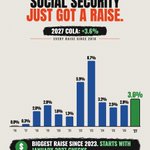
Social Security's raise for 2027 is official: 3.6%.
It starts with January 2027 payments for nearly 72 million people. That's the biggest raise since 2023, when it was 8.7%. This year's was 2.8%.
Here's basically why it landed there. The formula compares the average of an inflation index called the CPI-W for July, August and September with the same 3 months a year earlier. Prices went up, so checks go up to keep pace.
2 things to watch. If you're on Medicare, your December notice will show the new amount after your Medicare premium comes out. And the raise is built to protect buying power, so growth still has to come from the rest of your plan.
Check your notice in December before you budget for 2027! 📬

Retiring early? The account most people fund last may matter most in the early years: the plain taxable brokerage.
No age requirement. No early-withdrawal penalty. No required withdrawals.
And only the gain counts as income. Sell $60,000 where half is your original money and about $30,000 shows up as income. Take $60,000 of pre-tax money from a traditional IRA and generally all $60,000 counts.
Same cash out, half the reported income. Plan the order of your accounts on purpose! 🧭
The big banks kicked off earnings season this week. Before you react to any headline, run the report through 4 questions.
1. Revenue: what did they sell, and what drove the change?
2. Margin: what share of sales was left after costs?
3. Cash: did the business generate cash from operations?
4. Outlook: what does management expect, and why?
A beat or a miss is 1 number. These 4 tell you about the business! 📊
8 ages to know before you retire.
50: catch-up contributions start
55: leave your job that year or later and that job's 401(k) can skip the 10% penalty
59½: the 10% early-withdrawal penalty generally ends
62: earliest Social Security retirement benefit
65: usual Medicare age
67: full retirement age if born 1960 or later
70: Social Security delay credits stop
73: RMDs on traditional accounts (75 if born 1960 or later)
Know your ages before you set your date! 🗺️

A 13% distribution yield is not a 13% return.
Income ETFs like QQQI and SPYI generate their payouts with option strategies. Some of that can be return of capital, payouts can change, and the funds can fall in a downturn.
Run the math: 40% of a $1 million portfolio at a 13% distribution rate is about $52,000 a year if payouts hold, or 5.2% of the whole portfolio.
Judge the income by how sustainable it is, then by the size! 💵
Retire at 58 and, for most people, Medicare is still 7 years away. That gap needs a plan and a budget.
Medicare usually starts at 65. Until then, the common bridges are COBRA, which can keep your employer plan for up to 18 months, often at the full premium, and a plan from the Health Insurance Marketplace, where losing job coverage opens a special enrollment window.
Health coverage can be a big line in an early retirement budget.
Get real quotes for the gap before you pick the date! 🩺

Claiming your own Social Security retirement benefit at 62 instead of 67 can shrink it by about 30%, and that cut generally stays.
Let's look at the numbers. If your full retirement age is 67 and your benefit there would be $2,000 a month, claiming at 62 pays about $1,400. Waiting until 70 pays about $2,480, because each year past 67 adds 8%.
After 70, waiting adds nothing.
Spousal and survivor benefits follow different rules, and health, other income and a spouse all matter. Just pick your age on purpose! 🗓️

Lifespan is how long you live. Health span is how long you live well.
A Mayo Clinic study of 183 countries found the U.S. had the biggest gap between the two, about 12.4 years.
That's why the retirement date isn't only a money question. When someone asks me about retiring at 58 instead of 65, I ask 2 things. Does the math work earlier? And what does waiting cost you?
Answer both before you pick the date! ⏳
The first monthly Social Security check went to a legal secretary from Vermont named Ida May Fuller. It was for $22.54, dated January 31, 1940.
She'd worked under Social Security for about 3 years, and the taxes on her pay came to $24.75. She started collecting at 65 and lived to 100. Over those 35 years, she collected $22,888.92.
The lesson in her story is how long a retirement can last.
Plan your money to last as long as you do! ⏳

Leaving your job at 55 doesn't always mean waiting until 59½ to touch your 401(k).
It's called the Rule of 55. Leave your job in or after the year you turn 55, and withdrawals from THAT employer's 401(k) can skip the 10% early-withdrawal penalty.
Here's the catch. It covers the 401(k) at a job you leave in or after the year you turn 55, not IRAs. Roll that money into an IRA and the age is generally 59½ again. And pre-tax withdrawals are still taxed as income.
Know the rule before you roll anything over! 📝

The 10-year Treasury is paying over 5%. Here's why that matters even if you only own stocks.
Say the S&P 500 trades at 25 times earnings. Flip that and the earnings yield is about 4%. The 10-year yielded 5.24% on October 9.
That doesn't automatically make bonds the better investment. Stocks can grow their earnings. But you're paying a premium for that growth, and expensive stocks get more vulnerable if earnings disappoint.
Watch for slowing earnings while valuations stay high! 👀
Social Security's raise for next year is expected this Wednesday. The months that decide it are already over.
Here's basically how it works. The government averages an inflation index called the CPI-W for July, August and September. Then it compares that with the same 3 months of 2025. The rounded % increase becomes the cost-of-living adjustment, or COLA.
So it isn't a vote or a guess. It's a formula, and Wednesday's inflation report fills in the last month.
If you count on Social Security, know where your raise comes from! 📅

Stress-test your portfolio in 3 directions: covering bills after a decline, participating if markets rise, and keeping the plan working if your biggest prediction is wrong. Give the last scenario some time.
