

Product thinking beyond products. Field notes on tech, systems, work, strategy & practical AI. Written from real PM experience.
Joined September 2026
- Tweets80
- Following24
- Followers11
- Likes36

OpenAI is putting its models on Google Cloud.
Two companies competing in AI, sharing a checkout counter.
That’s a better product lesson than most strategy decks: customers don’t care about your rivalry. They care how much friction you remove.
Spotify is adding paid podcast memberships.
Good for creators. Fair enough.
But I'm curious how many subscriptions people are willing to juggle before listening to a podcast starts feeling like managing their electricity bills.
Every monetization feature looks great on a roadmap.
Not always on the customer's bank statement.
One team updates the offer.
Another updates the email.
Another updates the account page.
All three tickets are marked Done.
The customer still sees three different prices.
Funny how every team can deliver exactly what was asked, and the product can still be wrong.
In a product meeting this week, someone asked:
“What happens if the customer does nothing?”
We had a flow for Yes.
We had a flow for No.
But doing absolutely nothing?
That turned out to be the most complicated scenario.
Funny how often we forget that silence is a customer decision too.
“We’ll handle those customers manually.”
I've heard this in more product meetings than I can count.
Sounds reasonable at first.
Six months later, there's a spreadsheet nobody trusts, three teams involved, and a workaround that's somehow become the official process.
And we're still calling it temporary.
Tesla just showed a Roadster that can fly.
Insane engineering. Seriously.
But this car was announced in 2017. Now production is targeted for 2028.
As a PM, I can’t decide what’s more impressive: the technology or how long people will wait for it.
Figma is making it easier for AI agents to do the work.
Cool. But here’s what I’m curious about.
If your team already struggles to agree on what to build, what happens when everyone can generate 10 versions of it before lunch?
Faster execution doesn’t fix indecision. Sometimes it just makes the mess bigger.
Apple just announced a $299 AI home hub.
And I have the same question I have in half the product meetings I attend: Who actually asked for this?
Maybe it'll be great. Apple has surprised us before. But I'm getting a little tired of companies treating "we can add AI" as proof that people need another device.
Amazon blocking Meta's AI shopping agent is pretty funny.
For years, platforms wanted to remove friction from shopping. Now an AI wants to remove the platform from shopping. Suddenly, friction doesn't look so bad.
I get the security concerns. But come on, there's a business model to protect too.
Microsoft’s president says milk is more regulated than AI.
And somewhere, a product team is still being told to ship first and figure out the risks later.
I’ve seen teams spend weeks debating button colors and 15 minutes on what happens when something goes wrong.
Maybe that’s the part we should fix first.
Google, OpenAI, Meta. Everyone wants to build an AI agent that does everything for you.
But here's the product question nobody wants to answer:
If your AI books the wrong flight, spends $500, or emails your boss by mistake...
Who owns the mess?
The user, the agent, or the company?
One of the easiest mistakes in product is treating customer requests as requirements.
Customers are usually very good at describing pain.
They’re not always as good at prescribing the solution.
“We need an export button” might really mean:
“I don’t trust this dashboard.”
The useful question isn’t just:
What did they ask for?
It’s:
What problem are they trying to escape?
I think a lot of product teams confuse activity with progress.
More tickets closed.
More experiments launched.
More dashboards.
More meetings.
But if the important decision is still unresolved, none of that really moved the product forward.
Busy teams can still be stuck.
One thing I’ve learned in product:
A slow decision can be more expensive than a wrong one.
Wrong decisions create work.
Slow decisions create waiting, rework, side conversations, parallel assumptions, and five versions of “what we think is happening.”
Sometimes the real bottleneck isn’t delivery.
It’s nobody wanting to decide.
Product teams love asking:
“What should we build next?”
I think the better question is often:
“What are we still carrying that no longer deserves to exist?”
Roadmaps get crowded quietly.
Very few teams have a real deletion habit.
I’ve been in meetings where everyone agrees right up until one question gets asked:
“Who owns the decision?”
Suddenly the room gets quieter.
People are usually happy to give input.
Much fewer want to own the trade-off.
A lot of “alignment problems” are really ownership problems wearing nicer clothes.
I’m starting to think one of the most expensive habits in product is keeping features alive because nobody wants to be the person who kills them.
Launching gets applause.
Removing gets meetings.
So mediocre features survive for years.
What’s harder in your company: getting something built, or getting something removed?
I once watched a “temporary” workaround survive longer than the feature it was built for.
It started with:
“We’ll clean this up after launch.”
Then another team depended on it.
Ops built a process around it.
Reporting started assuming it existed.
Six months later, removing it was riskier than keeping it.
Since then, whenever someone says “temporary,” I ask one annoying question:
What has to be true for us to actually remove this later?
I’ve seen teams celebrate a product rollout too early.
The feature shipped.
Access was granted.
Training happened.
The dashboard showed “adoption.”
But people still did the real work the old way.
That changed how I think about AI products too.
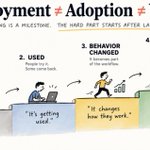
Deployment is not adoption.
Adoption is not behavior change.
Behavior change is not value.
The hard part starts after the launch.
