

YES Chad | Polymarket Tools @vatic_trading
Joined July 2025
- Tweets8.4K
- Following1.7K
- Followers4K
- Likes33.1K





Kimberly Guilfoyle is out as U.S. Ambassador to Greece.
The White House asked her to resign today and she confirmed it hours later. The Polymarket "out by Oct 31" market went from ~5% at the start of October to >99%.
How it unfolded:
> Oct 7 – WSJ: she allegedly asked a Trump donor to pay a $100K AmEx bill before her confirmation hearing, promising access. Story drops while Rubio is in Athens.
> More reports: gifts from Greek businessmen, a lobbyist in official meetings, a watchdog probe
> Oct 11 – AP: Trump & Rubio "extremely p*ssed off"
> Oct 12 – Trump: "we're looking at it"
> Oct 13 – WH asks her to resign. She resigns, denies everything.
Anyone holding Yes after the Oct 7 story printed.
Next question: who replaces her? Deputy Josh Huck runs the embassy for now, and nothing is expected before the Nov 3 midterms.
I've proposed a market for it on the Polymarket Discord


i was reading about @PendulumFlow's open order-book data feeds and realized they have a pretty direct, practical use case combined with @vatic_trading's historic btc price and target price endpoints for strategy evaluation, backtesting, and market microstructure research purposes. so i built this:
> GET /api/v1/replay/:slug
combines both into one payload: real order book (PendulumFlow) + Vatic's target price, full BTC TWAP price timeseries across the window, and Chainlink TWAP resolution, for any closed Polymarket crypto up/down market
> example: api.vatic.trading/api/v1/rep…
u can query them, they're public and unauthenticated. it's polling-based (get pending, poll again, eventually ready) since fetch time varies a lot by market.
you can also point your agent here:
> docs.vatic.trading/guides/re… and have it set up a rudimentary implementation itself. full working reference code is right there too if it just wants to build the terminal order-book animation directly.

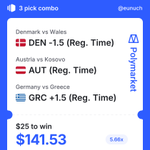
small 3-leg combo for today’s Nations League slate.
> 🇩🇰 Denmark -1.5 vs Wales
> 🇦🇹 Austria ML vs Kosovo
> 🇬🇷 Greece +1.5 vs Germany
Denmark at home should be able to create separation, Austria is my favorite outright spot, and I think the market is slightly too dismissive of Greece against a Germany side still finding its footing.
$25 → $141.53 (5.66x)

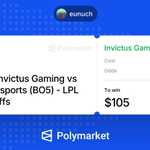
probably one of the craziest LoL games I’ve traded so far
DNS were down 0-2 in the series and Game 3 looked like it was about to bury both of my positions:
> Over 3.5 games @ 75¢
> DNS Game 3 @ 45¢
for a while I was basically staring at a ~$200 loss.
then DNS somehow dragged Game 3 back from the dead, won it, kept the series alive and turned the whole thing into roughly a $300 swing for me.
they eventually completed the full reverse sweep 3-2.
absolute cinema.


2/3 on the IG vs TES series this morning
> ✅ IG series ML @ 48¢
> ✅ IG Game 3 @ 47¢
> ❌ IG -1.5 @ 50¢
my thesis going in was that the longer the series went, the more TheShy + Rookie’s experience and champion depth could become an edge, especially if we reached games 4/5 and the drafts started moving away from the most obvious meta picks.
ended up getting the series read right, although not quite the way I expected.
Game 5 JiaQi’s Aphelios was absolutely flawless and IG closed it out 3-2.
fun series to trade.


2 bets for today
🇦🇹 Austria Wien vs Brann
Brann -1.5
- Brann lead 2-1 on aggregate
- Austria will eventually have to chase the game
- should leave plenty of space for Brann to punish in transition
🇨🇭 FC Zürich vs Young Boys
Young Boys ML @ 62¢
- YB: 19 goals in 5 league games
- Zürich: 12 conceded in 5
- YB unbeaten in the last 8 H2Hs (6 wins)


Hayden Adams’ thesis on AMMs and correlated tokenized assets makes a lot of sense. But there’s another asset class that fits naturally into this picture: event contracts.
- The core argument is that tokenization removes the legacy requirement for every asset to trade against dollars and allows liquidity to reorganize around correlated pairs.
- If two assets are highly correlated, their relative price is less volatile. That reduces LP inventory risk and narrows the performance gap between passive AMMs and sophisticated active market makers.
- At that point, the competitive advantage increasingly shifts toward whoever can supply inventory at the lowest economic cost.
Hence the idea that NVDA/SPY could be a more natural AMM pair than NVDA/USD.
- Blockchains are what make this market topology possible: assets share a settlement layer, execution is programmable, and markets can be created permissionlessly between assets that previously lived in completely different financial silos.
Now extend this to prediction markets.
What happens when one side of the pair is an event contract?
- Take a tokenized Treasury asset and a YES share on “Fed cuts rates in September.”
Their values are driven, at least partially, by the same underlying state of the world: the path of interest rates.
- Could an AMM directly market make:
TOKENIZED T-BILL <=> FED CUT YES
And under the right conditions, could the covariance between those assets reduce relative-price risk enough that investors who already want both exposures become natural passive LPs?
- This gets even more interesting with event contract <=> event contract pairs, where contracts can represent different expressions of the same underlying event and their terminal payoffs may be logically constrained.
Polymarket is particularly interesting here because outcomes already exist as transferable CTF tokens. Pair those with other event tokens (or eventually tokenized financial assets) and prediction markets start looking like a graph of related financial claims, with liquidity and execution able to route across the relationships between them.
I’ve been working through what an implementation of this could actually look like. More soon.

been talking with @probabilitygod about a version of this for prediction markets.
the bigger idea here isnt just AMMs.
it’s that markets are better understood as a graph.
prediction markets make this obvious: contracts may look separate, but many are just different expressions of the same underlying event.
today, liquidity and execution still treat most of them like isolated islands.
eventually, the execution layer should understand the relationships too and route across the graph, not just inside one market.
@haydenzadams gets there through correlated liquidity.
prediction markets get there through correlated probabilities.
that’s a much more interesting endgame.
might be the most thrilling LoL series I’ve traded so far
backed Nongshim as the frontrunner in game 2, then flipped to DN SOOPers at 31¢ for the series moneyline going into the decider.
game 3 looked dead for DN early. Caitlyn was basically the only winning part of the map while Nongshim built control everywhere else.
then the entire game slowly devolved into DN trying to kill an exposed Nexus while Nongshim somehow kept defending it over and over again.
absolute cinema
31¢ → $1.00


1/3 🧵
We tested how Polymarket’s 5m crypto markets would have resolved using a 60s Chainlink TWAP instead of the current 30s TWAP.
Across 435 markets from Aug 7–14, 20 outcomes flipped:
> BTC: 6.2% - max diff 2.54 bps
> ETH: 1.6% - max diff 4.81 bps
> SOL: 6.6% - max diff 5.85 bps
> XRP: 4.8% - max diff 10.59 bps
> DOGE: 3.2% - max diff 6.63 bps
> BNB: 6.5% - max diff 15.75 bps
> HYPE: 3.2% - max diff 5.70 bps
Overall flip rate: 4.6%


2/3
The interesting part is that TWAP sensitivity varies significantly by asset.
> BNB had the largest observed 30s/60s divergence at 15.75 bps, followed by XRP at 10.59 bps.
> BTC had one of the highest flip rates at 6.2%, despite having the smallest max divergence at just 2.54 bps.
Small changes in the resolution window can matter even when the underlying price difference looks tiny.

3/3
This is exactly the kind of resolution data we’re making easier to access through Vatic.
Traders can pull the target price, underlying price data and Chainlink TWAP references used across Polymarket crypto markets.
API keys: platform.vatic.trading
Docs: docs.vatic.trading
One of the most interesting markets right now is “NATO downs another Russian drone by August 31,” currently trading around 50/50.
This morning NATO shot down a drone over Latvia after authorities said Russian electronic warfare caused it to enter Latvian airspace. The origin of the drone, however, remains unconfirmed.
The market briefly jumped above 60%, although the chart is a bit misleading. The bigger reaction was in the orderbook: makers pulled liquidity and the book became extremely thin.
The interesting scenario now is if the drone is confirmed to be Ukrainian, but was diverted into Latvia by Russian EW.
The rules specifically require a Russian drone, and conflicting attribution gives the market a 3-day window before resolution based on the totality of available reporting.
Could turn into a pretty interesting resolution trade.


Here’s how the last 50 Polymarket crypto up/down intervals would have resolved using TWAP instead of spot at close.
Across 150 recent markets per asset, TWAP would have flipped:
> BTC: 9, max diff 6.18 bps
> ETH: 5, max diff 7.05 bps
> XRP: 9, max diff 8.43 bps
> SOL: 8, max diff 9.59 bps
> DOGE: 8, max diff 11.77 bps
> BNB: 2, max diff 11.13 bps
> HYPE: 6, max diff 11.67 bps
Why this matters: starting Aug 7, Polymarket crypto up/down markets move to TWAP resolution.
5m -> 30s Chainlink TWAP
15m -> 60s Chainlink TWAP
4h -> 60s Chainlink TWAP
Target price stays the same. The closing reference changes.


Developer update: Chainlink TWAP mainnet feeds are now available.
Developers can use their existing standard or sponsored Chainlink Data Streams credentials to begin integrating today. Find the 30-second and 60-second TWAP feed IDs here: data.chain.link/streams
Chainlink is completing development and soak testing through August 4, so feeds may still be updated before then. Polymarket RTDS delivery remains scheduled for August 4, 2026.
Integration guide: docs.polymarket.com/market-d…

We’re adding this to Vatic so traders can pull:
- target price / price-to-beat
- snapshot close
- Chainlink TWAP resolution refs
for Polymarket crypto up/down markets.
Get API keys: platform.vatic.trading/
Lowest-latency target price streaming + websocket guides:
docs.vatic.trading/websocket


read every prediction market fee doc, turned all 7 into code, checked each model against the venue's own published table
same trade everywhere. buy $1k of a coinflip at 50c, sell it back at 50c:
> kalshi $70
> polymarket $50
> limitless $45
> predictfun $40
> opinion $20
> hyperliquid $0.45
> sxbet $0
kalshi is the most expensive venue at every price below 90c. their flat 7% coefficient is exactly polymarket's crypto tier, the single worst bracket poly has, applied to every market they list
longshots are where it breaks. at 5c a roundtrip costs 13.3% on kalshi and 0.38% on opinion. 35x spread on the same bet
mechanism: kalshi and poly charge per contract. a dollar buys 20x more contracts at 5c than at 99c, so you eat 20x the fee base for the same dollar of risk


normalized all 7 into one notation. S = stake, W = max win. turns out there are only 4 shapes in the entire sector
p(1−p) x contracts, symmetric bell peaking at 50c
> kalshi F = 0.07 · S · (1−p)
> polymarket F = r · S · (1−p)
min of the two legs, tent peaking at 50c
> predictfun F = 0.02 · min(S, W)
> limitless F = 0.004 · S + 0.026 · W above 50c
p(1−p) x notional, skewed bell peaking at 67c
> opinion F = 0.04 · S · p(1−p)
flat
> hyperliquid 4.5bps, charged on close or settle, never on open
> sxbet 0
opinion looks like it belongs with poly and kalshi and it does not. their curve multiplies notional instead of contract count, so the dollar fee comes out p²(1−p) and peaks at 67c. you can see it in the image below, the pink sparkline leans right
three more things nobody says out loud
- kalshi is the only venue that charges makers. 0.0175 coefficient, 0.875% at the midpoint. everyone else leaves makers alone, poly actually pays them 15-25% of taker fees back
- "what does polymarket charge" has 11 answers. 0% on geopolitics, 7% on crypto, and the modal market is 5%
- opinion has the lowest headline rate and the most brutal floor. $0.25 min fee on a $5 min order is a 10% roundtrip, and it makes them the priciest of all 7 below 4c
- limitless publishes tables instead of formulas. fitted them: buy is 0.4% of stake plus 2.6% of upside, reproduces every published point to 0.01pp
fees are one input. spread, impact, and deposit rails are not in any of this


joined x 1 year ago.
polymarket changed my life.
building vatic changed it again.
thnx everyone for making it possible 🫡❤️

Prediction markets will fundamentally change how businesses are built and managed.
Companies will increasingly analyze which external events have the greatest impact on revenue and profitability, then hedge those risks using event contracts.
It’s the democratization of derivatives. The same risk management once reserved for airlines, commodity traders and investment banks becomes accessible to every small business.
A few examples:
> Ice cream shop => rainfall
> Delivery riders => heavy rain
> Construction => rainy days / heatwaves
> Hotels => geopolitical escalation (e.g. US–Iran)
> Agriculture => drought / rainfall
> Real estate developers => Fed / ECB rate decisions
Businesses that identify and hedge their key external risks will have more stable cash flows, lower volatility and a structural advantage over competitors.

IT ALL COMES DOWN TO THIS. 🏆
- Spain 🇪🇸 vs Argentina 🇦🇷.
The 2026 World Cup Final.
- Lamine Yamal vs Lionel Messi.
One generation trying to begin its dynasty, another trying to cement its legacy.
A few observations from the markets a few hours before kickoff:
> The World Cup Winner market currently has a ~2% cross-platform arbitrage.
-- Spain: 59c on Hyperliquid
-- Argentina: 39c on SXbet
-- Polymarket remains the liquidity king, with $10M+ matched volume and more than $50M in open interest on the final.
-- Despite that, Hyperliquid and SXbet continue to offer the best prices on individual sides for smaller trades.
Whales are also showing up for the biggest game of the tournament:
> $1.35M backing Spain
> $1.30M backing Argentina
> $700k on the Draw
> Plus multiple six-figure positions across qualification, totals and match result markets.
The market couldn’t be more split. Personally, I’m backing Spain. I took a small position around 59%. Let’s see if Yamal & co. can finish off an incredible tournament.

