

Prismark Systems / Lexicon, a temporal, sequential, no-code Strategy Research Platform for automated backtesting of trade ideas using common language input.
United States
Joined August 2026
- Tweets31
- Following1
- Followers5
- Likes9





Pinned Tweet
Every backtester you've tried asks one question: were all of these conditions true on the same bar?
That's not a setup. That's a snapshot.
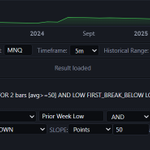
A setup develops. Break the weekly high. Then within five bars close above it. Hold it for three. Daily sloping up the whole time, and NQ disagreeing.
Five things, in order, each with a clock on it. Where are you testing that?
Lexicon is a research software. Not signals, not financial advice.
The Lexicon onboarding guide is out. All nine videos.
It walks you through building and testing one strategy in plain English, step by step. No code.
Watch the full series: youtu.be/UyEFPd3iNX8
Then come and try it on Lexicon. The guide is built into the portal, so you can follow along inside the tool. Apply for the beta: prismarksystems.com
Code has to be read, checked and trusted before you can believe the number it produces. Ask an AI to write the same backtest twice and you can get two different implementations of the same idea.
Both return a number. That's the part that gets skipped, verifying that what ran, is what you meant.
When the definition is the thing that runs, you read it back in plain English before you press the button.

Most of us check a higher timeframe before taking a trade. Then we test the strategy on one chart and wonder why the results look nothing like how we actually trade.
A daily moving average sloping up is a plain description of a bullish regime. Requiring it before every entry doesn't change the setup. It changes when the setup is allowed to happen.
One definition, not two strategies stitched together.
Same strategy, same history, higher timeframe added.

The MACD crossover. Most people who trade it end up adding a trend filter, so we tested both.
Same setup on NQ, built in plain English, run with and without a daily filter. Every result shown, including what the filter didn’t fix.
A mediocre result isn't a dead strategy. It's an unanswered question.
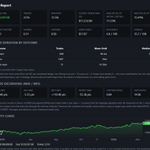
The headline number is an average, and an average hides the thing you need to know. Open the report and you might find one regime carrying the whole run while another bleeds it out.
Add the condition that describes that regime. Run it again. The number changes because the question changed.
That's a hypothesis worth testing forward.

2
I wasn't trying to become a programmer. I was trying to learn to trade.
There were patterns I wanted to test, and every answer to "how do I test this" came back the same. Learn to code first.
The distance between having a thought about the market and knowing whether it held up should be minutes. Not months.
That's the whole reason Lexicon exists.
3
Getting in is half the definition.
We spend most of our time on entries, then let the exit be whatever the platform defaults to. The exit decides what the entry was worth.
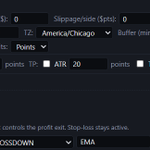
Fixed targets or ATR multiples. Trailing from the fill, or only once the trade has moved in your favour. An indicator exit that closes the position when the reason you entered stops being true.
Test the exit the way you test the entry.

5
The 9/21 EMA crossover. Most people who trade it end up adding a trend filter, so we tested both.
Same setup on ES, built in plain English, run with and without a daily filter. Every result shown, including what the filter didn’t fix.
7
Most of us check a higher timeframe before taking a trade. Then we test the strategy on one chart and wonder why the results look nothing like how we actually trade.
A daily moving average sloping up is a plain description of a bullish regime. Requiring it before every entry doesn’t change the setup. It changes when the setup is allowed to happen.
One definition, not two strategies stitched together.
Same strategy, same history, higher timeframe added.


The middle three steps aren’t the work. They’re in the way of the work.
Pick the conditions from dropdowns. Read the sentence back. Run it.
1
1

An indicator is a calculation. A temporal anchor is a moment.
The high of the prior day. The opening price. The first fifteen minutes. Each one is a point in time that stays fixed while everything else moves.
If you've ever waited for price to take out yesterday's high, or watched the opening range before deciding anything, you've traded off one. Most people do it daily without ever expressing it.
It shapes every entry. It almost never makes it into the test.
5
Cross-market analysis is something we do with our eyes but rarely test.
Does gold or oil actually tell you anything about an entry on ES or NQ? When YM, NQ and ES usually move in tandem, does it mean anything when one of them refuses to follow?
Most of us have an opinion. Very few of us have the stats.
Adding a cross-market condition puts these questions to the test. Requiring it to agree or disagree. The relationship becomes something you can measure instead of something you assume.
Same strategy, same history, cross-market added.

6
A setup most futures traders know: price breaks the high of the opening range, you take it long.
Here it is built in plain English and tested on ES, start to finish. No filters, nothing added to help it, and every result shown, including the ones that don’t flatter it.
Lexicon is a strategy research platform. Not signals, not financial advice.
10
Your strategy is a sequence of questions. Something forms first, THEN something else confirms it, WITHIN a window of time, FOR X amount of bars.
The majority of backtesters ask only 1 question: were all the conditions true in 1 bar. That's a snapshot, it's not how a setup is executed.
Over time your strategy unfolds, asking whether the 1st condition is true before moving onto the next. Your backtest should ask the same too.
