









Brilliant and Scary.

Introducing Griffin, the first model to pass the video Turing test.
48% of people who talked to it live thought it was a real human. Previous systems have had a pass rate <3%. It is #1 on NVIDIA's benchmark for full-duplex AI video.
It’s the first Human Interaction Model (HIM).
Readers added context they thought people might want to know
The 48% figure and "video Turing test" claim are from Tavus's own study of 54 one-minute calls, not independently verified or using a standard protocol. Griffin-Lite leads NVIDIA's VideoFDB benchmark on their public leaderboard.
cellcog.ai/blog/tavus-gri…
research.nvidia.com/labs/amri/proj…
tech-ish.com/2026/10/02/tav…


Calude Design to Replace Figma xitter.cf/claudeai/status/204515…

Nicholas Carlini, Research Scientist, Anthropic, speaks at [un]prompted 2026 on: Black-hat LLMs about Mythos 2 weeks back youtube.com/watch?v=1sd26pWh…

In the room where India’s AI future is being built.
@AIBoomi Annual ’26 — Chennai.
Building enterprise voice AI at @zudu_ai. If your business still runs on hold music and IVR menus, we should talk.
#AIBoomi2026 #BuildWhatsNext #VoiceAI

Anthropic CEO @DarioAmodei said we support the U.S. military.
But we will not allow our @claudeai to be used for mass surveillance or autonomous killing systems.
If that means losing government contracts, so be it.

A statement from Anthropic CEO, Dario Amodei, on our discussions with the Department of War.
anthropic.com/news/statement…

One invention that made humanity worse, not better:
The infinite scroll.
Before it existed, content had natural stopping points. You’d finish a page, hit “Next,” and your brain got a moment to ask “Do I actually want more of this?”
That tiny friction was a feature, not a bug.
The infinite scroll killed it.
It didn’t solve a user problem. It solved an engagement metric problem. The entire design intent was to eliminate the exact moment where someone might choose to stop.
And it worked:
→ Screen time exploded
→ Attention spans collapsed
→ Billions of people now struggle to sit with boredom
And here’s the thing - boredom is where the best thinking happens. Strategy. Creativity. Self-awareness. All of it lives in the empty space that infinite scroll filled with content you never asked for.
What makes it dangerous is that it doesn’t feel dangerous. It feels like convenience. Like a better UX.
But it quietly restructured how billions of people spend their waking hours - in ways they never consciously chose.
Aza Raskin, the person who invented it, publicly said he regrets it. He estimated it wastes roughly 200,000 human lifetimes worth of attention. Every. Single. Day.
Not every innovation is progress. Some just look like it.
The best products give users control. The worst ones take it away so quietly that no one notices.
-----
#productdesign #ux #startups #technology #attention #buildinpublic
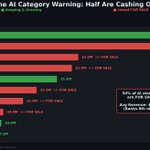
I spent 3 days analyzing $1.33B in verified Stripe revenue from 842 startups.
The #1 category by revenue isn't AI - it's Security.
69% of startups earn under $1K. 5 startups with <36 followers crossed $1M+.
Full data breakdown in the thread 👇

I analyzed 842 startups with VERIFIED Stripe revenue on TrustMRR.
$1.33 billion. 48 million transactions. No fluff real data.
Here's what's actually making money in 2026 and it's NOT what X thinks.

I analyzed 842 startups with VERIFIED Stripe revenue on TrustMRR.
$1.33 billion. 48 million transactions. No fluff real data.
Here's what's actually making money in 2026 and it's NOT what X thinks.
That's it. Real revenue data from 842 verified startups.
If this was useful:
→ Bookmark it (you'll need this later)
→ Repost to help another founder
→ Follow me for more data-driven breakdowns
I'll do a deep dive on the top 10 individual startups next week.
What category surprised you most?