
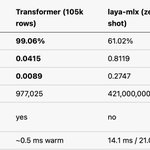


I did a small experiment with Jev. I build a TF-IDF and transformer to classify if a question is yes/no. The test was ~1000 questions. Jev did impressively because the TF-IDF and transformer were trained on this task, while Jev was zero-shot.

A while ago I got interested in converting speech directly into phonemes. I wanted to write an app to practice my English pronunciation. Back then I found the Montreal Forced Aligner, it was pretty hard to set up, and for what I wanted to do, the results weren't that great.
Here is some testing on my very much non-native ;) pronunciation of English word. ZIPA-Cr Small is fastest. I am not sure why they show different results, the audio is identical.


On my mac I am using github.com/kdcokenny/OpenDic… for voice dictation. It runs locally and using whisper-large-v3-turbo . It is pretty good to recognize my English

I tested DWQ, HQQ and ParaQuant against MLX's plain 4bit quantisation of Qwen3-1.7B on my mac. And plan mlx's 4bit wins of all of them. All were slower and less accurate.
I remember that it used to be really easy to connect a screen from old Nokia to Arduino. I have a nokia c1-01. The screen looks like it used to be but colorful. Interesting if I can connect it to esp32
I made a PCB with toner transfer technique. The PCB came out not ideal but fine xD
and I failed at soldering FPC to PCB. The plastic flex started deforming from the heat, and the copper traces cracked right at the base of the cable.
I never had enough time to implement something interested, especially with esp32. But now with LLM it cost me almost nothing. Just added screen glitches and sound noise to my Morse code trainer.
