

Miami, FL
Joined May 2026
- Tweets216
- Following5
- Followers16
- Likes1








A wellness app becomes a healthcare product the moment you connect health logs to a name and email address.
At that point you are handling PHI (Protected Health Information). Two days at the design stage keeps the architecture clean.


A CFO concerned about AI accuracy in financial operations is asking the right question.
A revenue forecast from a language model is pattern matching dressed as financial analysis.
The architecture that works keeps the calculation in a dedicated engine.

A language model identifies what an answer looks like. A calculation engine produces it.
Three weeks mapping entity exceptions and state rules before building a tax product. Zero calculation errors in production.

SOX (Sarbanes-Oxley Act) compliance extends to every automated financial reporting workflow.
The documentation obligation extends to the automated system.
When the auditor asks for evidence of controls, the audit trail has to already exist.

We mapped four federal repayment programs, state-specific rules, and family size adjustments before writing a single calculation.
That is what made the product correct from day one.


Disclosure requirements for AI estimates are active and expanding.
Platforms that built the audit trail into the feature from the start are operating in those markets on day one without rework.
That is the outcome of designing it in early.

83% of service decision-makers planned to increase data-integration investment.
The data layer is almost always part of the AI bill and almost never in the original budget.
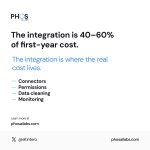
Connectors, permissions, cleaning, monitoring: often 40–60% of first-year cost.

Several states now require disclosure when AI is used in property valuation.
The requirement: tell buyers what the estimate is, where it comes from, and what gets logged every time they see it.
At Phos AI Labs, that is a design input from the start.


Real estate compliance shapes the product from the inside.
The qualification flow. The listing filters. The contract workflow. The data retention policy.
At Phos AI Labs, all of it comes before the first wireframe.


The NAR settlement changed what real estate platforms must show buyers and when.
Three requirements now apply: representation agreement status, compensation disclosures before recommendations, and auditable records for buyer communications.
The design determines the outcome.

90% expected AI implementation to raise IT costs. 70% expected ROI within 2–3 years.
On-premise adds a layer most budgets miss: GPU capacity, orchestration, monitoring, security, staff.
Unit economics decide this. Workflow by workflow.

Fair Housing evaluates outcome.
An AI trained on historical real estate data learns from decades of discriminatory practice.
HUD has investigated real estate tools for this. Most teams had no idea until it began.

Private AI deployment usually comes down to one of three reasons: data residency, vendor independence, or a compliance standard shared APIs cannot meet.
One contract clause decided a manufacturer's entire architecture this year.
Most workflows do not need that layer.

The typical enterprise runs 11 AI models. None of them designed as a portfolio.
IBM expects that number to grow 50% by 2027.
Eleven models inherited is a cost center.
Eleven models designed is a portfolio.
Route by task. Route by quality bar. Route by cost.

Three vendors hold most of enterprise AI spend.
Concentration is efficient until a pricing change, a deprecation, or a terms update makes it an operational event.
A concentrated stack is efficient until it is not.
A designed stack is resilient by default.

