

solo dev // not medical advice
New York City
Joined August 2026
- Tweets123
- Following94
- Followers20
- Likes70
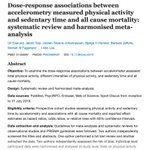



People who moved the most across the whole day, at any intensity, had a 73% lower risk of dying than those who moved the least.
Counting only exercise, it was 48%.

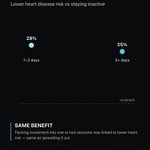
People active just 1–2 days a week had a 28% lower risk of heart disease, vs 25% for those active 3+ days.
The weekend warriors were right.

Source: Yang et al., Diabetes Res Clin Pract, 2025 · n=10,989 · cohort
doi.org/10.1016/j.diabres.20…
for those on claude max 20x - how are you managing usage? do you have a process for analyzing your token usage across Fable, Opus and Sonnet?
for now i'm defaulting to:
1) Fable 5.1 - Analysis, planning and writing plans, stubborn debugging, reviewing PRs
2) Sonnet 5 - Execution of plans and other general use
3) using /clear as much as possible
but wondering if theres a better way to quantify and monitor what i'm doing
Manan Shah, PharmD retweeted

How much water you drink changes how hard your body reacts to stress. Not how stressed you feel, and not your heart rate, but the stress hormone working underneath. A recent study found the difference was large.
Cortisol is the main hormone of the stress response. When you hit a psychological challenge, your body releases it, and a healthy system raises it and then brings it back down. The question here was whether chronic under-drinking changes the size of that hormone response. It is a fair question, because the systems that manage your body water and the systems that manage cortisol are wired together in the brain through the same signaling hormone, vasopressin.
Researchers compared two groups of healthy adults selected for how much they habitually drink. The low group averaged about 1.3 liters of fluid a day. The high group averaged about 4.4 liters. Both groups were confirmed to differ in hydration status, with the low drinkers showing more concentrated urine. After a week of monitored intake, everyone went through the Trier Social Stress Test, a standardized lab stressor of public speaking and mental math in front of an unresponsive panel. Salivary cortisol was tracked before, during, and after.
The two groups looked identical on everything they could consciously notice. Their self-reported anxiety rose the same amount. Their heart rate rose the same amount. If you asked either group how stressed they felt, you would not have told them apart.
The cortisol response was where they split. The low-water group had a significantly larger cortisol rise to the same stressor, a reactivity of about 6.2 versus 4.0 nmol/L in the high-water group. That is roughly a 55 percent bigger hormone surge, driven by nothing more than habitual water intake. The size of the response also tracked with hydration status across individuals, which strengthens the link.
This was a controlled comparison in 32 healthy adults, not a huge trial, and the two groups were selected rather than randomly assigned, so unmeasured differences between habitual low and high drinkers can contribute. Second, it measured the acute hormone response to a single lab stressor, not long-term health outcomes. Whether a repeatedly larger cortisol response to daily stress translates into anything clinical was not tested here. Third, this is about chronic habitual intake, not about chugging a glass of water right before a stressful moment.
If you are a habitually low drinker, your body may be mounting a bigger hormonal stress response than you realize, because the signals you actually feel, tension and a racing heart, look the same either way. Consistent daily hydration is not just about thirst or physical performance. It appears to set the gain on your stress hormone response. The simplest lever here is boring and free: drink enough water, consistently, not just when you feel thirsty.

Didn't know Clancy was on trazodone.
Traz has a pesky active metabolite called mCPP that is a legit anxiogenic compound
It has been used as a lab "panicogen" in psychiatric research.
Trazodone gets converted to mCPP via CYP3A4.
mCPP is a non-selective serotonin agonist. It's this 5-HT2C activation that drives its anxiogenic profile.
Charney, Woods, Goodman & Heninger (Psychopharmacology, 1987) gave mCPP to panic disorder patients and healthy controls and found clear anxiogenic effects, more pronounced in the panic group — one of the foundational papers using mCPP as a serotonin-function probe in anxiety research.
Animal data backs this mechanistically: mCPP produces anxiogenic (not sedative) effects in elevated plus maze and conflict tests, blocked by 5-HT3 antagonism and chronic anxiolytic pretreatment — pointing to a real, receptor-mediated anxiety signal, not just a side effect artifact.
Perhaps not the best sleep agent to use when she'd had a lot going on with her meds and mental health.

131 days (Sept 15, 2022 – Jan 24, 2023).
Clancy's meds
Taken (short courses):
• Zoloft 25 (~7 days)
• Ativan 0.5–1 (10/21–12/6, 1/1-1/10)
• Trazodone 50 then 150 (11/16–11/25, restart 1/5, ↑ 1/12 at her request)
• Prozac 10 (~4 days)
• Remeron 7.5→15 (~11 days)
• Ambien 5 (1 day)
• Seroquel 25→300→100
• Valium 5 (12/6-12/31, 1/11-1/23, start/taper/restart)
Notes:
- Zoloft start delayed by ~1 mos
- Buspar, Hydroxyzine, Lamictal not taken
- Benadryl OTC
- Took THC, CBD on her own
- Ketamine requested in January
I made 3 graphics
• What she took
• What she requested
• Where record suggests she didn't follow the plan
*Going over the transcripts of the Lindsay Clancy trial one more time.


Agreed and wish someone would throw money at proper clinical trials with good forms of magnesium.
N-Acetyl Magnesium Taurinate might go farther than say Magnesium Citrate at improving sleep quality.

There is not yet strong, consistent evidence that magnesium supplementation reliably improves sleep.
Observationally, people who consume more magnesium tend to report better sleep quality. And some meta-analyses suggest magnesium supplementation can improve sleep quality scores, sleep efficiency, and sleep duration. But the individual studies are inconsistent, and several have found no meaningful effect at all.
Could it help some people, particularly those with low magnesium status? Possibly.
Magnesium plays important roles in neuronal signaling, stress regulation, and pathways involved in sleep-wake control. So the biology is plausible.
However, to say “magnesium improves sleep” is a much stronger claim than the current evidence supports.



My hackathon build: a fleet of Gemini agents that reads new health research nightly and opens a tested draft PR when the science disagrees with my iOS app's scoring algorithm.
It can't merge — I review every diff. Google ADK + Cloud Run.
#AllThingsAgentic
youtu.be/xY8cbbjzGt8
this is a solid dopamine/ACh framework.
are you familiar with citicoline (CDP-choline)?
citicoline donates choline for ACh synthesis AND cytidine, which converts to uridine and drives phosphatidylcholine synthesis for neuronal membrane repair.
personally found it doesn't make me moody after a few days like Alpha-GPC
sauce:
Changes in brain striatum dopamine and acetylcholine receptors induced by chronic CDP-choline treatment of aging mice
pubmed.ncbi.nlm.nih.gov/1839…

If you have ADHD and aren't prioritizing dopamine and acetylcholine precursors, you're nerfing yourself
Dopamine for motivation, drive, and task saliency
Acetlycholine for sustained attention, learning, and mental clarity
Without them you are distractible, unmotivated, foggy
With them you are sharp, proactive, and high-functioning.
L tyrosine (dopamine precursor) and Alpha GPC (acetylcholine precursor) are subtle game changers
Don't forget metabolites and prodrugs.
They make the polypharmacy cocktail much more.... vibrant....
Consider trazodone's metabolite mCPP:
It has been used as a serotonergic/anxiogenic challenge agent in psychopharmacology studies. In many studies—especially IV challenges—it increases anxiety symptoms and activates HPA-axis markers such as ACTH and cortisol. A little ironic given that trazodone is used for depression and often insomnia.
@BadreNicolas
Lots of talk on polypharmacy and deprescribing these days.
A colleague and I noted an upstream process: polydiagnosing. We urged for de-diagnosing in an article.
Patients collect labels over years and arrive reciting them: bipolar II + MDD + ADHD + PTSD + GAD + insomnia. The med list grows to match: one drug per diagnosis.
Zyprexa for bipolar, Zoloft for MDD, Adderall for ADHD, Prazosin for PTSD, Paxil for GAD, Trazodone for insomnia. A cacophony of nonsense, with the diagnoses becoming the justification for the polypharmacy.
“The multiplication of diagnoses, ‘polydiagnosing,’ is a convenient justification for future polypharmacy.”
I was just asked to present on it, so I’m sharing it again. Link below:


Bonus: does not cause explosive diarrhea like metformin
Berberine has been on my radar for glucose control for years, and this new study caught my attention.
People who took a biooptimized form of berberine at just 200 mg/day for 2 weeks saw reductions in fasting glucose, improved glucose tolerance, and a 22-29% increase in fasting and post-meal GLP-1 levels.
The GLP-1 finding is particularly interesting because it suggests berberine may influence some of the same incretin biology that has become such a major focus in metabolic health.
Berberine isn’t part of my regular supplement routine anymore (I've shifted more toward alpha-lipoic acid), although I still think the evidence for glucose and lipid control is interesting. These results make me interested in seeing larger, independent, longer-term trials of lower-dose, more bioavailable formulations.


i have ADHD and run 5-8 Claude Code sessions in parallel.
every verbose reply costs me mental capital I can't afford to waste. especially when im feeling foggy and running on low sleep.
i found an adhd skill on reddit and then adapted it to my needs: an always-on "i-have-adhd" output contract.
Open-sourced it: github.com/m1insights/i-have…
screenshot illustrates the difference in terminal output

Great stack. Sabroxy would be a nice add!
For me the biggest ADHD hack is improving sleep quality. executive function is orders of magnitude better after a good nights rest.
How to beat your ADHD into submission (task-saliency maxxing):
- Yerba mate: alertness
- L-theanine: selective attention and removing background noise
- Magnesium taurate & glycinate: reducing excessive excitability/physical tension
- N-acetyl-L-tyrosine: dopamine precursor
- Benfotiamine (B1): ATP availability, dopaminergic boost
Energy + motivation + wakefulness + inhibitory control. Too little dopamine/norepinephrine and you'll be distractible and bored. Too much stimulation and you'll be hyperaroused and anxious. This combo gives me the desire to work while filtering out the desire to move, check my phone, scroll Twitter etc. Noticeable increase in task saliency.

rather unfortunate that poor sleep quality can lead to depression, and SSRIs can negatively affect sleep architecture...
... making sleep issues worse during therapy initiation, and increasing the likelihood of discontinuing treatment
@TheLancet

Depression affects approximately a quarter of a billion people globally, of all ages and from all walks of life.
A Seminar provides a comprehensive overview of the epidemiology, diagnosis, & management of depression in adults: spkl.io/601073you

ALT Figure summarising lifestyle modifications used in the treatment of depression.\n(A) Exercise (B) Diet (C) Sleep. Copyright: 2026 The Author(s). Published by Elsevier Ltd. CC BY 4.0.