

pgEdge is the open source Postgres company for agentic AI and enterprise applications.
Alexandria VA
Joined March 2023
- Tweets1.3K
- Following6
- Followers284
- Likes37


Phillip Merrick, pgEdge’s CEO and Co-Founder, speaks at PostgreSQL Conference Europe in Valencia this morning, 11:45 to 12:35 local time in SM1-A: “Agentic Engineering, Agentic Operations and Agentic Analytics with Postgres.”
The talk looks at how AI agents can help across the whole Postgres lifecycle: building applications, diagnosing database problems, and analyzing years of historical data. We've addressed all three situations through fully-open source tools (under the PostgreSQL license): The Agentic AI Toolkit covers engineering, the AI DBA Workbench covers operations and administration, and pgEdge ColdFront (currently in public beta) covers analytics. (🔗 Want to check these out ahead of time? Visit our GitHub: hubs.la/Q04BPYRW0)
We’re also giving away free signed copies of PostgreSQL Mistakes and How to Avoid Them, Jimmy Angelakos’s 2024 Manning book on the mistakes Postgres users tend to make and how to sidestep them. Come on by the booth anytime to meet the author and get a copy 📖
Session details: hubs.la/Q04BPYQ30
#postgresql #postgres #agenticai #aiagents #valencia #spain #programador #tecnologia #devcommunity #techconference #tech #programming

An application built quickly with AI coding tools still has to run somewhere that meets the enterprise's security, compliance, and reliability requirements. 🔒
That's the gap Phillip Merrick, co-founder and CEO of pgEdge, takes on in CTO Magazine. On where these apps end up running, his point is that "enterprise data often can’t leave the enterprise."
Gizel Gomes' piece turns that into a checklist for CTOs: weigh security, compliance, and data needs before choosing where an AI-built app runs (a vendor-managed cloud, your own cloud account, or on-premises), measure how often an AI agent gets things wrong and decide whether that rate is acceptable, steer teams toward vetted AI coding and database platforms before shadow IT does the choosing, and give every AI-built application a long-term owner.
pgEdge Starfleet, our enterprise Postgres cloud platform, is built around the same view: start on pgEdge-hosted cloud, then deploy to your own cloud or on-premises with pgEdge Enterprise Postgres, without replatforming.
Read the full piece in CTO Magazine: 📖 hubs.la/Q04BHyxH0
#postgresql #postgres #cto #enterprise #ai #aicoding #security #compliance #datasovereignty #shadowit #governance #opensource #database #devops

We're in Valencia for PostgreSQL Conference Europe 2026, and day one is underway.
New to Valencia (or the conference)? The conference website covers more than the schedule - it has venue and travel info, how lightning talks work, details on the social event, ideas for things to do around Valencia, and more info about the Community Events Day on Friday. Check it out if you haven't already 👀
Four pgEdge sessions are on the program this week. Jimmy Angelakos is on the Postgres On-Call Confessions panel (Tue 13:45, Audit 1), Dr. Ibrar Ahmed walks through eight steps to database disaster recovery (Tue 14:45, SM1-B), Phillip Merrick talks agentic engineering, operations and analytics with Postgres (Wed 11:45, SM1-A), and Jimmy is back Thursday with radar and radar-ui, agentless diagnostic snapshots for PostgreSQL (10:25, Audit 1). All times are Valencia local.
We're a proud Gold Sponsor of the event. Don't forget to come by the pgEdge table in the sponsor area. If hosted Postgres for enterprise requirements is interesting to you, we'd like to hear what you're dealing with. pgEdge Starfleet hosts 100% standard PostgreSQL on pgEdge-hosted cloud or in your own AWS, Azure or GCP account, with your choice of deployment at any point.
👉 Learn more about the conference: hubs.la/Q04BHNQG0
#postgresql #postgres #valencia #spain #espana #basededatos #tecnología #programador #opensource #database #techevent

Spinning up a PostgreSQL database for a new app takes minutes. Finding out later that the platform can't follow the app into production is the slow part. 💫
That's the problem behind today's webinar, live at 8 AM PT (11 AM ET): "Build on Cloud, Deploy Anywhere: pgEdge Starfleet Deep Dive + Live Demo." pgEdge Starfleet is an enterprise Postgres cloud platform built on 100% open source community Postgres, and the hosted side is built for the fast start. Paul Rothrock (Solutions Engineer) demos sign-up to a running database in under two minutes, and the session covers true copy-on-write branching, with fully isolated database branches created in just a few minutes.
Gil Browdy (Director of Engineering, Cloud) talks about how it fits together once you're ready to move: from pgEdge-hosted cloud to your own AWS, Azure or GCP account, or on-premises and air-gapped with pgEdge Enterprise Postgres, without replatforming.
The live Q&A at the end - don't forget to bring your questions to the session.
This is happening today at 8 AM PST // 11 AM EST. Register now to join live or watch on-demand later: 🎙️ hubs.la/Q04BHJnH0
#techwebinar #techpodcast #webinar #postgresql #postgres #developers #appdev #cloud #database #opensource #devtools #devcommunity

Where your PostgreSQL database runs is an easy decision on day one and a harder one when the application has to move. 🐘
Tomorrow, Oct 20 at 8 AM PT (11 AM ET), pgEdge hosts "Build on Cloud, Deploy Anywhere: pgEdge Starfleet Deep Dive + Live Demo." Gil Browdy (Director of Engineering, Cloud) covers how pgEdge Starfleet, an enterprise Postgres cloud platform built on 100% standard, open source community Postgres, works. Paul Rothrock (Solutions Engineer) then demos the path from sign-up to a running database in under two minutes.
For developers, that means starting on pgEdge Starfleet Managed, then deploying to your own AWS, Azure or GCP account, or on-premises or air-gapped with pgEdge Enterprise Postgres, without replatforming. True copy-on-write database branching is on the agenda too.
The live Q&A at the end is with Gil Browdy, one of Starfleet's key architects, so come with questions.
Register now to join live or watch on-demand later: 🎙️ hubs.la/Q04BChxB0
#postgresql #postgres #webinar #developers #appdev #backend #cloud #database #opensource #devtools #devcommunity #techcommunity #techwebinar #techpodcast #podcast #tech

"It appears that agents are now spinning up more Postgres databases than humans."
That's one line from pgEdge's sponsor interview with PostgreSQL Conference Europe, now live on the conference site. We talk about where we see Postgres growing (agentic platforms, and enterprises moving off legacy databases), why an open source license matters when you need to inspect the technology you depend on, and what regulated industries and government ask of a database: compliance, security, high availability, and flexible deployment.
The interview also covers the people behind it: a remote-first, globally distributed team that includes a Postgres core team member, significant contributors, and board members of PgUS, PGCA, and PGEU.
Read the interview: 🎙️ hubs.la/Q04Bt3pY0
PGConf EU 2026 runs October 20-23 in Valencia, Spain, and pgEdge is a Gold Sponsor. Haven't registered yet? You can do that here: hubs.la/Q04Bt3rz0
Already on your way? Come by the pgEdge table in the sponsor area and say hello. We'd love to hear what you're building.
#PostgreSQL #Postgres #OpenSource #PGConfEU #Valencia #Databases #AgenticAI #DevOps #DBA #OpenSourceDatabases

“The interesting part of a build system is not how clever it is but how much of it you can see.”
That’s Dave Page, creator of pgAdmin, closing out a two-part series on how pgAdmin is built.
This second post covers pgbuild, the repository that compiles PostgreSQL, OpenSSL, Kerberos and other libraries bundled into pgAdmin’s Windows and macOS packages. Its releases sat under tags that were replaced nightly, and there was no checksum anywhere in the chain. Dave mentions that the build process was “not a gaping hole so much as an unnecessary second door into the same room.” A signature vouches for what’s inside a package, and with no checksums the project couldn’t prove the libraries were the ones it intended.
The fix runs in both repositories. pgAdmin now records the SHA-256 of every archive it consumes and fails the build on a mismatch, and pgbuild publishes an immutable release for each upstream version to pin against.
So which OpenSSL and which libpq are in the installer you downloaded? The project has been asked that before and, in Dave’s words, answered “with more hedging than I was comfortable with.” It can now say precisely which version went into which release.
Read the full piece: 📖 hubs.la/Q04BrDNK0
#postgresql #postgres #pgadmin #opensource #softwaresupplychain #supplychainsecurity #devops #githubactions #pgedge

“For just about any data management problem, the answer is Postgres.”
That’s Phillip Merrick, pgEdge’s co-founder and CEO, in Paul Gillin’s new SiliconANGLE piece on why a 40-year-old database is getting fresh attention as AI coding agents write more of the applications.
Phillip’s point is that agent-driven development is multiplying the number of databases to manage. He calls Postgres “the default database for agent-generated applications.” In his words: “You’ve only got a fixed number of human [database administrators].”
The article also covers what keeps that manageable: read-only access enforced at the engine level, access controls on how agents reach the data, and a human approving any fix an AI suggests.
If you’re deciding where agents get write access in your own stack, the reporting on those guardrails is a useful starting point.
Read the full piece: 📖 hubs.la/Q04Bpypj0
#postgres #postgresql #ai #aiagents #database #dba #opensource #developers #devops #llm #pgedge

Dave Page, creator of pgAdmin - the PostgreSQL admin tool he started nearly 30 years ago - has moved the build farm for the project from Jenkins to GitHub Actions.
The old setup was jobs configured through a web interface, with Dave as the person who knew how it was wired together and fixed it when it broke. Now the Debian and Red Hat packages, Windows installer, macOS app bundle, Python wheel, container image, Helm chart and docs are all built from workflows in the repo, so a packaging change shows up in a pull request like any other.
Before anyone can promote a release candidate, an acceptance test installs it the way a user would: from the APT and YUM repos on nine distributions with no --nogpgcheck anywhere, plus signature checks on the Windows and macOS installers.
Building the test surfaced two bugs: packages published one directory deeper than the repo metadata claimed, and noarch RPMs filed where no dnf client would look. Every file existed and every signature validated... but the repos didn’t work.
Windows signing and publishing still can’t run on hosted runners (a hardware token and SSH keys, respectively). Both use self-hosted runners and are now documented in the repo.
Read Dave’s full write-up: 📖 hubs.la/Q04BlJ9y0
#pgadmin #postgres #postgresql #opensource #githubactions #cicd #devops #buildengineering #packaging #softwaredevelopment #developers

pgBackRest, largely considered one of the most widely used PostgreSQL backup tools, is getting its own session at PostgreSQL Conference Europe 2026 in Valencia, Spain. 🐘
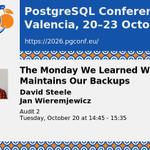
"The Monday We Learned Who Maintains Our Backups" is on Tuesday 20 October, 14:45 local time, in Audit 2 (Beginner level). David Steele (pgBackRest) and Jan Wieremjewicz (Percona) cover why the tool was created, how it became a core part of the PostgreSQL ecosystem, what maintaining it involves, and how users, vendors and the community responded when doubts about its future spread. The close is in regards to funding and succession planning.
New to it? pgBackRest is a free, MIT-licensed backup and restore solution for PostgreSQL. It supports parallel backup and restore, full, differential and incremental backups at the file or block level, per-file checksums rechecked on restore, repository encryption, and S3, Azure or GCS compatible object storage.
pgEdge is one of pgBackRest's sponsors, and a Gold Sponsor of the conference. If you're in Valencia, come by the pgEdge table in the sponsor area.
Session details: 🎙️ hubs.la/Q04Bj0970
#postgresql #postgres #pgbackrest #backup #disasterrecovery #opensource #database #dba #valencia #spain #techevent #techcommunity

PostgreSQL Conference Europe 2026 starts next Tuesday in Valencia, Spain, and registration is still open. 🐘
If production failure stories are your thing, Tuesday, October 20 is the day to be in the room (all times are Valencia local time):
🎙️ 13:45, "Postgres On-Call Confessions: Worst Practices 101," a six-person panel with pgEdge's Jimmy Angelakos. It ends with an open mic, so bring your own production "obvious fix" that backfired to contribute to what should be quite the entertaining discussion.
🛟 14:45, Dr. Ibrar Ahmed on "Eight Steps to Bullet-Proof Database Disaster Recovery." Every command in the talk runs on standard PostgreSQL, no third-party tools required, to help you have a procedure in place when systems go down.
Wednesday and Thursday belong to Phillip Merrick on agentic engineering, operations, and analytics with Postgres (11:45 Wednesday), as well as Jimmy who is giving a talk on radar, an agentless diagnostic snapshot tool for PostgreSQL (10:25 Thursday).
pgEdge is a Gold Sponsor, so come by the pgEdge table in the sponsor area and say hi, whether you're coming from Spain or from across Europe. 👋
Thinking about attending? Don't forget to register: 🔗 hubs.la/Q04BbgYT0
#postgresql #postgres #valencia #spain #europe #techevent #techcommunity #devcommunity #database #dba #opensource #disasterrecovery

An AI prototype built on a developer-friendly Postgres platform can become a re-platforming project the moment it has to meet enterprise security, compliance, and availability requirements.
Meredith Shubel's piece in @thenewstack puts a price on that.
> Besides the direct cost of technical work — which can get particularly gnarly if the application relies on proprietary capabilities from the original platform — @phillipmerrick cautions enterprises about the additional operational and administrative burdens of moving to and managing a new environment, including a second procurement cycle that few may plan for. It also takes time and resources to establish the necessary agentic operations strategy.
> Bottom line, he doesn’t see any way around the added expense: “Choose the wrong platform, and you are going to incur additional costs.”
Why do teams walk into it? Prototyping and production platforms are often separate products sold to different buyers, not tiers of one product. So the move to production is a migration, not an upgrade.
pgEdge Starfleet is a Postgres cloud platform built around that gap: a supported path from pgEdge-hosted cloud to your own AWS, Azure, or Google Cloud account, then on to on-premises or air-gapped infrastructure with pgEdge Enterprise Postgres. Same Postgres platform at each step. 🐘
Read the article: 📖 hubs.la/Q04Bb3Vw0
Try Starfleet (14-day free trial, no credit card): 🛠️ hubs.la/Q04Bb4070
#postgresql #postgres #database #ai #agenticai #dba #devops #opensource #datasovereignty

If you work with PostgreSQL anywhere in or around Edinburgh, the PostgresEDI meetup is on Thursday 15 October. 🐘
📍 Room 1.21, Paterson's Land, Holyrood Road, University of Edinburgh. Doors open at 6 PM for pizza 🍕 and networking, with talks starting at 7.
Elizabeth Christensen (Snowflake) opens with what's happening in Postgres 19, which is expected at the end of October. She'll cover the major new features to look out for, a few from Postgres 18 you might have missed, and some that almost made it into 19 and point to what's coming next. After that, pgEdge's Jimmy Angelakos, one of the PostgresEDI organizers, gives a lightning talk on pg_lakekeeper, which aims to connect the Lakekeeper Apache Iceberg REST catalog with PostgreSQL.
In Scotland for Community Over Code in Glasgow? Edinburgh is about an hour away. All levels are welcome, and the evening carries on at The Canons' Gait, a short walk from the venue 🍻
pgEdge is sponsoring. Thinking about coming? RSVP here: 🎙️ hubs.la/Q04B42YS0
#postgresql #postgres #postgresedi #edinburgh #scotland #glasgow #uk #meetup #techevent #techcommunity #devcommunity #database #dba #opensource

AI tools have collapsed the time it takes to build an app. Getting that app into enterprise production? That part hasn’t gotten any faster.
So what happens when the prototype lives on a platform your security team won’t approve, or the data can’t leave your own infrastructure? Too often it’s a replatform... or a project that never ships.
On Tuesday, October 20 at 8 AM PT / 11 AM ET, our Postgres Live monthly series takes a deep dive into pgEdge Starfleet, an enterprise Postgres cloud platform built on 100% open source community Postgres. Prototype on pgEdge-hosted cloud, then move to your own AWS, Azure, or GCP account with Starfleet BYOC, or to self-hosted pgEdge Enterprise Postgres on-premises or air-gapped. Same Postgres platform everywhere, no replatforming.
Gil Browdy (Director of Engineering, Cloud) covers how it works, including true copy-on-write database branching and agentic AI tooling for Postgres-based applications. Then Paul Rothrock (Solutions Engineer) demos sign-up to a running database in under two minutes. Antony Pegg hosts, and there’s live Q&A with one of the architects behind Starfleet, so bring your questions.
Save your spot 🎙️ hubs.la/Q04B2gJ_0
#postgres #postgresql #opensource #database #ai #agenticai #aidevelopment #devops #dataengineering #cloud #aws #azure #gcp #webinar

In PostgreSQL, pointing archive_command at /bin/true is a common way to stop pg_wal from filling a disk: Postgres treats every segment as archived and recycles it. However, it also breaks the chain of Write-Ahead Log (WAL) files a restore depends on.
In his latest PG Phriday, Shaun Thomas explains why with a bank account. “The data files holding tables and indexes are the balance, and the WAL is the ledger.” Tear a page out of the middle and, as he asks, “Would you trust anything that came after?”
Then he tests it. With one archived segment missing and no recovery target set, Postgres replayed what it had, treated the gap as the end of the archive, promoted itself to a new timeline, and started accepting writes. The restored ledger table held 2,001 of 5,001 entries. In Shaun’s words: “Three thousand entries simply vanished and Postgres was none the wiser.”
The fix is to repair the archive destination, or point archive_command at an emergency mount until you can, so the segments are kept instead of discarded.
Read the full breakdown: 📖 hubs.la/Q04zQJYv0
#postgres #postgresql #database #dba #backup #disasterrecovery #wal #pgphriday #opensource #devops #sre #dataengineering

In PostgreSQL, reaching for NOT IN to exclude rows is a mistake, and it’s the first one Jimmy Angelakos takes on in his book PostgreSQL Mistakes and How to Avoid Them (Manning).
The book started as a FOSDEM talk called “Don’t Do This,” and the pitch is that the best mistakes to learn from are the ones other people already made. Every mistake gets a demo and an explanation of the PostgreSQL internals behind it, in chapters that run from bad SQL usage to upgrades and migrations.
It’s written for PostgreSQL DBAs and application developers, at a beginner to intermediate level. Developers will recognize themselves in the SQL and data type chapters, which cover mistakes like using TIMESTAMP without a time zone. DBAs get the chapters on high availability and on upgrades and migrations.
Curious about common #Postgres mistakes you could avoid? Get a free signed copy at PostgreSQL Conference Europe 2026 in Valencia, Spain, on Tuesday, October 20 during the conference reception directly from the author. Just come by the pgEdge table in the sponsor area and say hi! 👋
🔗 Learn more about the book: hubs.la/Q04zN4cV0
#postgresql #postgres #pgconfeu #valencia #dba #database #sql #opensource #developers #booksigning #tech #devcommunity #europe #spain #programmation #programming #programación

In PostgreSQL, 1.5 and 1.50 are equal in a plain numeric column, but cast them to text and you get two different strings 🐘 The type stores the scale inside every value, and that one decision is part of why aggregating numeric costs more than aggregating double precision.
Andrei Lepikhov, a PostgreSQL Significant Contributor on our team, traces why in his latest blog. He walks through four design decisions behind numeric, PostgreSQL’s exact decimal type: width that doesn’t depend on the declaration, scale carried in the value, a result scale computed from the data, and a precision limit that isn't realistic to hit.
Then he reads DuckDB’s source 🦆 to see what a fast decimal looks like.
DECIMAL is stored as an integer sized by its precision, with the scale fixed in the column type. The trade-offs show up too: precision is capped at 38 digits, and division on DECIMAL returns floating point instead of an exact result.
His conclusion is that no decimal type is cheap, but the focus should be on designs where the expensive case happens less often.
Read the full breakdown: 📖 hubs.la/Q04zDDRz0
#postgres #postgresql #database #dba #duckdb #opensource #performance #sql #dataengineering #databaseperformance #developer #programming

A lot of "database branching" in the Postgres cloud market isn't what it sounds like. Often, you're limited in only being able to branch your schema - not your data. Some have rewritten the Postgres storage engine to make branching work, which means you're not really running Postgres storage anymore, open source or not.
pgEdge Starfleet does true copy-on-write database branching - fully isolated branches in a few minutes - without replacing the Postgres storage layer with a proprietary or semi-proprietary one. You get parallel environments for agentic experiments, testing, or staging, on the actual Postgres storage engine.
Want to try it? Start a free 14-day trial, no credit card required, and have your first database running in under two minutes. We'll email a reminder 3 days before the trial ends. Add a card any time to keep your database running, and it stays restorable for up to 30 days after the trial. 🚀 hubs.la/Q04zvZQx0
#PostgreSQL #Postgres #OpenSource #DevOps #Database #CloudComputing
