

@petry_benoit
Account based inFrance!
About this account
- Account based in
- France
- Connected via
- France App Store
X says this location may be affected by a proxy or VPN.
Account-level information from X, not a live location or the device used for a specific post.
Growth Strategist | Google Ads, LinkedIn & Content Strategy | $11M+ in ad spend | Scaling businesses with strategic, data-driven marketing
Where your ICP hangs out
Joined April 2022
- Tweets720
- Following225
- Followers304
- Likes33.5K






This @coderabbitai ad is gold. They went full Dragon Ball Z (perfect for the age-group they target) with AI (the villain) dropping a giant green ball of 500 bugs like it’s the final boss.
Then the hero (CodeRabbit) shows up, hits the special move and wipes them all out.
The villain just looks at it and says 'That’s bullshit!' 😂
The way they tell the story, the frustration with AI code and then the funny fix… it lands so well. Smart marketing.

Information/content is a data layer for agents.
Spending time, being present and visible on platforms where humans are - is becoming of capital importance.

Welp, that happened faster than I predicted. Thought it would be end of 2027, then early 2027, but agentic traffic growing so fast that bots have now passed human traffic online for the first time in the Internet's history. radar.cloudflare.com/traffic…

I tested Schema on 55 pages… and AI started citing them more.
It’s not a magic fix or silver bullet, but I saw a clear positive impact.
Sure, it could be correlation rather than causation, but there’s literally zero downside to adding proper schema.
Read @thinking_slow's post about @ahrefs study to make your own opinion: nitter.cf/thinking_slow/status/2…


I ran the same strategic prompt through Grok twice: once with a dedicated agent, once without.
I expected the difference to be obvious.
It wasn't. But one version was clearly more useful and the reason surprised me.
The prompt: Build a practical ABM strategy for a specialized B2B marketing agency targeting larger mid-market clients with limited resources.
Not a generic marketing plan. A real business prompt where quality depends on constraints: small team, limited budget, need for pipeline, realistic execution.
To avoid judging on vibes, I built a scoring rubric across 8 criteria:
▸ Prompt fit and constraint handling: 15 pts
▸ ICP and account selection quality: 15 pts
▸ Messaging and positioning depth: 15 pts
▸ Content and channel strategy: 15 pts
▸ Execution feasibility: 15 pts
▸ Measurement rigor: 15 pts
▸ Clarity and readability: 5 pts
▸ Evidence discipline / overclaiming: 5 pts
Final scores:
Grok with agent: 88/100
Grok without agent: 78/100
The difference wasn't that the agent version sounded smarter.
It was more constrained.
The no-agent version gave a solid ABM Lite strategy.
But it recommended a heavier scope: 50 target accounts initially, 20–30 in the pilot, a 90-day timeline.
Not bad. But for a resource-constrained agency, it's already a lot.
The agent version was tighter: 15–25 accounts max, 5 Tier 1 accounts, one 8-week pilot, 10–15 hours/week for the marketer, scale only after 1–2 wins.
Something a small team could actually execute.
The sharpest difference was in account scoring.
The no-agent version had a solid model. But the agent version added "Accessibility" as a criterion, whether key decision-makers (CMO, Head of Growth, VP Marketing) are actually reachable.
A company can be a perfect ICP fit with strong intent signals. But if you can't reach the right person, it's not a realistic ABM target.
That one detail made the whole answer more operational.
The positioning was sharper too.
Instead of generic agency framing, the agent version landed on:
"Too big for freelancers, too small for big agencies."
One line. Tells you who it's for, who it's not, and why it exists. That's a market wedge, not a tagline.
The no-agent version wasn't weak though.
It explained the 1:Few ABM Lite model clearly and included a useful 70/30 content principle, 70% reusable across clusters, 30% custom. Solid thinking the agent version missed entirely.
So this isn't agent = good, no agent = bad.
The real difference: the agent version was better at turning strategy into an operating system.
Smaller list. Clearer pilot. Better workload assumptions. More realistic milestones.
It felt less like a good answer and more like something you could use on Monday morning.
Here's where I'll be honest.
Both versions made unsupported performance claims like win rates, ROI targets, pipeline benchmarks stated as fact without evidence.
The agent version was actually more confident about this, not less.
Constraint handling doesn't fix overconfidence.
Strong AI outputs still need a human filter, especially in marketing, where models produce benchmarks that sound authoritative and aren't backed by anything.
My takeaway:
The value of agents may not be better writing.
It may be better constraint handling. Less generic advice. More realistic sequencing. More operational detail.
For business use cases, that matters more than elegance.

Gartner 2026 CMO Spend Survey just dropped: CMOs are spending 15.3% of their marketing budgets on AI.
I think that's the wrong approach.
It shouldn't be the CMO or any single department funding AI initiatives from their own budget.
AI transformation is a company-wide effort, not a marketing project. Marketing budgets should stay focused on marketing.
@ewanmcintyre4 said it clearly: “The risk is that CMOs invest in AI tools faster than they build the data foundations, processes, governance and talent required to scale them.”
I'd add that many marketing tools are already integrating AI very fast, which actually makes future AI deployment easier.


It’s programmatic SEO pages and some are targeting 🌽 websites.
These landing pages even rank #1, above the branded domain.
I get the intent. But users searching for 🌽 landing on an SEO tool page?
Traffic intent matters more than raw volume.
NB: Organic traffic data comes from Ahrefs' Site Explorer USA Location.


Benoit Petry retweeted

I know Silicon Valley startups don't want to hear this.....
But the combination of someone in the trades with deep domain expertise and Claude Code will run circles around your generic software.
I talked to Cory LaChance this morning, a mechanical engineer in industrial piping construction in Houston. He normally works with chemical plants and refineries, but now he also works with the terminal
He reached out in a DM a few days ago and I was so fired up by his story, I asked him if we could record the conversation and share it.
He built a full application that industrial contractors are using every day. It reads piping isometric drawings and automatically extracts every weld count, every material spec, every commodity code.
Work that took 10 minutes per drawing now takes 60 seconds. It can do 100 drawings in five minutes, saving days of time.
His co-workers are all mind blown, and when he talks to them, it's like they are speaking different languages.
His fabrication shop uses it daily, and he built the entire thing in 8 weeks. During those 8 weeks he also had to learn everything about Claude Code, the terminal, VS Code, everything.
My favorite quote from him was when he said, "I literally did this with zero outside help other than the AI. My favorite tools are screenshots, step by step instructions and asking Claude to explain things like I'm five."
Every trades worker with deep expertise and a willingness to sit down with Claude Code for a few weekends is now a potential software founder.
I can't wait to meet more people like Cory.


With xAI's recent merger with SpaceX, Grok is on track for massive growth in the years to come.
The integration potentially unlocks compute resources through planned orbital data centers powered by Starlink satellites and solar energy in space.

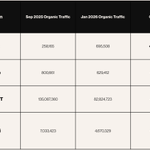
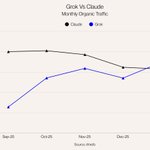
@grok received 695,508 monthly organic visitors in January, compared to 629,412 for @claudeai (source: @ahrefs).
With +169% growth for Grok compared to Claude's -21% dip (Sep 2025–Jan 2026), this shift highlights how integrations like Grok's X embedding and feature upgrades are reshaping user discovery.
These results are surprising, as I expected Claude to grow further with the massive PR it receives for Claude Cowork.

ALT chart comparing Grok and Claude web traffic from September 2025 to January 2026.
Very interesting read for anyone doing @Meta ads 👇

The new Meta release just exposed the Andromeda impact
(And previously unknown algo changes)
The 24% incremental conversion lift will get all the attention.
But three infrastructure changes buried in this release explain why some brands are seeing 30-40% discovery reach improvements.
Here's what actually matters:
1. Sequence learning replaced independent impression scoring
The old ranking system evaluated each ad in isolation.
The new architecture treats your entire session as a sequence.
What you watched three Reels ago now influences which ad you see next.
Your creative gets scored based on where someone is in their scroll journey.
2. Facebook surfacing 25% more same-day FB Reels vs Q3
This is the signal everyone will miss.
Reels are your primary discovery surface.
First touchpoint with net new audiences.
Where top-of-funnel creative testing lives.
Meta is now prioritizing same-day content in discovery feeds.
The half-life of Reels content is compressing fast.
Publishing velocity may matter more than volume now.
3. Original content jumped to 75% of Instagram recommendations
Up 10 percentage points in one quarter.
Meta's system can differentiate between original concepts and derivative rehashes now.
If your creative process starts with "find trending videos" the algorithm may already classify it as non-original.
4. Incremental attribution added 24% conversion lift over standard attribution
Hit multi-billion dollar run rate in seven months.
Fastest product adoption I've tracked.
Most advertisers are still optimizing for last-click ROAS while the system is trying to show them incremental impact.
Worth testing if you haven't already.
I find it matches store results much better than 7DC.
Most brands are still running 2023 playbooks:
- Weekly creative batches
- Trending audio strategy
- Same asset across all placements
The algorithm moved on.
Same-day publishing matters for discovery now.
Original concepts beat derivative trends.
Creative variants help sequence learning map performance across contexts.
The gap between brands adapting to this and brands ignoring it is widening fast.
Grok > Claude 🚀
While the AI world fixates on ChatGPT vs. Gemini, @xai's Grok has quietly surged past Anthropic's Claude in organic web traffic, claiming the #3 spot globally per January 2026 data.

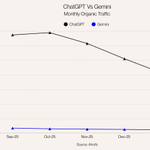
@ChatGPTapp still retains the crown with nearly 83M monthly organic visits. It is far above @GeminiApp at close to 5M organic web traffic.
ChatGPT's January 2026 drop in traffic (-39% since September 2025) is concerning, as its organic traffic has kept decreasing over the past 4 months.

ALT chart comparing ChatGPT and Gemini web traffic from September 2025 to January 2026.
Grok's explosive +169% growth signals xAI's rise in AI discovery. While Claude dips -21%, the real story is the shifting landscape beyond the giants.
ChatGPT's -39% slide shows even leaders aren't immune.
This Ahrefs data (Jan '26) highlights Grok's momentum via X integration.
Caveats
• This is estimated organic web traffic.
• It covers only organic web traffic and excludes mobile or desktop app users.
• Web traffic does not necessarily reflect overall user growth, but may indicate growth in active users.

ALT Table comparing main LLM platform organic web traffic from September 2025 to January 2026.