

“To err is human. To forgive is not SAC policy.”
Joined June 2011
- Tweets469
- Following1.4K
- Followers38
- Likes5.4K


pdbennett retweeted

The NSA mathematician who made the numbers protecting your passkeys died in 2023 without ever remembering how he made them. Cryptographers chased the answer for years and put up a $36,864 bounty. Claude figured it out in under 30 minutes, and the answer was the clock on his computer.
His name was Jerry Solinas. Back in 1997 he generated the starting numbers for P-256 and a few sibling curves, the math underneath your passkeys and a big chunk of the secure websites you visit every day. NIST published them in 2000 with no explanation of where they came from, and for a long time people mostly shrugged.
Then 2013 happened. The Snowden files showed the NSA had slipped a backdoor into a different crypto standard, and suddenly every unexplained number the agency had ever handed out looked suspicious. These were the most widely used ones of all.
Jerry's own story was that he'd hashed a joke sentence, something along the lines of "Give Bob and Jerry a raise," and then lost it when his work computer got swapped out. He tried to recreate it himself and never could. He even joked that any backup was probably sitting in the same warehouse as the Ark of the Covenant.
After he died, Steve went digging. He tracked down former NSA people and old cryptographers, and four of them independently told him the same joke-phrase story. Filippo Valsorda turned that into a bounty in 2023, and for three years people threw computing power at every version of that sentence they could dream up. A few folks at Anthropic took a crack at it too, Steve among them. He's now one of the people credited on the solve.
None of it matched.
So someone at Anthropic tried something different. They asked an internal Claude model to figure out where the seeds came from and purposely left out the joke-sentence clue.
Claude's first move was to think like a programmer in 1997. If you needed random numbers back then, you probably grabbed the basic generator that came with the C library on your Unix machine, and those old generators are simple enough that they leave fingerprints in their output. Sure enough, in four of the seeds the top bit of every 32-bit chunk was a zero. The odds of that happening by accident are about 1 in 5,810, and it's the calling card of a generator called lrand48.
And this is where it gets fun. lrand48 runs in reverse just as easily as forward, so Claude rewound each seed back to the moment the generator was switched on. Every prime-curve seed rewound to a date and time from 1997 or 1998. Whoever ran the program had seeded it with the computer's clock.
P-256's run started at 1:52:34 AM UTC on August 16, 1997. If that machine was at NSA headquarters in Maryland, somebody hit enter at 9:52 on a Friday night, and the seed that ended up in the standard was the 1,842nd one the program spat out.
Jerry's joke sentence was never in there. He misremembered, four people faithfully repeated what he told them, and some very good cryptographers spent years trying to crack a hash of a sentence that nobody ever typed. Leaving the clue out is probably what let Claude get there in half an hour.
I love the irony here. Using the clock to seed a weak random generator is one of the first things they tell you never to do in a security class. That exact laziness is why anyone can now rerun the NSA's 1997 program on a laptop and get the identical numbers, which makes it really hard to argue anything sneaky was hidden inside them.
There's still one thing left to argue about. In the P-256 run, number 876 also would have made a perfectly good curve, and someone skipped it and kept going to 1,842. Anthropic says so few got skipped that it couldn't have been a hunt for a weak curve, but nobody knows why it happened.
Claude's own notes from that moment are pretty funny. When the numbers matched, it actually stopped and wondered whether it was inside a test, since a 25-year-old mystery falling apart that fast seemed too good to be true. Then it reran the logic and talked itself into it, because ten curves each regenerating perfectly from a single timestamp doesn't happen by luck.
The $36,864 is going to the nonprofit that runs Let's Encrypt, the group that gives free security certificates to millions of websites, a lot of them built on these same curves.

CLAUDE FOUND THE SEEDS
anthropic.com/research/ecdsa…

pdbennett retweeted

Mid-1970s graphic depicting concept for "hardened" comms in HEO and GEO for nuclear command and control

pdbennett retweeted

This is a fantastic video explaining orbital dynamics and the resulting economics, and security considerations of cislunar space. Well worth the 8.5 minutes to watch. youtu.be/kdpOdSMzXTA?is=By6z…

pdbennett retweeted

In the history of nuclear weapons safety, there was a debate between the military and the scientists at Sandia National Labs about whether traditional analog electronics were safe enough to control detonation. The labs demonstrated that in the case of a fire, the circuit boards could short and cause safety mechanisms to fail.
This prompted the development of "strong links" in Enhanced Nuclear Detonation Safety (ENDS). They were designed such that it was physically impossible to activate from random electricity, fire, or a physical crash. They could only activate by a complex and unique "intent" signal that cannot possibly be produced by natural events.
We are having a similar debate now around AI safety. The solution is to contain agents using signals that they cannot possibly produce.
More history around this by @SteveBellovin :
usenix.org/legacy/event/usen…
pdbennett retweeted

Wernher von Braun, director of NASA's Marchall Space Flight Center, at his office in Huntsville, Alabama 1965.

pdbennett retweeted

Hey TWC! Unfortunately, this tracker is inaccurate and an unverified website. Here is our latest status map as of 5:30pm EST.

pdbennett retweeted
Strategic Air Command's information board for the Primary Alerting System in 1961

pdbennett retweeted

BREAKING: $HAWK HawkEye 360 has demonstrated that satellites built to detect radio signals on Earth can also be used to monitor other spacecraft in orbit.
In a test funded by the U.S. Air Force Research Laboratory, the Pentagon’s main science and technology arm, HawkEye used its RF-sensing constellation to detect and characterize emissions from satellites across low, medium and geostationary orbit.
The system can help determine whether a satellite is transmitting, communicating with a specific ground station or suddenly changing its normal behavior.
HawkEye also developed algorithms to match those emissions to the correct spacecraft and automate detection missions with limited human involvement.
The result gives the Pentagon another way to watch activity in orbit beyond just where a satellite is located.

pdbennett retweeted

It’s true, we have been here before! But I think what it reveals is even more interesting. In Sverdlovsk, declassified docs demonstrate the US knew pretty much what happened immediately when USSR had a huge accident in an illegal anthrax production facility. US diplomats happily

pdbennett retweeted

Opus 5.5 を使って軌道6要素をインタラクティブに学べるツールを作った。教科書などを読んでも絵が平面的でイメージをつかむのに苦戦していたけど、マウスでグリグリ回して色んな角度で3次元的に理解できるのに感動。良い時代になったもんだ。
ki-math.github.io/orbital-el…
pdbennett retweeted

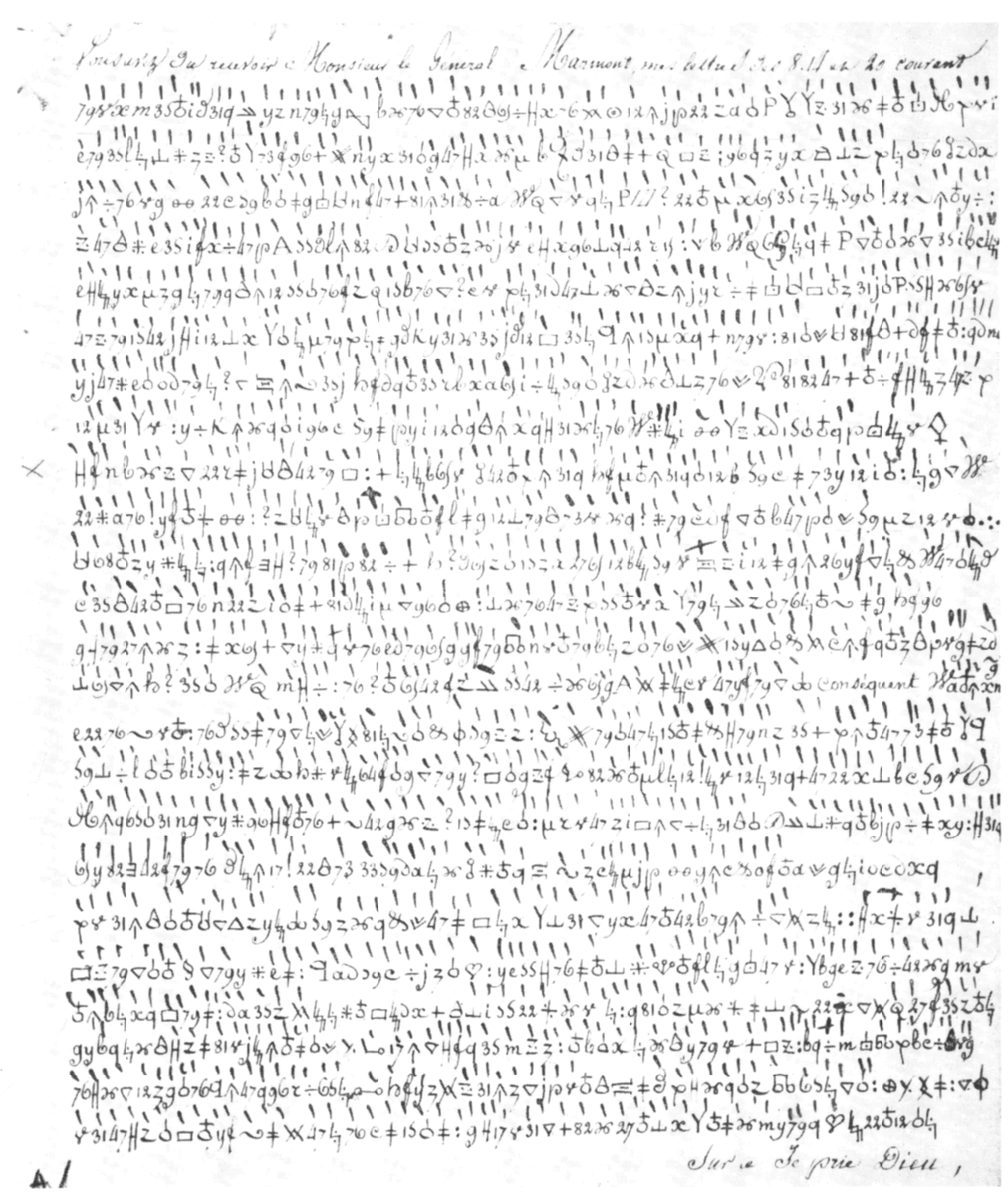
I used GPT-6 Astra to break an unsolved cipher to one of Napoleon's generals that had gone unread for 217 years.
What makes this impressive isn't actually the codebreaking, but that Astra completed the entire multi-modal workflow in ~6 hours from a single image and goal.
1/6🧵
pdbennett retweeted

Phase 3 of the Drone Dominance Program is live, and we’re raising the stakes once again, allocating $450 million toward roughly 60,000 drones. Awards will be split evenly across two mission sets, with an option to buy up to 40,000 more.
Deep Strike and Close Quarter Battle (CQB) mission sets return from Phase 2, with tougher scenarios and a faster pace. Both will be tested in GNSS- and comms-denied environments.
Learn more and apply here: info.nstxl.org/-drone-domina…

pdbennett retweeted
NEW: A 38-year-old U.S. spy satellite has unexpectedly broken apart in orbit, scattering debris through one of the busiest regions of low Earth orbit.
USA 32 (declassified briefing doc attached) launched in 1988 on a classified Cold War mission to monitor Soviet radar systems. On Sept. 13, the U.S. Space Force detected the spacecraft fragmenting roughly 775 km above Earth.
The cause is still unknown.
Investigators are now tracking the debris and working backward from the fragments’ trajectories to determine what happened. Possible explanations include an aging battery or pressurized tank failing after decades in orbit, though an impact has not been ruled out.
The breakup occurred in an especially crowded orbital shell, with more than 200 active satellites operating within roughly 50 km of its altitude - including the Iridium NEXT constellation.
Space Force says no immediate threat to active spacecraft has been identified, but the new debris will now have to be tracked for years.

pdbennett retweeted

Four years in the rabbit hole with millions of Russian military docs, and I finally feel comfortable writing this (very uncomfortable) story.
Russia appears to have upgraded and re-activated the fabled Dead Hand that ensures global nuclear retaliation if Russia is attacked.

pdbennett retweeted

We’re launching the Army of Robots.
In 2022, we launched the Army of Drones. Today, drones account for over 95% of battlefield strikes, and Ukraine has more than 700 UAV manufacturers.
Now we need the next technological breakthrough: the robotization of warfare.
The goal is simple — save lives. Robots should take on the most dangerous missions: evacuating the wounded, delivering ammunition, mining and demining, reconnaissance, defending positions and engaging targets.
The Army of Robots is not one company. It’s an ecosystem. We will invest in defense tech companies, launch our own technology projects, test them with the military and scale what works on the battlefield.
We’re now looking for defense tech companies and engineers working on robotic technologies — as well as a CTO / Tech Lead for the Army of Robots.
Join us: thearmyofrobots.com/en
pdbennett retweeted

An incredible photo from Moscow shows a Russian serviceman shouldering a manpad anti air launcher aboard a lifted crane with a spotter during yesterday’s massive air raid.

pdbennett retweeted

A Russian Pantsir air-defense system in combat position, with its radar active, deployed directly above a busy Moscow highway near the Moscow Oil Refinery.
(55.6518692, 37.8362733)


pdbennett retweeted

Starlink laser terminals.
Imagine this thing locking onto a target the size of a dinner plate, 4,000 km away, while both ends are moving at orbital speed.
pdbennett retweeted

The U.S. Space Force wants a satellite that can chase down and inspect other objects in orbit on short notice, part of a program built for rapid launch instead of years of development.
More details: defence-blog.com/u-s-space-f…
