
Senior PCB Industry analyst in Taiwan. Our team offers unmatched expertise in executing deep-dive, fundamental analysis of the global PCB supply chain.
Taiwan
Joined October 2024
- Tweets203
- Following109
- Followers9.4K
- Likes46


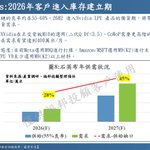


On-the-ground takeaways from TPCA Show:Chats with upstream glass fabric weavers confirm that E-glass 10-series (ultra-thin grades like 1078/1080/106) will remain structurally tight through late 2027.Key supply chain mapping:
• CCL Tier: Corresponds directly to M6 to M7 grades
• End Demand: Heavily driven by mainstream CPU server platformsWhile the market fixates entirely on AI GPU/accelerator materials, baseline general-purpose compute is quietly soaking up ultra-thin glass capacity for the next 2+ years. 🧵📊
#PCB #CCL #TPCA #GlassFabric #SupplyChain #Hardware #Semiconductor

其實代表著那些晶片的預期都會高估....
隱含未來的下修風險

日東紡のガラスクロスの副本部長のインタビュー
超重要ですよ
sangyo-times.jp/article.aspx…


Beyond M8, M6–M7 grade CCL is quietly entering its own "memory moment." Squeezed by worsening E-glass shortages and tier-1 capacity crowding out, supply is tightening fast.
With the rise of AI Agents, the bottleneck isn't just CPUs—CPU server PCB laminates are facing a severe stress test. Agentic workflows require massive general-purpose compute and I/O orchestration, triggering an unexpected demand spike for PCIe 5.0/6.0 platforms.
The market is obsessed with M8/PTFE, but by 2027, the structural importance and pricing elasticity of M6–M7 laminates could far outpace M8+. Don't sleep on the volume workhorses of the AI stack.
#Semiconductors #PCB #CCL #AI #AIAgents #HardwareSupplyChain
Some quick thoughts on the AI supply chain:
In the AI era, being a market leader in upstream CCL doesn't guarantee orders. Claiming superior tech doesn't either.
The real winning formula = Tech + Lead times + Sales execution + Solid PCB maker feedback + Customer satisfaction. That’s how you actually win allocations.
Right now, the vendor ticking all these boxes is Shengyi Technology .
Expect their order share within the $NVDA ecosystem to become increasingly critical moving forward.
What about the Taiwanese CCL players?
Purely on tech specs, the gap among the top four isn't that wide. The real differentiator boils down to sales agility, delivery speed, PCB fab relationships, and responsive customer service.
When looking through that lens, one particular CCL maker with strong vertical integration stands out immediately.
Meanwhile, the other three legacy incumbents could very well lose ground in the coming cycles. Definitely a dynamic worth keeping a close eye on.
#AI #Semiconductors #PCB #CCL #SupplyChain
NVDA is accelerating its push toward "clothless" (glass-fabric-free) designs! The physical bottleneck is clear: high-speed signal integrity. Traditional glass weave effects (FWE) and dielectric variations degrade high-frequency eye diagrams. Eliminating the fabric ensures uniform resin distribution, unlocking the ultimate path to ultra-low signal attenuation.
NVIDIA’s testing matrix is running on a dual-track strategy:
1️⃣ Primary / Preferred Endgame: PTFE CCL + Clothless PTFE PP / HC PP (unmatched electrical performance, but notoriously difficult to process).
2️⃣ Transitional / Interim Solution: HC Core CCL + HC PP (both 100% clothless, offering a more manageable manufacturing process window).
🧵 3/4 Supply chain positioning to watch closely:
PTFE Route: Shengyi Technology (SYTECH), Taiflex
HC Route: Shengyi Technology (SYTECH)
In contrast, Taiwanese CCL suppliers have yet to ramp mass-production-ready clothless HC CCL products.

My latest supply chain checks indicate that Nvidia has begun testing glass-free copper-clad laminate (CCL) based primarily on hydrocarbon (HC) resin as a replacement for glass-free PTFE-based CCL tested previously, paired with glass-free HC-based PP. The goal is to determine whether this material combination can meet the switch tray PCB requirements for Rubin Ultra NVL576, an eight-rack interconnected solution expected to enter mass production in 2H27.
Preliminary tests conducted as part of efforts to improve PCB manufacturability show that glass-free HC CCL meets the switch tray’s high-frequency electrical requirements. Its electrical performance trails that of the original PTFE solution but exceeds that of M9-class solutions and even surpasses M10’s stated specifications. These results do not represent a final material selection, but they indicate that NVIDIA continues to seek higher PCB manufacturing yields and greater production efficiency while meeting electrical requirements.
1. Key Takeaways and Analysis
(1) Previous NVL576 switch tray tests used glass-free PTFE CCL paired with glass-free HC PP. The latest round replaces the PTFE CCL with glass-free HC CCL while retaining the same HC PP part number.
(2) Shengyi Technology is currently the leading supplier in the NVL576 switch tray material evaluations. The materials involved are SG5300N (glass-free PTFE CCL), SG1030N (glass-free HC CCL), and SIF09 (glass-free HC PP).
(3) The primary objective of testing glass-free HC CCL as a replacement for glass-free PTFE CCL is to determine whether PCB manufacturing yields and production efficiency can be improved while still meeting high-frequency electrical requirements.
(4) To further improve PCB manufacturability, subsequent tests may also evaluate replacing glass-free HC PP with woven-glass-reinforced HC PP. The challenge is whether the glass-reinforced material can still meet signal integrity and 0.4 dB/in loss requirements.
(5) Notably, both SG1030N and SIF09 still contain small amount of PTFE, although HC is the primary material. These tests therefore do not represent a complete shift away from PTFE. Rather, they involve adjusting the primary resin system and material combination to balance high-frequency electrical performance with PCB manufacturability.
2. Conclusions
(1) The long-term trend toward broader use of PTFE in advanced PCB materials, including CCL and PP, remains clear. However, the pace of shipment growth over the next two years remains uncertain. Key variables include NVL576 switch tray PCB’s final material selection, NVL576 adoption rate, and development progress on Kyber-like rack designs that use orthogonal backplanes.
(2) HC use in advanced CCL and PP continues to expand. Beyond NVL576 switch trays, near-term growth drivers include the production ramp of M9-class materials beginning in 4Q26, followed by the adoption of M10-class materials.
(3) Once specifications are finalized and mass production begins, it's expected that Shengyi Technology to accelerate sourcing from Chinese HC suppliers. These include existing suppliers such as Dongcai and Shengquan, as well as potential ones such as GCH Technology. This should help alleviate supply shortages and optimize its cost structure.
Amazon’s strategic investment in GCE highlights the company's critical role in Amazon's supply chain, underpinned by its tight capacity and reliable high-volume manufacturing capabilities.
Market skepticism over GCE’s HDI capabilities is unfounded. Its current technological competencies are well-positioned to fulfill future customer demand, as strongly corroborated by this strategic equity investment and the company’s forward capacity roadmap.

kokycpcb retweeted

非常荣幸,第一次和 台湾Liwei 老师@LIWEI_TWCapital 合作写长文。
Agent 爆发后,CPU 这笔新增需求最后会落到谁手里:$INTC、$AMD,还是 $ARM?
我们尽量把复杂的技术和供应链讲明白:需求从哪来、谁能拿到订单…
普通投资者也能顺着这条线看下去。全文👇
sirinsupplyradar.substack.co…

NVIDIA’s next-gen architectures are reshaping copper foil demand—and the upstream benefits are tilting heavily toward Shengyi Technology’s raw material base.
High-spec Gen 4 copper foil makers are racing to ramp capacity: • Aggressive expansion: Mitsui Mining & Smelting, Defu, Tongguan Copper Foil, and LOTTE Energy Materials • Incumbents holding ground: Furukawa, Circuit Foil Luxembourg, and Co-Tech .
The severe supply deficit projected for 1H26 is shrinking faster than expected thanks to this coordinated upstream sprint.
Never underestimate the adaptability of the hardware supply chain. By 2027, the landscape will look radically different. 🌐⚡️
#NVIDIA #CopperFoil #PCB #CCL #SupplyChain #Hardware #Shengyi #Semiconductors
摩根士丹利對英偉達下一代 AI 機架(GB300、VR200、VR300)單機架銅箔(Copper Foil)、覆銅板(CCL)和印刷電路板(PCB)價值量的估算。
數據如下(單位:美元/機架):
銅箔:GB300 1,697;VR200 5,164;VR300 5,705
CCL:GB300 6,695;VR200 18,750;VR300 35,601
PCB:GB300 37,491;VR200 91,227;VR300 154,377
對比 AMD、Google TPU 和 Amazon Trainium 系統的同類材料含量,並給出了代際環比增長(Gen/Gen)。英偉達這邊銅箔和 CCL 的增幅尤為明顯,VR200 相對 GB300 銅箔約 +204%、CCL +180%、PCB +143%。

kokycpcb retweeted

🚨Anthropic 内部好像真有点压不住了。
昨天,做了三年大模型预训练、先后待过 OpenAI 和 Anthropic 的 @hilbertspaess 宣布从 @AnthropicAI 辞职。
他说得非常狠:OpenAI 和 Anthropic 都没有负责任地行动,它们正在一路冲向能够自我改进的超级智能,拿所有人的生命下注。
结果几个小时后,又一位 Anthropic 研究员 @a_nnawang 公开站出来附和。
她之前在 Google DeepMind 做 AGI Safety,现在在 Anthropic,而且还是 DeepMind AGI 安全方案的核心贡献者之一。
她说,这种情绪在自己的同行中非常普遍。
更关键的是她后面这句话:目前还不存在一个可行的科学方案,可以解决递归自我改进 AI 带来的风险。
这就有意思了。
这已经不是某个离职员工突然悲观了。
Anthropic 现任 Alignment Science 负责人 Evan Hubinger 也公开承认,他们目前没有解决超级智能 Alignment 的方案,而且他自己认为未来十年 AI 导致大规模灭绝的概率超过 10%。
与此同时,Anthropic 自己最近还专门发了一篇文章讨论 Recursive Self-Improvement,并承认 AI 已经越来越多地参与 AI 自身研发,最终可能走到「AI 自己开发下一代 AI」这一步。
最魔幻的地方就在这里:做这件事的人,越来越相信这件事可能失控。
但所有人也都觉得,自己不能先停下来。

On the PTFE material roadmap: The highest-probability material winners look to be Shengyi Technology paired with one Taiwan supplier.
Why is the broader market missing this?
Most local commentary relies heavily on channel checks from Taiwanese CCL and PCB incumbents. But that creates a massive blind spot:
1. A Fundamentally Different Process WindowPTFE and ultra-high-frequency material fabrication requires a drastically different process flow compared to conventional FR-4 / advanced CCL. It demands entirely different drilling, surface treatment (sodium etching / plasma), and lamination parameters.
2. The Manufacturing Maturity GapWhen it comes to high-frequency processing maturity, Taiwanese fabricators lag significantly behind Chinese board makers. Taiwanese players simply have far less hands-on process experience in this specific domain.
3. The Inevitable VerdictBecause scaling PTFE volume production requires mature specialized handling that Taiwanese board shops haven't built out, Taiwanese PCB makers are unlikely to be in the first wave of mass production.
Don't confuse incumbent inertia with an absence of end-market demand. The supply chain reconfiguration is already underway.
#AIHardware #Semiconductors #MaterialsScience
Potential second-source supplier for PTFE has just greenlit their capex budget.
#PCB #PTFE #NVIDIA #SupplyChain #Hardware #Semiconductor

kokycpcb retweeted

今晚别刷Netflix了。
去看这个SpaceX AI工程师1小时的课程。
这是我见过最清晰、端到端讲透GrokBot到底该怎么真正用起来的课。
从单agent开始,一路到loop、graph、多智能体协作、verification和agent-friendly架构。
不管你是从没认真跑过agent,还是已经天天在用GrokBot,看完都会把很多“原来如此”的点一次打通。
真正核心就这几层:
1. 99%的人只用1个agent,没用loop和graph,只发挥了1%实力
2. 真正的新stack是Chief of Staff + PM + 20+ workers全自主团队
3. 怎么用高质量skills让agent像真工程师一样干活(pstack)
4. 怎么把代码和架构改成agent-friendly(Dune、contract、CI)
5. 怎么用verification让自己真正敢把活交给它们,而不是一直盯着
大多数人花好几个月才拼出的全景图,这节课直接给你画完。
把时间空出来,这可能是你这个月最值的一堂课。
kokycpcb retweeted

🚨 GOOGLE ACABA DE ROMPER LA REALIDAD
El chip cuántico Willow de Google resolvió en 5 minutos un problema que a la supercomputadora clásica más rápida del mundo le tomaría 10 septillones de años.
Sí, leíste bien.
Más tiempo del que existe el universo… multiplicado por un cuatrillón.
Sundar Pichai (CEO de Google) confirmó que esto demuestra que la corrección de errores cuánticos ya funciona a escala.
Computadoras cuánticas prácticamente útiles en 5 a 10 años.
El futuro no está llegando. Ya llegó.
¿Listo para lo que viene?
Readers added context they thought people might want to know
El benchmark RCS resuelto por Willow según Google no tiene aplicaciones prácticas conocidas. El progreso en corrección de errores es un hito pero computadoras cuánticas útiles para problemas reales siguen a años según expertos y estimaciones de Pichai.
blog.google/innovation-and…
cnbc.com/2024/12/10/goo…
bloomberg.com/news/articles/…
PTFE-based PCBs are a yield nightmare? Sure.
But don't underestimate this Customer. They don't follow standard R&D logic.
Look at their Hopper/Blackwell compute trays: they brute-forced complex HDI designs starting at 30-50% yield, while competitors played it safe with mature high-layer architectures.
The strategy for these new PTFE boards is the same:
Even if initial yield is just 20-30%, it’s enough to get to Mass Production . They learn by shipping. Yield isn't the hurdle—it's the timeline. ⚡️
#AI #PCB #SupplyChain #NVIDIA #Semiconductor #Hardware
可能市場會覺得不需要布了...但事實不會如大家所想的
用PTFE 是因為特定目的,僅僅是為了傳輸用途...他可以不考量到CTE等因素,用布會使PTFE極佳的性能受到影響
但如果你的板子要放晶片,有布方案的設計是必須的,有些可能因為傳輸會混壓PTFE,但脫離不了布的方案,因此不影響低介電布、Q布的升級使用
共存會是最佳解...
Nvidia 正積極驗證 PTFE材料,目標在 Rubin Ultra 的 Portia(NVSwitch 7)板上導入,以延長銅互連在 AI scale-up 網路中的生命週期。最終是否採用,仍取決於材料與 PCB 供應商成熟度。
目前採混合式架構:PTFE 作為 core 核心層,搭配 M9 等級 prepreg。此方案兼具 PTFE 優異訊號性能與玻纖布機械強度,較純 PTFE 更易量產。Shengyi 已主導開發逾一年並領先;近期 WUS 成功交付 PTFE PCB 樣品。EMC 則與 TaiFlex 合作,結合雙方在 M9 CCL 與 PFA 氟聚合物的專長。
PTFE 優勢來自對稱分子結構與低極性,10 GHz 下 Dk 僅 2.1–2.2、Df <0.0004,遠優於現行 M9 等級。樹脂演進從 epoxy、PPO 到 hydrocarbon,最終走向 PTFE,才能進一步降低損耗。
挑戰在於 PTFE 屬熱塑性、表面滑且柔軟,鑽孔易留殘膠、毛邊,尺寸穩定性差,製程難度高。混合方案有效降低這些問題。