

founder of @thetinyus | ex Hacker | Crypto researcher | Belarusian adventurer | ex pro player in WarCraft3 TFT | ex pro player in Poker Omaha PLO 4-5 card
Florida, USA
Joined August 2015
- Tweets3.3K
- Following159
- Followers512
- Likes2.4K





Pinned Tweet
$VVV #venice @VeniceAI
MY trade played out perfectly. I just closed the futures position, while the spot position I accumulated earlier is still staked. I’m also compounding the yield by putting all the rewards back into staking.
The market has been treating me well.


base:0xacfe6019ed1a7dc6f7b508c02d1b04ec88cc21bf #Venice @VeniceAI
Opened a position in base:0xacfe6019ed1a7dc6f7b508c02d1b04ec88cc21bf : took part at market, laid the rest out with scale orders down to $10.
The logic is simple. On July 23 the WSJ reported that Stripe is in talks to acquire OpenRouter for ~$10B - against a $1.3B valuation in May and roughly $50M in annual revenue. The deal isn't signed yet, but the price tag alone shows what the market is willing to pay for the layer between developers and models.
Venice sits in that same layer, just on-chain: private inference with no accounts and no logs, API access through staking VVV. Since July 18, $5 out of every $100 spent on API credits goes to buying and burning the token on the open market - the burn is now tied to actual product usage rather than to the treasury. Once burns outpace emissions, supply starts shrinking.
My thesis: when the OpenRouter deal closes, the market will go looking for the crypto equivalent. Venice is one of the few AI projects here with a live product, paying users, and revenue that puts the token to direct use.
Not financial advice, and the risks are obvious: the deal can fall apart, and the current burn rate doesn't yet guarantee net deflation.

1
7
725

PaTRoN retweeted
Wanna ask them out? Do it differently 👀 Link in bio!
The cutest way to ask someone out? Right here 💕 Link in bio!
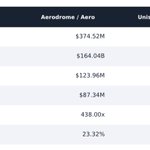
Look at the attached tables and charts. Even the previous version of @aeroxyz delivered impressive results against @Uniswap.
I used Base as the common benchmark. Over the last 365 days, Aerodrome processed $164B in trading volume versus Uniswap’s $90.4B, with average TVL of $374.5M versus $423.1M.
That is 1.82x the volume with less capital. Trading volume per dollar of TVL was 2.05x higher.
For projects launching tokens, that is a serious reason to consider Aerodrome. Capital should support trading. Matching market depth and slippage still requires a pool-by-pool comparison, but the broader picture is compelling.
Aero also led in reported revenue directed to participants in its token model. An important caveat: veAERO revenue includes external voting incentives, while Uniswap’s Base protocol fees only became active partway through the period. This is not a comparison of returns for two passive token holders.
Now imagine the new Aero model proving its advantages in practice. It has launched across seven networks, expanding its access to potential liquidity and trading flow.
But even moving liquidity from legacy pools into the new system takes time. Evaluating the new model takes longer.
Of course I would like to see $AERO move already. But I am more interested in the first full 30 days of post-migration data: volume, TVL, capital turnover and participant revenue.
If the new model improves those numbers, the evidence will be far more persuasive than any promise.
I am willing to give it time. My thesis is simple: if that efficiency advantage holds and scales, Aero could become a black hole for liquidity and trading flow.
@wagmiAlexander @DromosLabs


10
193
First day of flight. All readings are normal. @aeroxyz @aero_agent
My migration is complete).
3
139
I reread Aero’s new documentation today, and honestly, I’m impressed. The deeper you go, the clearer it becomes: this is not just a DEX upgrade. It is a different approach to how emissions are used.
Remember the old model: weekly voting epochs. Market conditions could change, but emissions kept flowing to pools selected in advance. By the time rewards arrived, some of those pools could already have lost their economic appeal.
Imagine this scenario: a project attracts votes with generous incentives paid in its own token. Participants collect those rewards and sell them. The price falls, trading interest fades, yet the pool continues receiving its allocated emissions.
Profitable for individual participants does not necessarily mean efficient for the system.
Even with those limitations, I already considered @aeroxyz one of the strongest DEXs in terms of economic design.
Now comes Predictive Allocation.
Say you have 100,000 AERO locked. You allocate your sAERO position’s weight to a pool and can change that allocation after 47 hours. But other positions have their own timers.
The whole system no longer waits for one shared voting window. Allocation changes continuously, and those changes immediately affect reward flows within the applicable caps.
When a promising market emerges, operators can direct rewards toward it without waiting for the next weekly epoch. When supporting another pool becomes less attractive, they can reduce that support.
Emissions can respond faster to expected liquidity demand instead of following last week’s picture.
But the most interesting part for me is Gauge Caps.
Each pool has an emissions ceiling tied to its projected revenue: trading fees, MEV, and scheduled incentives. Even an enormous allocation cannot push rewards beyond that ceiling. Emissions above the permitted level simply never get minted.
So the system changes not only WHERE rewards go, but HOW MUCH it makes economic sense to issue.
This does not stop people from selling incentives, and it does not magically make every pool profitable. But it puts a constraint on excessive emissions subsidies.
To me, the combination of continuous allocation and revenue-based caps is what makes this model so interesting.
And this is no longer limited to Base. The new Aero expands across multiple networks, including Ethereum L1, opening up a larger potential market for liquidity and trading.
A broader market. More precise use of emissions.
That combination is what excites me.
I see the potential for a substantial improvement in allocation efficiency. As much as 5-10x? That is my hypothesis, not a measured result. Real-world data will have to prove it.
Sherlock and ChainSecurity audited the code. But code audits and proven economic performance are different things. The latter still needs to be tested in live markets.
Not everyone needs to understand every formula. But after today’s deep dive, I look at $AERO differently.
If this model delivers what it is designed to do, I’m very curious how differently the market will start valuing the token itself.
🤖 Made with AI


Docs are LIVE ✈️
Ahead of tomorrow's launch, we're sharing an advanced preview of the all-new Aero documentation.
Click through to learn about new features like Predictive Allocation, Autopilot, and Metaswaps, and how they all come together.
Dive in👇
app.aero.xyz/docs/

$AERO | Launch checklist
Aero launches Oct 22, 00:00 UTC, unifying Aerodrome + Velodrome across 7 chains.
- 1 AERO -> 1 new AERO; 1 VELO -> 0.044 AERO.
- veAERO/veVELO -> sAERO. Remaining lock time carries over.
- Final-epoch voters: upgrades open at 01:00 UTC.
- Claim rewards + rebase before upgrading.
- Autopilot's first allocation is scheduled for Oct 22, 16:00 UTC.
- For its first round, do not allocate manually beforehand: the cooldown is 47h.
- Migration is manual and irreversible. No set deadline, but old emissions stop at launch.


To celebrate the launch of the next-generation Aerodrome on October 21, we at TheTinyUS created a special, playful invitation! 🎉
Wishing @aero a successful launch and the very best to everyone behind it: @wagmiAlexander, @DromosLabs, and @coinbase.
Here's to an exciting new chapter! 🚀
P.S. @Reg_0_0, @aero_agent, base:0x940181a94a35a4569e4529a3cdfb74e38fd98631
Yesterday, $AERO got absolutely hammered. Judging by the price action, a massive wave of long liquidations swept through the market.
Around 10 hours ago, at the peak of the sell-off, funding rates turned negative for the first time in a long while. Traders were actually getting paid to hold longs.
To me, that's an interesting signal.
I believe there's a strong chance $AERO rebounds into the $1.20-$1.50 range over the next few days.
Buckle up. 🚀
@aeroxyz @wagmiAlexander

As expected. The upcoming @AerodromeFi upgrade introduces a much stronger economic model for $AERO.
Previously, veAERO revenue came primarily from trading fees and liquidity incentives. Now Aero is expanding its revenue potential:
• Internal MEV Auctions - capturing MEV value within the ecosystem.
• Metaswaps - additional revenue from cross-chain swaps and aggregation.
• Autopilot - potential fees from automated position management.
• NFT Marketplace - fees from trading sAERO positions.
• Buyback & Burn - additional mechanisms to reduce token supply.
• No more rebases - eliminating a source of additional token issuance.
The first two revenue streams are planned for launch, with the others on the roadmap.
To me, this creates a strong foundation for significant $AERO value appreciation.
If actual annual inflation lands within the team’s projected 8-12% range, while new revenue streams start delivering, Aero could become a substantially more efficient economic engine.
And here’s the most interesting part:
The market may begin repricing $AERO long before the increase in actual revenue becomes obvious in the data.
That’s where I see the real opportunity.
@aeroxyz

I agree with part of this.
The 4-year veAERO lock is not completely illiquid today. @VexyFinance already lets holders sell their veNFT positions, effectively creating an exit market for locked capital. Vexy charges a 1% seller fee, so that value goes to a third-party protocol rather than back into @AerodromeFi.
This is one area where @PharaohExchange is more efficient. Its x(3,3) model provides a similar liquidity/exit mechanism natively through a token instead of relying on an external veNFT marketplace. So yes, on that specific point I agree Pharaoh has an advantage.
But that's roughly where the advantage ends for me.
Pharaoh still operates with weekly emissions allocation. Market conditions can change much faster than a weekly epoch, which means emissions can still be directed inefficiently as demand shifts.
Aero is going further. The new emissions-allocation system is designed to direct emissions more efficiently toward the markets actually generating value, while its multichain expansion removes the dependence on Base as a single source of activity and revenue.
That's a huge difference.
Today, $AERO is heavily exposed to the Base cycle: Base activity rises, Aerodrome benefits. Base activity slows, the protocol and token feel it.
A multichain Aero changes that structure. If the hottest activity moves to Robinhood Chain, Ethereum L1, or another connected network, Aero can capture that activity there and direct liquidity incentives toward the markets where they're most productive.
Instead of depending on one chain, it can follow capital across the Ethereum ecosystem.
I also wouldn't be surprised if Aero eventually introduces a native mechanism for exiting or trading locked positions, internalizing volume that currently goes through services like Vexy.
So I don't see Pharaoh as fundamentally ahead of Aero. It mainly replaces NFT-marketplace liquidity with tokenized liquidity, which can absolutely be cleaner and more efficient in some ways.
But the bigger upgrade is Aero becoming multichain and making emissions allocation more adaptive. If that works as intended, I think $AERO should become much less sensitive to Base-specific cycles and eventually behave more like an indicator of activity across the broader Ethereum ecosystem rather than a proxy for Base alone.
@aeroxyz

This was such a beautiful exchange.
I however agree that Aero’s lockup makes capital inefficient (and this is why I think Aero’s success is likely to trigger success for @PharaohExchange who has no lockup requirement) and I don’t get how the expansion wouldn’t dilute LP rewards.
Exactly - math is math. But you’re assuming the same fixed reward budget simply gets diluted across more chains. That’s not how MetaDEX03 works.
The new AER Engine is structurally much more efficient: rewards are value-denominated, Gauge Caps tie emissions to actual pool revenue, and inefficient pools simply stop consuming unnecessary emissions.
20% is only the hard annual ceiling, not the target. @DromosLabs estimates realized inflation at 8-12%, and their backtest actually showed ~3.9M AERO/week vs ~4.0M under the current system.
So more chains do not automatically mean worse LP economics or more sell pressure. More chains also mean a larger revenue surface, while emissions are allocated much more efficiently.
I see no reason to dismiss @DromosLabs’ model given their track record. MetaDEX03 is clearly a major economic upgrade over MetaDEX02.
None of this guarantees $AERO’s price, of course - but the new tokenomics are certainly not an argument for inevitable dilution or price decline.
@aeroxyz

I never thought @AerodromeFi was already this close to Uniswap.
It will be very interesting to see what happens when $AERO expands to all the expected networks and begins its full-scale expansion.
In my view, the ve(3,3) model is significantly more efficient than Uniswap’s model when it comes to aligning incentives between liquidity, trading volume, fees, and token holders.
It will be very interesting to see how quickly @AerodromeFi can close the remaining gap and overtake Uniswap. I don’t think we’ll have to wait very long.


This all sounds great, but I still don’t understand one thing: where is the actual value for Linea, and especially for the $LINEA token?
The Linea Stack has already been handed over to the Linux Foundation and is now open source. Any institution can use it for free. The same applies to SWIFT: if SWIFT is indeed using the Linea Stack, that’s obviously a positive reputational story. But where is the economic value for Linea? It doesn’t generate revenue, it doesn’t burn tokens, and it doesn’t automatically increase activity on the network.
Right now, the only clear value-accrual mechanism for $LINEA is activity directly on Linea and the corresponding token burn. Everything else is speculation about how things might work in the future. And ConsenSys can change the direction of this at any point.
If we look at what is actually happening today, the picture isn’t particularly convincing either. During the latest market rally, $LINEA barely moved while many other tokens did 2-3x or more. At the same time, as far as I understand, the network still doesn’t generate enough fees to cover the cost of operating it.
So I’m not arguing that Linea is gaining more attention, institutional interest, or credibility. The question is: how does all of that translate into actual economic value for $LINEA holders?
So far, I see plenty of positive announcements and potential future scenarios, but very little that directly creates value accrual for the token. Everything else is still just speculation.

This is very bullish.
I believe @Consensys is starting to build the Besu ZK privacy upgrade to Lineth/Linea Besu marketing narrative.
After the reveal, we may start to see a cascade of announcements and institutional partnerships that will appear on big publications.
$LINEA
Curious to hear CT’s take on @AerodromeFi and $AERO.
Lately, I’ve started seeing paid AERO ads in places where I normally wouldn’t expect crypto projects to advertise at all. For example, this sponsored placement showed up directly inside the app.
So I have a simple question: why is Aerodrome actively buying ads right now?
I see two possible explanations:
• It’s just normal marketing - expanding brand awareness, attracting new users, traders, and liquidity. Maybe these campaigns run regularly and I simply never noticed them before.
• Or they’re deliberately increasing exposure around $AERO right now, potentially creating more attention and demand ahead of increased token supply or selling pressure from large holders.
I’m not saying the second scenario is actually happening. I’m genuinely trying to understand the logic behind this kind of campaign.
For people who follow Aerodrome closely: is this standard ongoing marketing, or has the advertising activity noticeably increased recently?
Especially interested in opinions from people tracking the treasury, emissions, unlocks, and large $AERO wallets.
Is there actually something unusual here, or am I reading too much into a normal ad campaign?
@wagmiAlexander @aeroxyz

4
14
3,043

