

Digital Art pioneer/Father of Genres Animator/media maker of RTMark/The Yes Men Editor in Chief Intelligent Agent magazine, 2000-12 HB Art Arabia 2016-19
Winona, MN
Joined April 2007
- Tweets1.9K
- Following1.9K
- Followers1.1K
- Likes1.6K




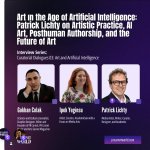



This interview focuses on Patrick Lichty’s long-standing artistic practice across new media art, conceptual art, performance, virtual worlds, and artificial intelligence. The questions trace his experience from early experiments in networked and virtual environments such as Second Life to VR/AR and generative AI, examining how technological transformations have reshaped the ways art is produced, perceived, and circulated. The interview also explores how Lichty’s roles as an artist, curator, writer, researcher, and educator have informed one another, while considering how AI art should be evaluated beyond its visual output—through its production process, conceptual framework, and the artist’s relationship with technology.
The second axis of the interview focuses on artistic identity, legitimacy, authorship, and the future of art in the age of AI. Drawing on Studio Visits: In the Posthuman Atelier, the questions examine how the art world constructs the idea of the “real artist” and how artistic value and legitimacy are produced through artists, institutions, curators, biographies, and cultural narratives. They also address distributed authorship in AI art, involving artists, algorithms, datasets, software developers, prompts, curators, and audiences. Finally, the interview considers younger generations’ relationship with generative AI, changing educational needs, copyright, training data, labor, ecological costs, algorithmic bias, and potential transformations in museums, galleries, biennials, academia, and the art market over the next 10–20 years. The interview concludes by asking how art can maintain its critical and cultural role within an increasingly technological, commercialized, and rapidly circulating media environment.
Interviewers: Gokhan Colak & Ipek Yeginsu
@gokhancolakfounder @ipekyeginsu
Interviewee: Patrick Lichty
@patlichty
@intheposthumanstudio
@patlichty_art
#artandai #aimediaart #posthumanart #newmediaart #futureofart


Deadline extended into Early October.
Call for Papers: The Designer as Bricoleur—Exploring Praxiology, Epistemology, and Phenomenology in Design Research
CUBICx JOURNAL
Send submissions to [email protected]
We invite submissions that explore the landscape of design research through the lenses of design praxiology (the study of design practice and processes), design epistemology (the study of design knowledge and knowing), and design phenomenology (the study of the experience of designed artifacts) (Cross 1999), with the concept of the researcher-as-bricoleur (Crotty 1998; Denzin & Lincoln 1994) serving as a central, transversal theme. Design research occupies a unique space where creative exploration and scholarly inquiry converge (Niedderer & Roworth-Stokes 2007). Moving beyond traditional scientific methodologies, design embraces speculation, open-endedness, and a generative approach. It calls for a deeper understanding of how design knowledge is generated, validated, and disseminated (Gaver 2012; Pierce 2014). This call for papers seeks to explore these dimensions by focusing on the actions, knowledge, and experiences in the design process, particularly through the concept of the designer researcher as a bricoleur. The concept of the researcher-as-bricoleur, drawing from Lévi-Strauss (1966) work, describes a person who creatively adapts and improvises with available materials and knowledge to solve problems. This relates to the iterative and exploratory nature of design research (Redström 2021), where solutions often emerge organically through experimentation. The bricoleur embodies a hands-on, engaged approach, creatively combining diverse tools and knowledge, much like a designer navigating a design challenge. This call also aligns with constructionist (Hare and Papert 1991) and constructive (Krogh & Koskinen 2020; Koskinen, Zimmerman, Binder, Redström, and Wensveen 2012) principles of design research, and by extension with the concept of Research through Design (Findeli 1998; Frayling 1993), in all of which knowledge is seen as actively constructed through engagement with the design process and its outcomes. Possible application areas for these explorations include, but are not limited to, interaction design, service design, material design, system design, or social design. This call encourages submissions that investigate the following themes:
•
Design Praxiology and the Bricoleur: How do designers, acting as bricoleurs, navigate the processes and methodologies of design? How are existing methods adapted, combined, or reinvented to address specific design challenges? We encourage explorations of:
1. Adaptive design processes:Studies examining how designers creatively adjust their approaches in response to evolving project needs and constraints.
2. Resourceful use of materials and tools:Investigations into how designers leverage available resources, both tangible and intangible, in innovative ways.
3. Prototyping as bricolage: Analyses of how the iterative creation of prototypes serves as a form of bricolage, where insights emerge through making and experimentation.
4. Developing design work to meet user needs: How the bricoleur-designer understands and responds to user needs and wants through practical action and iterative refinement.
· Design Epistemology and the Bricoleur's Ways of Knowing: How does the designer as a bricoleur generate and validate design knowledge? What are the unique forms of knowing that emerge from their resourceful and hands-on engagement with design? We seek contributions on:
1. Embodied knowledge in design practice:Explorations of how practical experience and the manipulation of materials contribute to design understanding.
2. Learning through making: Studies focusing on how the act of creating artifacts leads to the acquisition of new knowledge and insights.
3. The role of intuition and improvisation: Investigations into how the bricoleur's capacity for intuition and improvisation shapes the design process and knowledge generation
4. Combining knowledge sources:Analyses of how designers draw upon and synthesize knowledge from various fields in a bricolage manner.
• Design Phenomenology and the Bricoleur's Creation of Meaningful Experiences: How do designers, as bricoleurs, shape the experience and meaning of designed artifacts for users? How does their engagement with form, materials, and finishes impact human experience? We welcome submissions on:
1. The designer's intentionality: Studies exploring how the designer's conscious engagement with design objects shapes the overall human experience.
2. Empathy and the understanding of subjective experiences: Investigations into how designers, like bricoleurs attuned to their materials, understand and respond to users' subjective experiences of designed objects.
3. The role of artifacts as embodiments of design knowledge: Analyses of how the forms, materials, and finishes of designed objects embody implicit knowledge.
4. The creation of meaningful artifacts:Explorations of how the bricoleur-designer crafts artifacts that resonate with users and impact their everyday lives.
We encourage submissions that offer theoretical frameworks, empirical studies, case studies, and reflective accounts that explore the role of the researcher-as-bricoleurand their designerly ways of knowing (Archer 1979), in advancing design praxiology, epistemology, and phenomenology. Possible topics for submission may include (but are not limited to):
· Case studies of design projects that exemplify the researcher-as-bricoleur approach.
· Theoretical explorations of the intersections between bricolage and design research methodologies.
· Empirical studies investigating how designers utilize available resources and adapt methods in practice.
· Analyses of how embodied knowledge and learning-by-making contribute to design expertise.
· Investigations into the phenomenological impact of artifacts created through bricolage.
· Reflections on the challenges and opportunities of embracing the researcher-as-bricoleur identity.
· Studies exploring the role of improvisation and intuition in design problem-solving.
· Development of frameworks for understanding and evaluating design knowledge generated through bricolage.
In addition to conventional research papers, we encourage submissions in the following formats:
Photo Essays: Visual narratives that explore the bricoleur's process, materials, or experiences.
Pictorial Papers: Papers that integrate visual elements (diagrams, sketches, illustrations) as central components of the argument.
Videos: Short films or documentaries that document design processes, interviews, or reflections.
Zines: Self-published, creative publications that offer unique perspectives on the bricoleur concept through text and visuals.
I think that the renaming of AI doesn't go far enough. I hereby rechristen it "crazy fresh super-duper intelligence!"

I'm writing a bit lately,
Mostly catalogue commissions on New Media.
Also am playing with some JavaScript. I love this stuff.

Patrick Lichty retweeted

i can feel an evolution taking place in real-time in regards to how we think about the intersection of technology, creativity, and culture so i wanted to share some publications/orgs that have been major sources of inspiration for me over the years when contemplating this extremely wide spectrum
@sfpc
@rhizome
@sanctucompu
@PioneerWorks_
@GrayAreaorg
@e_flux
@asteriskmgzn
@logic_magazine
@HOLO_mg
@trust_support
@otherinternet__
@donotresearch_
@antikythera_xyz
@arenamag
@palladiummag
UMBAU
Real Life Mag
UCLA DMA
MIT ACT
NYU ITP
Patrick Lichty retweeted

Interesting to see the same dynamic schools are grappling with wrt student assessment being played out on the research publishing level

We are seeing a new trend in submissions to @arxiv (and presumably to conferences and journals): Authors submitting papers whose contents they likely do not understand. 1/

We learn what artists have always known - that "CAD" programs (and AI), paint brush programs, paint brushes and drawing paraphernalia do not make art. Neither do artists or designers simply "make art". The one over-riding essential element to the process, "a developed artistic procedure", is necessarily unique for each artist and for each work of art. The procedure addresses a singular conjunction of elements for which there is no "universal" rule. The "calculus of form" may be placed in the service of such procedures but should not be confused with the art-making procedure. For the artist who writes the code the artistic procedure includes creating the code", pretty much like the work of the composer includes creating the musical score.
-R. Verostko.
RTMark, from the Opening of Bringing it to YOU, video, 1996-2001, Whitney Biennial.
@SpalterDigital

There are reasons why I post or not.
Right now, the academic semester is starting to move, and I imagine that puts me in more of a routine.
And I'm working on my Guggenheim narrative and formatting some video for a possible screening in Shanghai.
Busy.
In 2023, I had a panel-style discussion with ChatGPT3 about contemporary art. Amazing what has happened in 3 years.
patlichty.substack.com/publi…
After studying my old friend Roman Verostko's Sayings of Omphalos from his original, archival code, I have recoded several "Sons of Omphalos". This initial version has a roughly similar form to the CGA version, sans the contemporary register and my sensibility; new code based on his. A work that spans 44 years (1982-2026)
@RtClick_Save #codepoetry @DAMDigitalArt
