

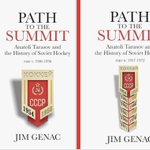
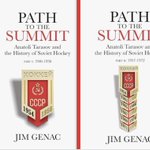
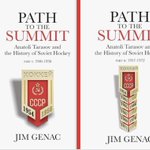
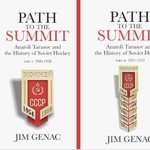
Author: Path To The Summit: Anatoli Tarasov & the History of Soviet Hockey Part II - now available on Amazon. Email: [email protected]
Vancouver, British Columbia
Joined March 2021
- Tweets759
- Following17
- Followers109
- Likes816




Path To The Summit retweeted

🚨𝗙𝗢𝗨𝗡𝗗 𝗜𝗧! | Carney 2012🚨
Before Brookfield
Before U.N
Before Trump
Before Tariffs
Before Trade War
Telling a room of executives that Canada should organize itself to present its infrastructure to China's sovereign wealth funds.
Says it's "a tremendous opportunity."🤔
Path To The Summit retweeted

Got to hand it to Bill Maher. We may not agree on everything but thank God he is calling out the insanity. That takes moral courage & principles. And deserves respect.

Path To The Summit retweeted

Unique research from 1920s soccer coaching to 1970s Soviet hockey tactics. Material no-one else has. In-depth dives into strange worlds of the past that still hold insights for the present.
Subscribe for free. And share with people who might want this.
mlanghockey.substack.com

Path To The Summit retweeted

Ooops… there goes NET ZERO…

Was the booing justified in Game 4 of the #1972SummitSeries? Bobby Clarke says yes.
=========
You can read all about the Soviet journey to the 1972 Summit Series in ‘Path to the Summit Part I & Il’ available on Amazon.
#pathtothesummit #anatolitarasov #soviethockey #usahockey

During Game 4 of the #1972SummitSeries, Vancouver fans unleashed their frustration at watching the cherished myth of NHL superiority evaporate before their very eyes.
The emotional reaction of Phil Esposito after the game became a rallying cry that would unite a nation.
But the fact remains, @TeamCanada1972 produced their worst effort of the series in Game 4 and they looked like cheap weekend hacks in the process.
As he reflected on that game, Bobby Clark said the Vancouver fans were justified to boo. It is an analysis that will be examined in depth in ‘Path to the Summit: Part III.’
===========
You can read all about the Soviet journey to the 1972 Summit Series in ‘Path to the Summit Part I & Il’ available on Amazon in paperback or hard cover editions.
#pathtothesummit #anatolitarasov #soviethockey #russianhockey #usahockey
54 years ago tonight.
===========
You can read all about the Soviet journey to the 1972 Summit Series in ‘Path to the Summit Part I & Il’ available on Amazon in paperback or hard cover editions.
#pathtothesummit #anatolitarasov #soviethockey #russianhockey #usahockey
54 years ago tonight, I was at Pacific Coliseum for Game 4 of the #1972SummitSeries. I will always be grateful to my Dad (who won the right to buy two tickets to the game in a national lottery) for taking me when he had many offers for that second ticket.
I will never forget that game or the atmosphere in Pacific Coliseum that night. #pathtothesummit #anatolitarasov #TeamCanada1972


Overconfidence plagued Team Canada before the 1972 Summit Series began. But after the 4-4 tie in Winnipeg,the Soviets were convinced, with four games to be played on the larger, international ice surface, victory would be theirs.
After the 4-4 tie in Winnipeg, the Soviets were supremely confident. While coach Vsevolod Bobrov continued to spout the party line that the Russians were here 'to learn,' others were already claiming victory in the series.
“There's no way we can lose this eight-game series with Canada now. The series is lost for Canada. We have now reached our objective, which was a win and a tie in the four games here. We’ll wrap it up in Moscow, no matter what happens in the Vancouver game,” said one member of the Soviet hierarchy travelling with Russia’s National Team.
Although not directly named, many believe the statement was made by Andrei Starovoitov, general secretary of the Soviet Ice Hockey Federation. He was the one who negotiated the terms of the Summit Series with Joe Kryczka of the CAHA.
In his younger days, Starovoitov had been a defenseman with CSKA, where he played from 1946 to 1951. That first year, he played under coach Pavel Korotkov and became a lifelong friend of team captain Vsevolod Bobrov.
When Korotkov retired as CSKA’s head coach at the end of the 1946 season, Starovoitov was offered the position as a player/coach, but he declined, citing work commitments to the Lenin Military-Political Academy. He would remain as a player with the team. Anatoli Tarasov was appointed player/coach instead.
In 1951, Tarasov cut Starovoitov from the team after Bobrov had left to play with VVS MVO. Starovoitov believed he could still play. Twenty years later, Starovoitov got his revenge. After wotking his way to become head of the Soviet Ice Hockey Federation, he was the one who dismissed Anatoli Tarasov just prior to the 1972 Summit Series.
Enroute to Vancouver for Game 4 of the Summit Series, Starovoitov took the time to explain how the Soviet team was picked. Fifty were chosen from the nine-team Soviet League and invited to a special camp. Twenty-seven came on the trip, and eight more back in Moscow are qualified to play in the final four games. He then said that after the Canada leg of the Series, the Soviet players would be allowed to return to their respective clubs to await the remainder of the series.
Many would later criticize this move as contributing to the Soviets' overconfidence in the last four games. In a personal interview in 1987, Vladislav Tretiak would say Anatoli Tarasov would never have allowed this move. In a separate interview Tarasov criticized the move (and the fact that Bobrov engaged in ‘North American tricks’ for most of Game 2) as the reasons the Soviets lost the series.
============
You can read all about the Soviet journey to the 1972 Summit Series in ‘Path to the Summit Part I & Il’ available on Amazon in paperback or hard cover editions.
(Pictured is Andrei Starovoitov, Boris Kulagin and Anatoli Tarasov)
#pathtothesummit #anatolitarasov #soviethockey #russianhockey #usahockey @TeamCanada1972

There's a new version of this post
The national mood as Game 2 loomed…
The national mood 54 years ago today, as Game 2 of the 1972 Summit Series loomed at Toronto’s Maple Leaf Gardens, was a mixture of stunned, humiliated, and newly anxious.
The easy swagger of the previous week was gone. Saturday’s Game 1 had shattered the near-universal belief that Canada’s NHL stars would steamroll the Soviets. By Monday morning, that shock had settled into a national mood of disbelief mixed with rising fear.
Because many Sunday papers on Sept 3rd were thin or nonexistent, Monday Sept 4th was when the full reaction landed across the country. Columnists who had predicted an 8–0 or 7–1 sweep were eating their words—sometimes literally, as Globe writer Dick Beddoes attempted to do with his hat in Toronto’s Nathan Phillips Square.
The Montréal Gazette’s Aislin perfectly captured the public sentiment with an editorial cartoon depicting NHL President Clarence Campbell clutching the Stanley Cup and heading into a pawn shop.
Its genesis was a 3rd period comment from a reporter in the Forum press box. Watching the Soviets skate & pass rings around Canada in the third period, he muttered aloud that the Stanley Cup playoffs now looked like “pure sh*t” by comparison. Aislin took that sentiment and made it visual: the keeper of the NHL’s sacred trophy reduced to hocking it.
This particular rendering was given to me by Terry Mosher (Aislin) as I was preparing to release Path to the Summit - Part 1.
===========
You can read all about the Soviet journey to the 1972 Summit Series in ‘Path to the Summit Part I & Il’ available on Amazon in paperback or hard cover editions.
#pathtothesummit #anatolitarasov #soviethockey #russianhockey #usahockey

On the morning of September 3rd, 1972, Canada scrambled to redesign their tactical approach to the Soviets
On September 3rd, barely 12 hours after the Soviets stupefying upset of the NHL All-Stars in Game 1 of the 1972 Summit Series, the Russians were zipping through a brisk 90-minute workout, shouting, laughing, and even singing as they skated up and down the ice at Maple Leaf Gardens.
The mood wasn’t so joyous in the Canadian camp.
When Team Canada coaches Harry Sinden & John Ferguson woke on the morning of September 3rd, both were still sick to the stomachs as they discussed the disaster of the first game over breakfast. Before the series started, they believed that the Russians would have to change their passing and possession game to keep up with Canada. But instead of the Canadian style dominating, the Russian style did.
Studying game film at Maple Leaf Gardens, Sinden came to the conclusion that his decision to go for speed and quickness had been a mistake. The Russians were faster and quicker and he had to find a way to slow them down.
“We definitely have to get our diggers into the game and try to grind the Russians down. We'll get Wayne Cashman, Jean Paul Parise and Bill Goldsworthy in there, Mikita too. And Serge Savard on defense. The Ratelle line has to come out. I have to get Don Awrey out of there, too. He started guessing with the Russians and committing himself first. You can't do that with these people. That's what they want—to get you running all over the place, getting out of position.”
The next step was to develop a new game plan to stop the Russian attack.
“They got seven goals and could have had more if they shot better and more often. We played the textbook style of NHL defence against them, but they tore it to pieces. The key to their success was how their forwards could handle our defensemen in man-to-man situations in our end of the rink. We need to give our defensemen more help, so I'm going to bring our forwards back deep to assist the defence.”
For decades, the NHL had boasted that the awesome firepower of its professionals would overwhelm any amateur team. Now, after only one game, they were retreating to the same defensive philosophy Father Bauer had relied upon with his Canadian National Team in the 1960s.
Game 2 had suddenly become a must-win game. Canada spent the day preparing for the game of their professional lives.
===========
You can read all about the Soviet journey to the 1972 Summit Series in ‘Path to the Summit Part I & Il’ available on Amazon in paperback or hard cover editions.
#pathtothesummit #anatolitarasov #soviethockey #russianhockey #usahockey

The headlines said it all!
===========
You can read all about the Soviet journey to the 1972 Summit Series in ‘Path to the Summit Part I & Il’ available on Amazon in paperback or hard cover editions.
#pathtothesummit #anatolitarasov #soviethockey #russianhockey #usahockey
Shock, humiliation, and the sudden collapse of a national myth. That was the Canadian mood 54 years ago on September 3rd—the morning after Game 1 of the 1972 Summit Series.
Canada had gone into the Montreal Forum expecting a mismatch. NHL stars versus “amateurs.” Many writers and fans assumed an 8–0 sweep. Phil Esposito scored 30 seconds in; Paul Henderson made it 2–0. For a few minutes the storyline seemed intact.
Then the Soviets took over.
They tied it by the end of the first, pulled away, and won the game 7–3. The Forum crowd went quiet. The dressing room was silent. Players later described it as walking around dazed, “like there’d been a death in the family.”
For the Canadian papers that did publish a Sunday edition, the headlines captured the raw feeling. The Sunday Express ran a giant “WE LOST” across the front page, with a photo of the action and the small, almost plaintive caption “At least we started well.” The Globe and Mail declared “CANADA MOURNS HOCKEY MYTH.” The Montreal Gazette (the next day) ran “The night the Russians buried a myth forever,” with pictures of Ken Dryden’s agony, Soviet players celebrating, and Valeri Kharlamov flashing a V-sign.
The loss was treated as more than a hockey result. Hockey was a core piece of Canadian identity and one of the few things the country felt it owned outright. When that assumption cracked in a single night, the reaction mixed grief, embarrassment, and anger at the team’s arrogance and lack of preparation. Team Canada had trained for two weeks; the Soviets had been at it since mid-July. Columnists attacked NHL complacency. Dick Beddoes, who had promised to eat his hat if Canada lost Game 1, showed up in Toronto and made a public show of it. Some writers called it the end of the NHL’s “myth of invincibility.”
On September 3 the dominant mood was one of stunned silence, national self-doubt, and a dawning realization that the Soviets were not a novelty act. They were faster, better conditioned, and played a different, more collective game.
===========
You can read all about the Soviet journey to the 1972 Summit Series in ‘Path to the Summit Part I & Il’ available on Amazon in paperback or hard cover editions.
#pathtothesummit #anatolitarasov #soviethockey #russianhockey #usahockey @TeamCanada1972


Path To The Summit retweeted

Shock, humiliation, and the sudden collapse of a national myth. That was the Canadian mood 54 years ago on September 3rd—the morning after Game 1 of the 1972 Summit Series.
Canada had gone into the Montreal Forum expecting a mismatch. NHL stars versus “amateurs.” Many writers and fans assumed an 8–0 sweep. Phil Esposito scored 30 seconds in; Paul Henderson made it 2–0. For a few minutes the storyline seemed intact.
Then the Soviets took over.
They tied it by the end of the first, pulled away, and won the game 7–3. The Forum crowd went quiet. The dressing room was silent. Players later described it as walking around dazed, “like there’d been a death in the family.”
For the Canadian papers that did publish a Sunday edition, the headlines captured the raw feeling. The Sunday Express ran a giant “WE LOST” across the front page, with a photo of the action and the small, almost plaintive caption “At least we started well.” The Globe and Mail declared “CANADA MOURNS HOCKEY MYTH.” The Montreal Gazette (the next day) ran “The night the Russians buried a myth forever,” with pictures of Ken Dryden’s agony, Soviet players celebrating, and Valeri Kharlamov flashing a V-sign.
The loss was treated as more than a hockey result. Hockey was a core piece of Canadian identity and one of the few things the country felt it owned outright. When that assumption cracked in a single night, the reaction mixed grief, embarrassment, and anger at the team’s arrogance and lack of preparation. Team Canada had trained for two weeks; the Soviets had been at it since mid-July. Columnists attacked NHL complacency. Dick Beddoes, who had promised to eat his hat if Canada lost Game 1, showed up in Toronto and made a public show of it. Some writers called it the end of the NHL’s “myth of invincibility.”
On September 3 the dominant mood was one of stunned silence, national self-doubt, and a dawning realization that the Soviets were not a novelty act. They were faster, better conditioned, and played a different, more collective game.
===========
You can read all about the Soviet journey to the 1972 Summit Series in ‘Path to the Summit Part I & Il’ available on Amazon in paperback or hard cover editions.
#pathtothesummit #anatolitarasov #soviethockey #russianhockey #usahockey @TeamCanada1972
It quickly became evident that Team Canada ‘72 was in for a long, tough series. Read all about the Soviet journey to the 1972 Summit Series in ‘Path to the Summit Part I & Il’ available on Amazon.
#pathtothesummit #anatolitarasov #soviethockey #russianhockey #usahockey
54 years ago tonight, on a sweltering Saturday night at the Montreal Forum (no air conditioning, fog rising off the ice), Game 1 of the long anticipated 1972 Summit Series opened exactly as most Canadians expected — and then it didn’t.
Phil Esposito scored 30 seconds in. Paul Henderson made it 2–0 at 6:32. The building erupted. Fans laughed.
The pre-series consensus — that NHL professionals would roll over the “amateur” Soviets — looked confirmed. It felt like a coronation, only the Soviets refused to play along by rolling over and quitting; they simply kept playing their game. Yevgeni Zimin scored at 11:40. Vladimir Petrov tied it on a shorthanded 2-on-1 with 2:32 left. By the time the siren sounded to end the first period, it was 2–2 and the laughter stopped.
That intermission is the moment captured in this Brad Park clip. Park and his defensive partner Gary Bergman sat in the dressing room gasping for air. Bergman asked what he thought. Park’s answer was immediate: “We’re in trouble… we’re in trouble.” The Canadians were already exhausted. The Soviets were not.
Team Canada had come out of summer jobs and a short camp completely unprepared while the Soviets were in peak condition, moving the puck with short, crisp passes, using long stretch passes to beat the Canadian forecheck, and skating around defenders who dropped to block shots. The early 2–0 lead had felt like validation. The 2–2 score felt like the floor dropping out.
The shock was not just the score. It was the realization that the entire premise of the series had been wrong. Canadian hockey’s sense of itself — that this was “our game” and no one else could play it at this level — cracked in 20 minutes. Canadian players later said they knew, even while leading 2–0, that they had badly underestimated the opponent.
As Anatoli Tarasov had presciently foreseen, it was unwise for either side to overestimate their abilities and predetermine the outcome. This was going to be an epoch encounter.
===========
You can read all about the Soviet hockey journey to the 1972 Summit Series in ‘Path to the Summit Part I & Il’ available on Amazon in paperback or hard cover editions.
#pathtothesummit #anatolitarasov #soviethockey #russianhockey #usahockey
@TeamCanada1972
54 years ago today, the 1972 Summit Series began. You can read about the Soviet journey to the Summit Series in 'Path to the Summit Part | & Il' available on Amazon in paperback or hard cover editions.
#pathtothesummit #anatolitarasov #soviethockey #russianhockey #usahockey
On Saturday, September 2, 1972, Canada woke up to a late-summer Saturday that felt like the start of something larger than a hockey game. After years of watching Soviet teams dominate the World Championships against Canadian amateurs, the country was finally sending its best professionals onto the ice against the USSR. The mood was confident, almost festive — a national assumption that the series would be a coronation rather than a contest.
Newspapers and radio had spent weeks building the story. Columnists predicted an eight-game sweep. The Soviets were still largely anonymous: a 20-year-old goaltender named Tretiak was rumoured to be ordinary, the rest of the roster a collection of “amateurs” in inferior equipment. Many fans and writers treated the visitors as a curiosity from behind the Iron Curtain rather than a genuine threat. Harry Sinden captured the prevailing swagger when he said Canada was first in the world in two things: hockey and wheat.
In Montreal the Forum itself was dressed for the occasion. Box seats were draped in red, white and blue bunting. The ice looked brighter than usual even if the late-summer heat left wet patches. Tickets that had gone to Canadiens season-ticket holders for $7 were changing hands for $250 outside. A capacity crowd of 18,818 filled every seat and standing-room spot. Prime Minister Pierre Trudeau took part in a light-hearted pre-game ceremony; Phil Esposito won a ceremonial face-off with visible enthusiasm. The building hummed with the particular electricity of a Saturday night in the Forum, only louder.
That same energy ran across the country. In taverns on St. Catherine Street, living rooms from Halifax to Vancouver, and ticket lines already forming for later games in Toronto, Winnipeg and Vancouver, people gathered as if waiting for Christmas. It was the first time Canada’s professionals would represent the nation on this stage, and the first time most Canadians would see the Soviet style live.
The political backdrop of the Cold War added extra charge: two systems meeting on the ice of the world’s hockey cathedral. The anticipation of September 2 itself remains one of the purest expressions of Canadian hockey confidence ever recorded.
You can read about the Soviet hockey journey to the 1972 Summit Series in 'Path to the Summit Part I & Il' available on Amazon in paperback or hard cover editions.
#pathtothesummit #anatolitarasov #soviethockey #russianhockey #usahockey @TeamCanada1972

Anatoli Tarasov knew before the 1972 Summit Series began that these games would be important to world hockey.
On the eve of the 54th anniversary of the 1972 Summit Series, we recall Anatoli Tarasov predicting these games would be of “epoch importance” to the game of hockey. While he would not lead the Soviets as their coach, this match was the culmination of his life’s work. You can read about the Soviet hockey journey in 'Path to the Summit Part I & II’ available on Amazon in paperback or hard cover editions. #pathtothesummit #anatolitarasov #soviethockey #russianhockey #usahockey
Path To The Summit retweeted

It's four days since Carrington's flagrant, intentional, dangerous foul and ejection after which she posted "White privilege" and tagged the opposing team. She played the next game and there is still no supplemental discipline. Nothing. The @WNBA cannot be taken seriously as a premium pro league. >


Sad to hear of the passing of 1972 Summit Series referee Josef Kompalla. Condolences to his family. 💐
Josef Kompalla, the Polish-German ice hockey referee best remembered for officiating in the historic 1972 Summit Series between the Soviet Union and Canada, passed away yesterday (July 12, 2026) at the age of 90.
Born in Katowice, Kompalla began his career as a defender with Gwardia Katowice in 1951, winning three Polish junior championships before moving up to Górnik Katowice’s senior team in 1956. He became Polish champion in his final season as a player in 1958. He then emigrated to West Germany, joining Preussen Krefeld in the German Eishockey-Bundesliga, and played a handful of international games at the “B” level for both Poland and Germany.
Kompalla shifted to officiating in 1969, joining the German Ice Hockey Federation in 1970. In 1972, the International Ice Hockey Federation selected him to officiate the World Ice Hockey Championships, including both meetings between gold medalist Czechoslovakia and silver medalist the Soviet Union.
That same year, he was chosen to officiate the Summit Series, working alongside Franz Baader. Both officials drew heavy criticism from Team Canada during the series, and Kompalla was paired with Rudolf Baťa for the deciding final game, during which a penalty call against Canadian forward J. P. Parisé led to Parisé swinging his stick at Kompalla in anger.
Even 50 years on from the famous eight-game series between the USSR and Canada, referee Josef "Jupp" Kompalla hasn't changed his mind on the calls that infuriated a nation. "If I had to do it all over again, I would do exactly the same thing today,” he said during an interview in 2022.
In fact, having recently viewed the video footage of the legendary series, the Kompalla says he may have even gone a little too easy on the Canadians, whose well-documented strategy was to play a tough physical game to try to slow down the swift-skating Soviets.
Part III of the ‘Path to the Summit’ series will have a chapter dedicated to his views on the series. Condolences to his family.
#teamcanada1972 #soviethockey #1972SummitSeries

There's a new version of this post
Outstanding summary of the Soviet Youth hockey system. The long awaited Path to the Summit: Part II now available on Amazon.
In June 1975 Guy Dyotte and André Ruel were part of a Concordia University hockey study internship that travelled to Moscow to study the Soviet hockey system. In 1976 they published this french language book detailing their visit and what they learned. Path to the Summit compares the Soviet Youth development system to the Canadian system in the lead up to the 1972 Summit Series. Available now on Amazon. #soviethockey #teamcanada1972 @usahockey @HockeyCanada #anatolitarasov #stanleycup

There's a new version of this post
“𝘑𝘪𝘮 𝘎𝘦𝘯𝘢𝘤 𝘩𝘢𝘴 𝘸𝘳𝘪𝘵𝘵𝘦𝘯 𝘵𝘸𝘰 𝘣𝘰𝘰𝘬𝘴 𝘵𝘩𝘢𝘵 𝘸𝘪𝘭𝘭 𝘤𝘩𝘢𝘯𝘨𝘦 𝘵𝘩𝘦 𝘸𝘢𝘺 𝘸𝘦 𝘶𝘯𝘥𝘦𝘳𝘴𝘵𝘢𝘯𝘥 𝘵𝘩𝘦 𝘩𝘪𝘴𝘵𝘰𝘳𝘺 𝘰𝘧 𝘩𝘰𝘤𝘬𝘦𝘺 𝘣𝘦𝘩𝘪𝘯𝘥 𝘵𝘩𝘦 𝘐𝘳𝘰𝘯 𝘊𝘶𝘳𝘵𝘢𝘪𝘯." #russianhockey #usahockey #1972SummitSeries #anatolitarasov

Path to the Summit Part II is currently listed as #3 in hockey biographies.
#soviethockey #anatolitarasov #teamcanada72 #usahockey #nhl #NHLHockey #tmltalk

Hockey’s reach is international. So far this week copies of Part II have sold in Germany, Italy & France. This comes from France. So awesome to hear from those who are interested in this topic.
#soviethockey #anatolitarasov #1972summitseries

La saison morte va être studieuse... avec les 2 livres @pathtothesummit sur l'histoire du 🏒 de @Jim_Genac
