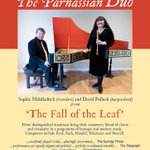
Parnassian Ensemble (@parnassians) header
Parnassian Ensemble (@parnassians) profile picture

Baroque period ensemble. Specialises in rare early 18th century English music, along with modern works, for virtuoso recorders, cello and harpsichord.

U.K.
Joined April 2014
Photo by Parnassian Ensemble (@parnassians)Photo by Parnassian Ensemble (@parnassians)Photo by Parnassian Ensemble (@parnassians)Photo by Parnassian Ensemble (@parnassians)Photo by Parnassian Ensemble (@parnassians)Photo by Parnassian Ensemble (@parnassians)Photo by Parnassian Ensemble (@parnassians)Photo by Parnassian Ensemble (@parnassians)Photo by Parnassian Ensemble (@parnassians)Photo by Parnassian Ensemble (@parnassians)
Looking forward to our next concert, in the beautiful village of Bosham. 😃
29
Parnassian Ensemble retweeted
In the winter of 1926, a ten-year-old boy in East Los Angeles watched his childhood end in the space of a single afternoon. Anthony Quinn’s father was struck and killed by a car. Within months, the boy who had been an infant when his family crossed from Chihuahua into the United States was the sole provider for his mother, younger sister, and grandmother. There was no plan, only whatever work appeared. He picked fruit in the fields, shined shoes on street corners, hawked newspapers, and dug ditches. Later he would remember those years without softening them: the only living available to a Mexican family was hard manual labor, and while the telling of it later sounded like pure hardship, to him it had been an adventure. By twelve he had quit school entirely. “I became the man in the family,” he said. For roughly a dozen years that is exactly what he was. One way he earned money was by stepping into a ring. As a teenager he boxed for purses of five or ten dollars. He could fight, but his trainer saw something missing: the coldness required to hurt another man for a living. Away from the gym, a different ambition kept surfacing. Quinn drew constantly, modeled clay, entered art competitions, and dreamed of becoming an architect. That path led him to Frank Lloyd Wright, who recognized talent in the drawings but also noticed the young man struggled to speak clearly. After surgery, Quinn needed speech lessons he could not afford. He struck a bargain with a theater teacher: he would clean the school in exchange for instruction. Sweeping floors became the route onto a stage. By the mid-1930s Hollywood offered work, but only of a certain kind. Quinn was repeatedly cast as the Mexican, the Native American, the gangster, the Arab—anyone coded as foreign or threatening. Leading men were expected to look like something else. He later put the realization plainly: years after he started, he understood he was not really being treated as an actor. During the war years especially, the industry’s idea of a romantic lead was narrow—blonde hair, blue eyes. Quinn refused to stay inside that box. Broadway gave him the space the studios had denied. He stepped into the role of Stanley Kowalski in A Streetcar Named Desire, a part already fused in the public mind with Marlon Brando. Then came the performance that forced a reevaluation. In Viva Zapata! (1952) he played Eufemio Zapata opposite Brando—raw, physical, volatile. The Academy Award for Best Supporting Actor that followed made him the first Mexican-born performer to win an acting Oscar. The boy who had once fought for five-dollar purses now held Hollywood’s highest prize. Four years later he did it again. As the painter Paul Gauguin in Lust for Life (1956), he dominated the screen in limited time and took home a second supporting-actor Oscar. The roles continued to widen: the strongman in La Strada, the title character in Zorba the Greek. Through all of it he carried a double exclusion he never forgot. “With a name like Quinn, I wasn’t totally accepted by the Mexican community in those days, and as a Mexican I wasn’t accepted as an American.” He spent a lifetime refusing both refusals. 🌹
23
195
3
1,195
58,592
Parnassian Ensemble retweeted
This is the pink silk waistcoat worn by the funeral effigy of Edmund, 2nd Duke of Sheffield, which is on display in our museum. It's richly decorated with patterns of foliage, grapes and flowers, and the embroidery technique shows a French method of shading coloured silks which was only introduced in 1735, the year he died. The duke had seen military service in Germany, but was forced to retire to Rome on account of ill health and died there of tuberculosis aged only 19. The effigy is unique in being displayed in its original eighteenth-century case, which is an important survival in its own right. #Museum30 #Pattern
2
30
245
5,747
Parnassian Ensemble retweeted
The grave of author Douglas Adams is located in Highgate Cemetery in London, adorned by fans with a pot of pens and references to his famous sci-fi series The Hitchhiker's Guide to the Galaxy, including a "42" sign... Visitors leave ballpoint pens and writing instruments in a container by the headstone as a nod to his work as an author and a playful reference to a running joke in his books about where all lost biros go. Fans also leave or bring towels in honor of "Towel Day" (celebrated annually on May 25), referencing the advice that a towel is about the most massively useful thing an interstellar hitchhiker can have. . . . Adams was the British writer behind “The Hitchhiker’s Guide to the Galaxy,” which started as a BBC radio comedy in 1978 before becoming a bestselling series of books, a TV show, video games and a 2005 movie. The pens are a tribute to him as a writer, left at his grave in Highgate Cemetery in London. The towel is a nod to one of the most famous lines in his books, which calls a towel “the most massively useful thing an interstellar hitchhiker can have.” The “42” sign is another tribute. In the story, a giant supercomputer spends seven and a half million years calculating the answer to life, the universe and everything, and finally announces that it’s 42. For years, readers came up with theories about the meaning behind the number. Adams said there wasn’t one. He said he simply picked it while staring out at his garden, and decided “42 will do.” He passed away suddenly in 2001 at age 49. Two weeks after he died, fans created “Towel Day,” held every May 25. Readers around the world carry a towel all day in his honor. #archaeohistories
2
13
68
4,704
Parnassian Ensemble retweeted
En mars 2015, Tom Hanks reçut un appel téléphonique à quatre heures du matin. Au bout du fil, son épouse, Rita Wilson, était en larmes. Elle venait d’apprendre qu’elle était atteinte d’un cancer du sein. Une double mastectomie était nécessaire. Tom Hanks se trouvait alors à New York, où il tournait un film. Après avoir raccroché, il quitta son hôtel à 4 h 15 du matin, encore en pyjama, prit le premier avion pour Los Angeles et ne quitta plus son épouse pendant les neuf mois qui suivirent. Il annula tout. Plus de tournages, plus d’interviews, plus de tapis rouges. Depuis trente ans, Hollywood connaissait Tom Hanks comme l’inoubliable Forrest Gump, la voix de Woody et l’un des hommes les plus appréciés du cinéma américain. Mais ce que le public ignorait, c’était la manière dont il se comportait lorsque les caméras s’éteignaient. Rita dut subir l’ablation de ses deux seins, suivie d’une reconstruction mammaire. Puis vinrent les complications. Pendant plusieurs semaines, elle ne pouvait même plus lever les bras. La douleur l’empêchait de dormir. Tom apprit à lui laver les cheveux. Il lui préparait des repas réduits en purée et changeait ses pansements sans jamais lui donner l’impression de perdre sa dignité. Une nuit, vers trois heures du matin, Rita se réveilla, terrassée par la douleur. En ouvrant les yeux, elle aperçut Tom endormi sur une chaise, juste à côté de son lit, lui tenant la main depuis des heures. « Tu peux aller te coucher », murmura-t-elle. « Mais je suis déjà dans mon lit », lui répondit-il. Lorsque son état s’améliora, Rita lui demanda pourquoi il ne s’était jamais plaint. Il lui répondit : « Tu m’as épousé quand je n’avais rien. Tu es restée à mes côtés quand je n’étais encore personne. C’est cela, le mariage. On ne fuit pas les moments difficiles. Au contraire, c’est vers eux que l’on court. » Lorsqu’on demanda à Tom quel était le secret de leur longévité, il répondit simplement : « Nous rions. Chaque jour. Même dans les pires moments, nous trouvons toujours quelque chose qui nous fait rire. » Le véritable amour ne se mesure pas aux beaux jours que l’on publie sur Instagram. Il se révèle dans ces nuits interminables où l’on reste assis sur une chaise, à trois heures du matin, à tenir la main de la personne que l’on aime. Car aimer quelqu’un, ce n’est pas seulement être présent lorsque tout va bien. C’est aussi choisir de rester lorsque la vie devient douloureuse, lorsque le corps souffre, lorsque les nuits semblent interminables et que les mots ne suffisent plus. Le véritable amour ne promet pas de vous éviter les tempêtes. Il promet de ne pas vous laisser les affronter seul. #TomHanks #RitaWilson #AmourVéritable #Mariage #36AnsDeMariage #WeAreHumanAngels #HistoireDamour
125
966
36
6,629
290,944
Parnassian Ensemble retweeted
'Now that the year grows wearisome with age And days grow short and nights excessive long...' Tonight's the eve of Martinmas, a festival to cheer the lengthening winter nights. John Clare's 'St Martin's Eve' describes a merry party, playing games and getting tipsy by the fire!
7
140
4
508
10,110
Parnassian Ensemble retweeted
For 57 years, Sesame Street has welcomed all children to learn, play, and laugh with their favorite furry friends. The neighborhood you love, bringing sunny days your way, now and always. Happy #SesameStreetDay!
103
1,466
75
6,910
80,899
Parnassian Ensemble retweeted
Hunter Alan Scott (b. 1985) an American best known for the research he did on the sinking of USS Indianapolis as a sixth-grade student, which led to a United States Congressional investigation and exoneration for its captain... As a 12-year old living in Pensacola, Florida, Hunter Scott created a National History Day project on the sinking of USS Indianapolis, becoming interested in the subject after seeing it discussed in the film Jaws with his father. Scott interviewed nearly 150 survivors of the Indianapolis sinking and reviewed 800 documents. He concluded that the ship's Captain Charles Butler McVay III, who had been blamed for the tragedy, was innocent. . . . In 1996, an 11-year-old boy watched the movie Jaws and became fascinated by a story that had nothing to do with the shark. During one scene, a character named Quint described the terrifying experience of sailors stranded in shark-infested waters after their ship, the USS Indianapolis, sank during World War II. The boy, Hunter Scott, had never heard of the incident before. Curious to learn more, he began researching the ship for a school history project, unaware that his investigation would eventually help correct an injustice that had lasted more than 50 years. The USS Indianapolis had been struck by a Japanese submarine in 1945, shortly after delivering components for the first atomic bomb. The ship sank in just 12 minutes, leaving hundreds of sailors stranded in the Pacific Ocean for days. Only 316 of the nearly 1,200 men aboard survived. The ship's captain, Charles McVay, was later court-martialed, even though many survivors believed he had been unfairly blamed. Hunter contacted more than 150 survivors, gathered their accounts, and examined hundreds of documents. The more he learned, the more convinced he became that the captain had been treated unjustly. Determined to help, Hunter took his findings to lawmakers in Washington, D.C., and eventually testified before a Senate committee while still a teenager. His research helped strengthen a campaign that survivors had been fighting for decades. In 2000, Congress passed legislation calling for McVay's name to be cleared, and the Navy officially added the statement to his record in 2001. What began as a school project inspired by a short scene in a shark movie had helped restore the reputation of a captain who had been blamed for one of the worst naval disasters in American history. One of the strongest supporters of clearing Captain McVay's name was Mochitsura Hashimoto, the Japanese submarine commander who sank the USS Indianapolis. He explained that even if the American ship had been zigzagging to avoid submarines, it would not have prevented his attack. He later supported efforts to clear McVay's record. #archaeohistories
9
81
4
575
19,194
Parnassian Ensemble retweeted
Marine creatures including fish, octopuses and eels decorate this elegant Roman glass beaker from the 4th century AD (Rheinisches Landesmuseum Trier, Germany) rlp.museum-digital.de/object…
20
225
12
1,195
17,925
Parnassian Ensemble retweeted
A wooden carving of a cat-like figure, historically known as a Puss-and-Mew machine. Created in 18th-century London (around the 1730s) by Captain Dudley Bradstreet. It acted as an early, covert alcohol "vending machine" to bypass the strict and heavy taxation laws of the Gin Act of 1736. . . . During the 18th Century London Gin Craze, the British government passed the Gin Act of 1729 and 1736 to heavily tax and curb gin consumption. But Captain Dudley Bradstreet found a clever way around the law. He hung a wooden carving of a cat (often called "Old Tom") in his window. The customers would approach the cat, whisper "Puss, give me two pennyworth of gin", and drop a coin into its mouth. If the person inside the house had gin ready, they would meow back, and then pour the gin out through a small lead pipe hidden under the cat's paw. Because the buyer and seller never saw each other face-to-face, authorities could not legally prove who made the sale. #archaeohistories
18
78
2
354
14,133
Parnassian Ensemble retweeted
In 1952, an English teacher named Cecil Dormand secretly paid for a dirt-poor 11-year-old to take a drama course. He never told him and the boy didn’t find out until decades later. By then, he was a knight, that little boy’s name was Patrick Stewart. He was born into a poor family in Mirfield, a small mill town in Yorkshire and his father came home from World War II a violent man, and he was violent toward Patrick’s mother. Young Patrick learned exactly when to step between his father’s fist and his mother. An English teacher put a copy of Shakespeare in his hand and told him to get up and perform. He never stopped and left school at 15. By 19 he was completely bald... most agencies told him he'd never make it because of that. In 1987, the LA Times called him an “unknown British Shakespearean actor” when he was cast as Captain Picard. Then he became one of the most famous faces on Earth. You’ve probably heard that part. Here’s the part you haven’t: He spent decades as a patron of Refuge, sheltering women and children from domestic violence. But he never stopped trying to understand his father. He dug up a 1940 newspaper clipping that said his dad had come home with severe shell shock. He went to France and walked the ground where his father’s unit was pinned down under bombing for hours. He learned his father had PTSD, and nobody ever helped him. So Patrick became an ambassador for Combat Stress, a charity that helps veterans. In 2013, a young woman at a Texas convention told him she was a survivor of domestic violence. He asked, “My dear, are you okay?” Then he hopped off the stage, held her, and told her: “You never have to go through that again, you’re safe now.” At Dragon Con, a Make-A-Wish girl dressed as Spock came to meet him. 2,000 people were waiting for him to speak... he sat down and talked with her for 15 minutes, making all of them wait. He told her that since they were friends now, whenever she saw him on screen she could wave and say, “Hello Patrick.” After 9/11, he felt helpless, so he brought his one-man A Christmas Carol back to Broadway for a full week of charity shows. He played every character himself and donated every cent. In 2019 he did it again, and every dollar went to feeding hungry New Yorkers. In 2017, he fostered a pit bull named Ginger, who had been rescued from a dogfighting ring. She was his first dog in more than 50 years. He couldn’t bring her home to England, so he found her a family. Then he kept fostering more. When he said he was done with Star Trek so many people told him the show had gotten them through the hardest times of their lives. So he wanted to see if Picard could do it one more time. Rest in Peace, Sir Patrick 🖖
798
11,555
668
62,398
1,099,251
Parnassian Ensemble retweeted
In lieu of flowers, memorial contributions may be made to: Johns Hopkins Alzheimer’s Disease Research Center Fund    alzresearch.org/giving/ Alzheimer’s Foundation of America Caregiver Resources     alzfdn.org/donate/ Photo Credit: Tommy Garcia
6,674
79,673
17,357
345,167
11,996,193
Parnassian Ensemble retweeted
Sesame Workshop mourns the loss of Sir Patrick Stewart. Thank you for being our friend and for sharing your brilliance, joy, and kindness with the world. 💛💚
197
7,916
318
32,445
489,101
Parnassian Ensemble retweeted
SIR PATRICK STEWART (1940-2026) Before everything else, Patrick was defined by being born and bred in Yorkshire, the proud county in the north of England which he loved to the end. You could hear it in his accented voice and in the stern honesty with which he told you what he thought and felt. Yorkshiremen have no truck with half-truths or avoidance of big issues. He wore his heart on his sleeve, which made him a man to rely on, to admire and in my case, love. We first met as ambitious young actors with the Royal Shakespeare Company half a century ago but we weren’t in the same productions. My first strong memory was a few years later, meeting him in the street in central London when he told me about an offer to take over a leading part in 'Star Trek'. “But Patrick think of your stage career in the UK. Do you really want to risk—getting lost in Hollywood for years and years?”. Well, he took the risk and thank goodness for us all that he did for not just his devoted Trekkies but film and theatre audiences, who marvelled at his using international celebrity to star in a string of cinema successes ('X-Men' of course) and in great classical plays by Shakespeare, Ibsen, Arthur Miller, Peter Shaffer, Pinter and Beckett at Stratford-upon-Avon, in London’s West End and on Broadway. America was his adopted home, where he met his adored Sunny who has cared for him through sickness and health, through thick and thin. But he never forsook his origins: and the proudest achievement of the most respected and beloved actor of his generation on either side of the Atlantic, was his appointment as Chancellor of Huddersfield University in Yorkshire. His farewell performance in 'Avengers: Doomsday' is yet to be seen. Ian McKellen 29 October 2026 Photo: University of Huddersfield
3,371
91,933
4,328
474,282
6,962,117
Parnassian Ensemble retweeted
The Cosquer Cave (Marseille, France) was discovered in 1985 by a diver, Henri Cosquer, deep under the sea (the original entrance is about 115 feet below present-day sea level) but its paintings were not mentioned until 1991 after three divers died in the cave when they got lost... . . . In 1985, the diver Henri Cosquer was exploring the Calanques near Marseille when he found a tunnel opening 37 metres below the surface of the Mediterranean. The tunnel runs about 175 metres through the rock and rises into dry chambers whose walls are covered in prehistoric art. People painted there in two phases, around 27,000 and 19,000 years ago. Back then sea levels were far lower and the coast was kilometres away, so they simply walked in. They left dozens of hand stencils, along with horses, bison and ibex, and even sea creatures like seals and great auks, a seabird that is now extinct. The gallery slopes up for about 360 feet under water before reaching a huge chamber that partly remained above the sea and where many prehistoric paintings and engravings are preserved on the walls, as well as remains on the ground (charcoal from fires and torches, a few flint tools). This is the only painted cave in the world with an entrance below present-day sea level where cave art has been preserved from the flooding that occurred when the seas rose after the end of the last glaciation (Clottes & Courtin 1994, 1996). Right from the start, it was obvious that the discovery of the Cosquer Cave was both an important and original art find. It was located in a provence of France near Marseilles, an area where no Palaeolithic art had ever been discovered. This highlighted a supposedly well-known but rarely referred to problem, which is the disappearance of uncounted prehistoric caves under the sea all along the Mediterranean and other shores since Ice Age times. Several large caves are next to Cosquer. A number of them could have been - and probably were - lived in, painted or engraved. Despite the destructions due to the sea, Cosquer ranks among the few caves where more than 150 animal figures have been found. Hand stencils now total 65, the highest number in Europe except for Gargas (Hautes-Pyrénées) and possibly El Castillo in Spain. They are all located in the east side of the chamber, with one in the south. None is in the west. Right at the brink of a 57 feet deep vertical shaft – a location which in itself is significant - they are all black. On other panels, they may be black or red. One positive red hand has been found. A number of hand stencils have been scratched or painted over with dots and bars. Only adult hand stencils have been found. Many of them have incomplete fingers: they were realized by bending the fingers. Hand stencils with incomplete fingers had until very recently only been found in very few caves, mostly in the Pyrénées (Gargas, Tibiran, Fuente del Trucho). Now, we know that the phenomenon was far more widely represented than had been thought. The now established fact that roughly at the same time such hand stencils were being made in sites hundreds of miles apart should deal a death blow to the theory of pathologic mutilations. Today the Cosquer Cave is the only known painted cave whose entrance lies under the sea. It is also one of the most endangered. As sea levels keep rising, water is slowly creeping up the walls and erasing art that has survived since the Ice Age. The cave is too dangerous for visitors, and divers have died in its tunnel, so researchers raced to scan it in 3D. In 2022, a full-scale replica called Cosquer Méditerranée opened in Marseille so everyone can see the paintings before the sea takes them. #archaeohistories
64
273
6
1,872
150,042
Parnassian Ensemble retweeted
Poet Geoffrey Chaucer died #onthisday in 1400. For almost 80 years, Chaucer, 'the father of English poetry', was commemorated with a stained-glass window in the Abbey. It illustrated scenes from The Canterbury Tales and was installed in 1868 above his tomb in Poets’ Corner. The window was destroyed during the Blitz, and no fragments of the original glass survived. The Abbey’s collection does though hold a cartoon of one of the panels which gives a sense of how the window, designed by JG Waller, would have appeared: a procession of elegantly drawn scenes from the Tales, the medieval characters depicted with the detail and idealism characteristic of the Pre-Raphaelite Movement. Chaucer lived beside the Abbey for the final year of his life and was the first notable writer to be buried in what would come to be known as Poets’ Corner. The window was, for some decades, a further testament to his stature in the history of literature. Even though the window is no more, the undimmed popularity of his work speaks to the enduring attraction of pilgrimage.
1
41
3
224
4,374
Parnassian Ensemble retweeted
Best social media advice of the day!
106
2,123
128
10,756
198,099
In 1943, the Gestapo finally caught Raymond Aubrac, one of France’s most wanted Resistance leaders. The German secret police sentenced him to death, and his execution was only days away. At the same time, his wife Lucie was six months pregnant with their second child. Most people in her position would have gone into hiding, grieved quietly, and prayed for a miracle. Lucie Aubrac decided to do something completely different. She got her hands on forged identity papers, created a believable cover story, and walked straight into the office of Klaus Barbie. History would later remember Barbie as the brutal Butcher of Lyon, but Lucie did not let fear stop her. She looked him in the eye and successfully convinced him to grant her a final visit with her condemned husband. But Lucie did not risk her life just to say a tearful goodbye. While she was inside the prison area, she was secretly memorizing the positions of the guards, counting the minutes between patrols, and mapping out the exact route the prison truck would take. She was treating a desperate situation like a military operation. On October 21, 1943, that prison truck rolled through the streets of Lyon. It was carrying Raymond and several other prisoners toward what should have been their final destination. What the German soldiers did not know was that Lucie had spent weeks quietly assembling a dedicated team of Resistance fighters. She planned an ambush with absolute precision. When the truck finally reached the chosen ambush spot, her team struck fast, coordinated, and without a single moment of hesitation. In the middle of the sudden gunfire and chaos, Raymond Aubrac was pulled free from the truck. Lucie, who was visibly and unmistakably pregnant, had organized every single detail of his dramatic liberation. Right after the rescue, the couple had to go into deep hiding. A few weeks later, Lucie gave birth to their daughter in a secret safe house while German forces searched frantically for them across France. They managed to evade capture until the war ended. When liberation finally came, the Aubracs did not just try to sit back and recover from their trauma. Instead, they rebuilt their lives and continued to serve their country. Raymond became a celebrated engineer and entered public life to help rebuild France's infrastructure. Lucie became a respected historian, pouring decades of her life into making sure that the women of the French Resistance were never forgotten. She wanted to make sure these women, who were so often unnamed in the history books, were written permanently into the record. Together, the couple raised three children, traveled the world, argued, laughed, and grew old side by side. Years later, journalists asked Lucie what had compelled her to risk everything on that dangerous October day. She did not hesitate for a second. She looked at them and said, "He was my husband. What else would I do?" In his final years, he continued speaking publicly to young generations about the Resistance, the power of memory, and the absolute obligation to tell the truth about history. When Lucie passed away in 2007 at 94, and Raymond followed her in 2012 at 97, they left behind a 64 year marriage that was a testament to the ultimate triumph of life and family over hatred. Their love didn't just survive a war it blossomed into a lifetime of shared smiles, proving that the greatest force in the world is a heart that refuses to give up on the one it loves ♥️♥️
266
3,153
134
17,590
548,351
Parnassian Ensemble retweeted
Two #Roman gold bracelets in the form of snakes. The craftsmanship on these is beautiful, with a lot of intricate detail including the scales. They were found in Herculaneum (Italy), lost or left behind when the city was abandoned following the eruption of Vesuvius in AD 79
13
59
2
335
4,388
Parnassian Ensemble retweeted
Fearchair a' Ghuna (Farquhar of the Gun), also known as the Ross-shire Wanderer, photographed in the early 1860s.... Born in Strathconon into a family of small farmers and whiskey smugglers (a trade that was once deeply rooted in parts of the Highlands). The increasing presence of excise officers eventually brought the family business to an end. He became a well-known nomadic street entertainer and eccentric figure in the Scottish Highlands. He was small in stature with long, uncombed hair, dressed in layered rags, chains, and feathers, and carried a large sack. His nickname came from his prized possession—a large six-barrel gun. . . . . In the Contin Poor Register, there is a rather unassuming entry dated 27 February 1867 for a man named Farquhar Maclennan (1784-1868). He was recorded as a 76-year-old “blaster of stones” living on the Moor of Tarradale, and described as “very eccentric and peculiar”. But this elderly pauper was no ordinary local labourer. He was Fearchair a Ghunna — “Farquhar of the Gun” — a well-known Highland character who became better known as the Ross-shire Wanderer. In 1809, Farquhar left home and chose a very different life. Rather than settle into conventional work or village life, he became a wanderer, travelling through the Highlands and earning a reputation as an eccentric and memorable local figure. By the time he appeared in the Poor Register in 1867, he had spent decades living on the margins of society. #archaeohistories
20
78
3
550
41,078
Parnassian Ensemble retweeted
Jake Jarman + floor exercise = Dream duo 😍 Jake Jarman wins world champs floor exercise SILVER with a score of 14.600 🥈 @BritGymnastics
10
36
2
849
21,251