

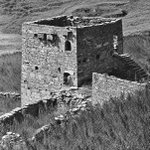
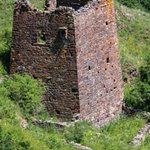



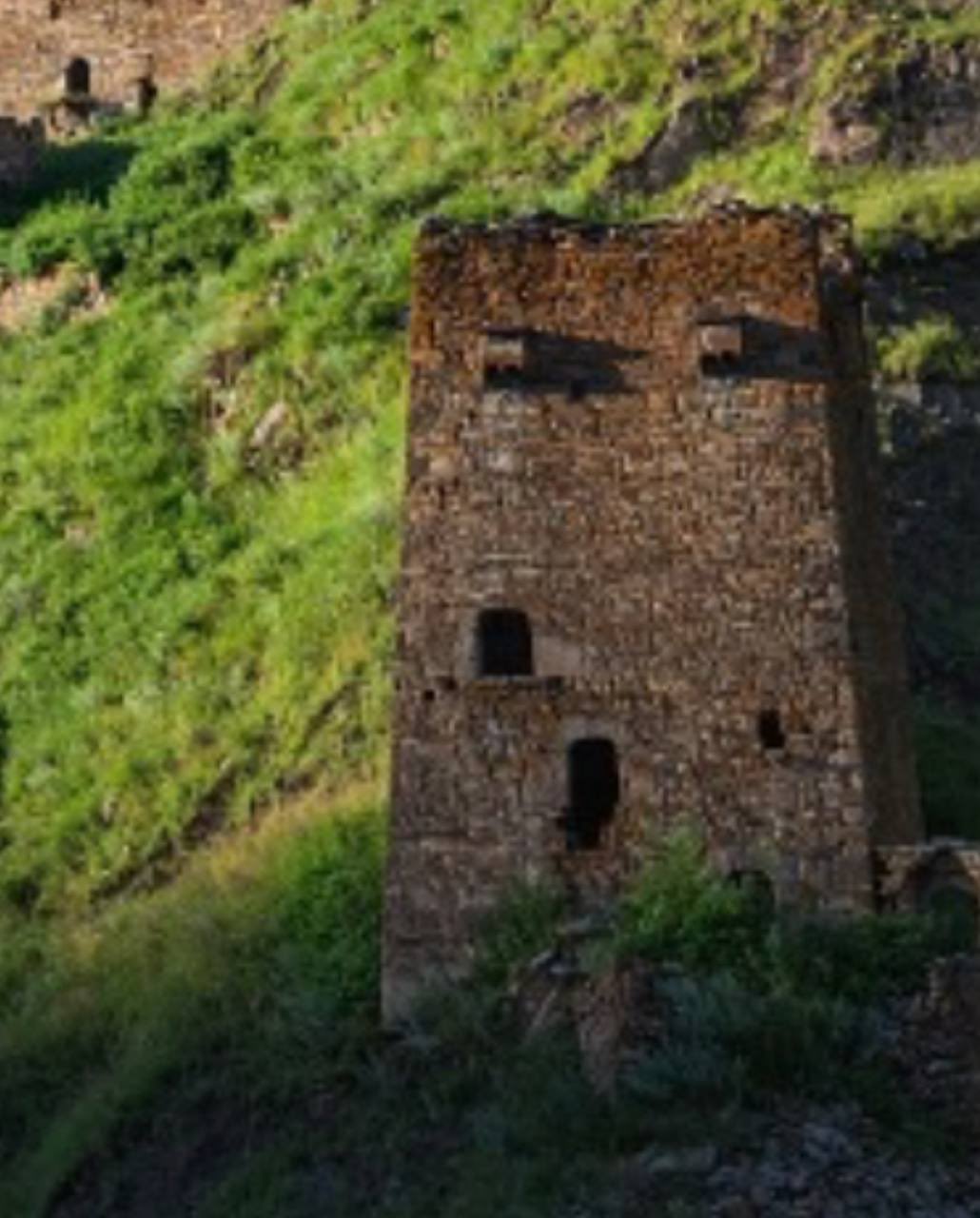
Although he possesses a large, well-preserved castle with high walls and a tall tower, he does not call himself a prince. Indeed, the Chechens have no princes at all.
71




Mozghar Therluo retweeted

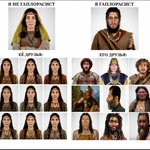
Facial Reconstruction of a 4,000-Year-Old couple from Gatyn-Kale, Chechnya
The Gatyn-Kale burial ground lies about 3 km northwest of Aslanbek-Sheripovo (formerly Gatyn-Kale), near the road connecting Shatoy and Sharoy-Argun. The site is located on a small plateau that slopes eastward toward a stream valley. South of the burial ground, beyond a narrow rise, lies a broad hollow containing the medieval village of Gatyn-Kale and the steep canyon of the Verdy-Akhk.
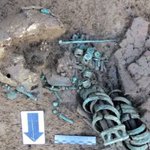
The reconstructed individuals, a young warrior and likely his wife, were buried in a paired burial no. 7. The young man stood approximately 179 cm tall, while the young woman was about 160 cm in height.
The warrior had suffered a fatal blow to his head.
Burial 7 contained more than sixty objects, including ceramic vessels, bronze items such as ornaments, amulets and weapons, beads, arrowheads, and ornaments made from Caspian Sea shells (Krupnov, E. I., 1961).
The population of Gatyn-Kale engaged in pastoralism and agriculture. The society was patriarchal: research has shown that paired burials (men and women) appear with the emergence of patriarchy. At the Gatyn-Kale site several such graves have been discovered - in these cases the woman was sacrificed so that she could accompany her husband in the afterlife. (Markovin, V. I., 1969)
The individuals whose DNA was sampled at Gatyn-Kale carried the Y-DNA haplogroup J1-Z1842 and autosomally belonged to the Kura-Araxes cluster (Ghalichi, 2024).
Anthropologically, the Gatyn-Kale skulls are relatively gracile for the Bronze Age. They are characterized by small cranial dimensions, a medium cranial index, a moderately high cranial vault, a medium-height face, narrow cheekbones, and low orbits.
Culturally and anthropologically, the burial ground appears to represent a contact zone between the tribes of North Caucasus and Dagestan.
Comparisons with cranial series from Dagestan, Georgia, the South Caucasus, and the Trans-Volga region show that the Gatyn-Kale skulls resemble the Volga series in cranial indices, while in their gracile morphology they correspond more closely to the southern (Indo-Mediterranean) type.
These features may represent either a gracilized Proto-Europoid type, a southern variant, or the result of interaction between northern and southern anthropological types. However, the absence of medium cheekbone breadth (which would have resulted from admixture between a wide-faced northern population and a narrow-faced southern population) argues against significant admixture, suggesting instead a local southern variant or influence from populations of the Northcaucasian cultural sphere (“Antiquities of Dagestan”, Makhachkala, 1974).

