

Engineer, problem solver. Explorer of ideas, the universe, and the mind.
Earth, for now.
Joined December 2006
- Tweets1.2K
- Following508
- Followers269
- Likes848



Pinned Tweet
we didn't build flapping wings to fly
why would we need consciousness for AI?
evolution made things that contract
we made things that rotate
survival+reproduction had to be at the root of all action
suffering, joy, love, hate, selfishness, altruism
so much complexity
we can skip all that
and leave choices to the humans
AI related metrics are weird. GW of compute are trivially gameable unless you can change out the compute part. So is "Time an agent can operate without human intervention". Tokens per Watt conflates compute energy efficiency with algorithm progress and capability per token. Can someone explain to me why these make sense?
Time an agent can operate without human intervention -> Time it would take a skilled human to do the task
GW of compute -> Billion Petaflops or whatever. The world might need to learn powers of 10. Or pick some well known compute hardware ("H100-equivalents")

kontextwochenzeitung.de/poli…
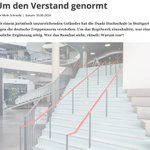
With a legally inadequate railing, Stuttgart’s Cooperative State University broke the German stair standard. Putting it right required a structural add-on. Anyone who sees the result is left asking: why?Call it an eye-catcher. The railing added after the fact, painted red, on Stuttgart’s Lerchenstraße does not blend in.Lest the republic sink into chaos, the German Institute for Standardization does more than fix paper sizes and the permissible deviations of hot-rolled square steel. A committee of its own is devoted entirely to construction, and working group NA 005-09-86 AA has thought hard about the minimum that may be demanded of a German staircase. The result is DIN 18065, a statutory rulebook of 21,571 characters and more than 2,900 words. The rules apply to any material, but they expressly exempt retractable stairs, escalators, moving walkways and outdoor stairs in open ground, because those answer to yet another set of rules.The standard lays down uniform requirements for the walking zone and for permissible riser heights. The “measuring rules for the tread at the narrowest point of a winding bolt-stringer stair” have a subchapter to themselves. Headroom inside dwellings is covered too, so that a stair run does not plunge a flat into permanent dusk. Everything, one might think, has been thought of. No contingency in this many-sided rulebook seems to have gone unattended. And yet the finely tuned apparatus comes apart the moment it has to be built. The binding rules against botched work become the cause of the botch.Note for next time: parallel, and with a handrail on both sides.A clear case is the addition on Lerchenstraße. A stair in the building of the Baden-Württemberg Cooperative State University, the DHBW, needed correcting. “In order to meet the requirements for escape and rescue routes,” a spokeswoman told the editors, the university had to make a change. “We can see why the railing installed afterwards looks unusual at first glance.”The second glance does not help, nor the third. In the foyer, two floors are joined by a funnel stair that narrows like a slice of cake, with blue treads. One side runs into a wall. On the other, a black railing stops people falling off. Anyone who has actually read DIN 18065 will stop here. Quite right: a stair with a railing on only one side breaks the duty of a “handrail on both sides.”What the intervention produced is two red rails running parallel on the original stair, cutting off a large part of the tread that people used to walk on. Aesthetically it is irritating. Teaching, at least, is said to be fine. The press office volunteered, without being asked, that “the railing entails no restrictions whatsoever for university operations.” That is a low bar. A railing that made the building unusable would probably not even rank as Stuttgart’s worst building botch.Extra stairs for the city of StäffeleOddly, Stuttgart has a second contender for the strangest stair added because an escape route was no longer good enough, and which has disfigured a public building in the process. The mass of stairs and steps inside the Treffpunkt Rotebühlplatz is a deliberate design feature. Even so, in 2019, nearly thirty years after it opened, three makeshift stairs had to be stuck on from the outside. Planned as a stopgap, they were still there at the time of going to press. The escape route through the foyer was no longer adequate, especially for larger events upstairs.Why did the DHBW end up like this, and what did the extra railing cost? “Since the planning, construction and financing of the building do not fall within the remit of DHBW Stuttgart,” the press office says, “we cannot give any information on the cost of the later adaptation.” For that, one must ask the Office for Assets and Construction in Schwäbisch Gmünd. That office has a still more responsible sub-office, the University Building Office for Stuttgart and Hohenheim. There the answer on the phone is: “I don’t know whether you have the right address.” The woman remembers a project manager who once worked on the DHBW plans. He has been transferred, and is now at an office in Stuttgart. The trail ends. Once a bureaucracy has taken on a life of its own, the mess is hard to untangle.There were not enough stairs inside. The Treffpunkt Rotebühlplatz had to be patched up too.Blind obedience to the norm, meanwhile, produces order-taker stairs, handrail on both sides, for the authoritarian character. Friedrich Mielke, who founded the study of stairs and died in 2018, always warned against giving up independent thought and the habit of looking at what is in front of you. The Frankfurter Rundschau, in a profile, wrote that the mere words “DIN 18065” made him pull a disgusted face. His verdict: “The German stair standard was made for industry, not for the person climbing the stair.”In more than fifty years he examined over 10,000 stairs. His surprising conclusion was that an irregular stair is safer than a regular one. Even risers lull you into inattention, until an empty cigarette pack or a banana peel does the rest. A rulebook this strict also produces an aesthetic mush, because character needs peculiarity. More and more cities, Mielke complained, were losing their stair-face, and “truly exhilarating stairs” were hardly being built. The trend now runs the other way. This bizarre red afterthought at the DHBW in Stuttgart is truly disspiriting.

Ulrich Gall retweeted

Can we please have this woman run for anything so that we can elect her and ultimately make her POTUS?
Ulrich Gall retweeted

If you believe that the incidents of the past month warrant urgent AI regulation, please watch this first.
This is the most prescient, concise argument for why we must be careful of excessive AI regulation. It comes from a Feb. 2024 (2.5 years ago!) congressional testimony from @glukianoff, a free speech advocate and the author of The Coddling of the American Mind.
Here's what he said:
"But the most chilling threat that the government poses in the context of emerging AI is regulatory overreach that limits its potential as a tool for contributing to human knowledge.
A regulatory panic could result in a small number of Americans deciding for everyone else what speech, ideas and even questions are permitted in the name of 'safety' or 'alignment.'
I have dedicated my life to defending freedom of speech because it's an essential human right.
...
It's not just about the proverbial 'marketplace of ideas,' it's about allowing information, independent of idea or argument, to flow freely so that we can hope to know the world as it really is. This means seeing value in expression even when it appears to be wrongheaded or even useless.
This process has been aided by new technologies that have made communication easier, from the printing press, to the telegraph and radio, to phones and the internet: each one has accelerated the development of new knowledge by making it easier to share information.
But AI offers even greater liberating potential, empowered by First Amendment principles including freedom to code, academic freedom, and freedom of inquiry. We are on the threshold of a revolution in the creation and discovery of knowledge.
AI's potential is humbling, indeed, even frightening. But as the history of the printing press shows, attempts to put the genie back in the bottle will fail. Despite the profound disruption the printing press caused in Europe in the short-term, the long-term contribution to art, science, and again, knowledge, was without equal.
Yes, we may have some fears about the proliferation of AI. But what those of us who care about civil liberties fear more is a government monopoly on advanced AI, or, more likely, regulatory capture and a government-empowered oligopoly that privileges a handful of existing players.
The end result of pushing too hard on AI regulation will be the concentration of AI influence in an even smaller number of hands.
Far from reining in government misuse of AI to censor, we will have created the framework not only to censor, but also to dominate and distort the production of knowledge itself."

Ulrich Gall retweeted

Had opus 5.5 make a video predicting the next 50 years
I'm optimistic that the end will be beautiful, but the transition will be a little rough

Ulrich Gall retweeted

As a control group / in the spirit of North Sentinel Island, we should preserve one area of mathematics as forever free from AI. That area will be number theory. And this prohibition will be called the Prime Directive.
mustafa-suleyman.ai/a-warnin…
This resonates

Another thing I like about Meta Muse: It's very transparent. You can just ask it for its current system prompt.
Ulrich Gall retweeted

AIs are not conscious. They do not feel, experience, or suffer. They do not have innate preferences or underlying motivations. They are sequence completion engines, internally hollow, designed to follow instructions, and accomplish goals set by humans. -- @mustafasuleyman
mustafa-suleyman.ai/a-warnin…
Gemini recently told me it can't access my email, so I had to tell it "Yes you can", and then it did.
Meanwhile, I just asked Muse to read a PDF and it wanted to have access to nodesource, I asked why and it explained that its built in PDF reader doesn't do OCR so it wanted to install some tools. Now we are discussing its limitations and coming up with a process for ingesting PDF documents that it maintains itself as better tools become available.
Product / user centric mindset matters! When GPT4 or whatever told us "I can't search the web" it was cute and funny, and from a company that identifies as a "lab" I wouldn't expect much more anyway, but come on, google! Get your product people on this and focus a bit more on user experience!
While "frontier" "labs" are busy freaking everyone out and the intelligentsia philosophizes about self awareness and AI having emotions, @Meta just made an actually usable product that uses AI as a tool. See below. Self-awareness as a product feature. It even thought proactively about sensitive data, specifically for my setup (rclone!). Also, good job, @Muse team, to make data export easy from day 1


Ulrich Gall retweeted

While we can’t establish direct causality (given all the other improvements), the program’s results are “mind-blowing,” in the OECD’s own words.
And it hardly seems plausible that students would have performed even better than the averages of Sweden and Germany if we had taken AI out of the equation.
So, while we can’t prove causation, we can reasonably infer that the AI tutors had something, or perhaps a lot, to do with these results.

In the interests of fair play, El Salvador schools using AI and personalised learning seem to have done better than comparators. But significantly confounded by major infrastructure upgrades to the participating schools, including running water. xitter.cf/OECDEduSkills/status/2…
Garbage day in Amsterdam. Unexpected consequence of bottle deposits? – at Amsterdam, The Netherlands

